
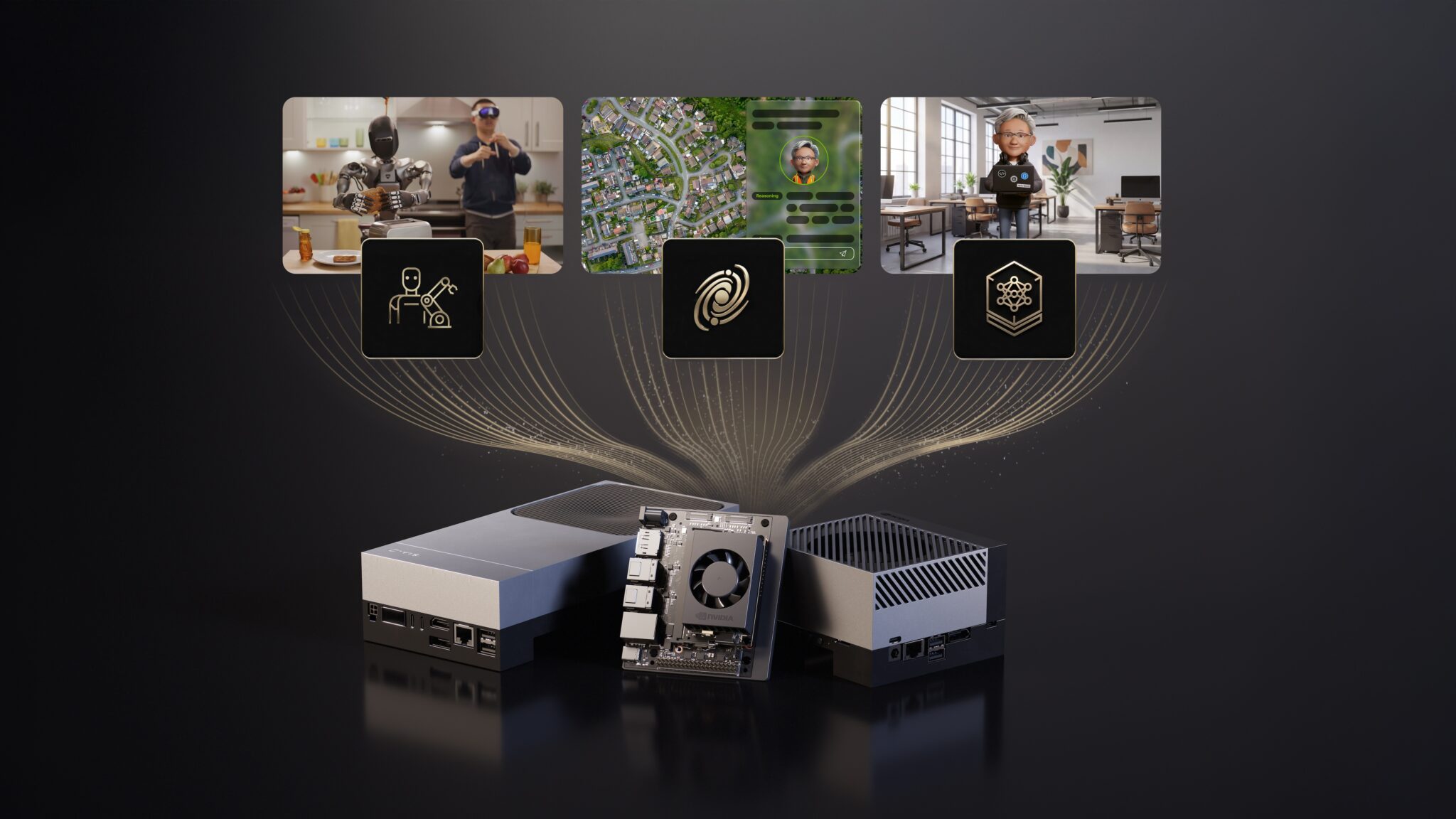
NVIDIA Jetson Brings Open Models to Life at the Edge for Industrial and Robotics Applications
Key Facts
- What: NVIDIA Jetson platforms, including Jetson Thor, enable local deployment of open generative AI models such as Qwen3 4B and NVIDIA Nemotron for real-time inference in industrial equipment and robotics.
- Who: NVIDIA partnered with Caterpillar to demonstrate the Cat AI Assistant running on Jetson Thor in a Cat 306 CR mini-excavator; additional examples include Franka Robotics, UIUC SIGRobotics, NYU robotics researchers, and Hugging Face.
- How: Open models run locally via tools like vLLM and OpenClaw, delivering low-latency performance with full data privacy and no cloud dependency or API costs.
- Where: Deployments focus on edge environments in construction, robotics research, and personal AI assistants, starting from Jetson Orin Nano 8GB for entry-level models up to higher-performance Jetson Thor modules.
- Why: Edge computing addresses latency, power limits, and reliability needs of physical systems while leveraging efficient open models.
Lead paragraph
NVIDIA is extending the open models AI boom to the physical edge, powering real-time generative AI directly on industrial machines and robots through its Jetson platform. In a prominent demonstration, Caterpillar integrated a Cat AI Assistant into its 306 CR mini-excavator using the NVIDIA Jetson Thor module, enabling natural voice interactions and operator assistance without cloud connectivity. The initiative highlights how compact, power-efficient edge AI hardware allows developers and enterprises to run open-source large language models locally for low-latency, privacy-preserving applications in robotics and heavy equipment.
The Cat AI Assistant on Jetson Thor
The Cat 306 CR mini-excavator, weighing just under eight tons and sized to fit inside a standard shipping container, represents a typical machine used in tight job sites such as utility trenches or basement digs in dense neighborhoods. Operating its controls — two joysticks with multiple functions per hand — requires significant training and experience to achieve proficiency.
At CES earlier this year, the machine featured an in-cab Cat AI Assistant running on NVIDIA Jetson Thor, an edge AI platform designed for real-time inference in industrial and robotic systems. According to NVIDIA’s blog post, the assistant leverages NVIDIA Nemotron speech models for natural voice interactions, while the Qwen3 4B model, served locally via vLLM, interprets operator requests and generates responses with minimal latency. This setup eliminates the need for a cloud link, addressing key constraints of physical systems including low latency requirements, limited power budgets, and the need for consistent behavior.
The integration demonstrates Caterpillar’s push to bring AI-driven operator guidance and safety features to construction equipment. The Cat AI Assistant, currently in development, combines speech and language models with trusted machine context to support operators in real-world conditions.
Open Models and OpenClaw on Jetson
Open models are unlocking new experimentation opportunities for developers by allowing free building and customization without proprietary restrictions. NVIDIA’s blog emphasizes that running OpenClaw on Jetson enables private, always-on AI assistants at the edge with zero API costs and full data privacy.
All Jetson developer kits support OpenClaw, providing flexibility to switch between open models ranging from 2B to 30B parameters. This allows users to power applications such as morning briefings, task automation, code reviews, and smart home control — all executing in real time locally.
The shift from cloud to edge reflects evolving priorities in AI deployment. While open models have historically run in data centers with abundant compute, physical systems demand different optimizations. Jetson addresses these by integrating compute and memory in a system-on-module design, simplifying hardware development, sourcing, and validation compared to discrete components. As models become more efficient, the question increasingly becomes not which model is best in isolation, but where it makes the most sense to run it — often directly on the device, beginning with the entry-level Jetson Orin Nano 8GB.
Physical AI and Robotics Momentum
Generative AI models are expanding capabilities in autonomous physical systems. Beyond Caterpillar’s industrial application, robotics demonstrations at CES showcased the potential. Franka Robotics’ FR3 Duo dual-arm system ran the NVIDIA GR00T N1.6 model end-to-end onboard, handling perception to motion without task scripting. The policy executes entirely locally.
In research settings, NVIDIA’s GEAR Lab SONIC project trained a humanoid controller on over 100 million frames of motion-capture data and deployed the policy on a physical robot using Jetson Orin. The kinematic planner runs at approximately 12 milliseconds per pass, with the policy loop operating at 50 Hz — all onboard.
Student and academic teams are also advancing the field. A UIUC SIGRobotics club team built a dual-arm matcha-making robot on Jetson Thor using the GR00T N1.5 model, securing first place at an NVIDIA embodied AI hackathon. At New York University’s Center for Robotics and Embodied Intelligence, researchers ran the YOR robot on Jetson Thor powered by NVIDIA Blackwell compute. Early results indicate improved generalization to new objects and robustness to scene variations, supporting complex household tasks like cooking and laundry.
Independent developers are applying the technology in practical ways. Hugging Face multimodal research lead Andrés Marafioti built an agentic AI system on Jetson AGX Orin that routes tasks across models and autonomously schedules work. In one instance, the agent messaged him to go to sleep, assuring tasks would be completed by morning. Similarly, Collabnix community developer Ajeet Singh Raina demonstrated running OpenClaw on Jetson Thor to create a 24/7 personal AI assistant for private large language model inference on user data, managing emails and calendars through a local gateway.
Jetson as the Emerging Standard for Edge AI
NVIDIA Jetson has become a common platform for deploying open models at the edge, supporting a wide range of open models and AI frameworks. This flexibility allows developers to address diverse generative AI use cases across industrial, robotics, and personal computing scenarios.
By bringing powerful AI compute directly to devices with strict power and latency constraints, Jetson helps bridge the gap between the rapid progress in open models and the real-world requirements of physical AI systems. The platform’s system-on-module approach also mitigates industry challenges such as memory shortages and component sourcing difficulties.
Impact on Developers, Industry, and Users
For developers, Jetson lowers barriers to building edge AI applications by providing consistent hardware and software support for open models. Enterprises like Caterpillar gain tools to enhance operator safety and productivity while maintaining data privacy and operational reliability in environments where cloud connectivity may be impractical.
The broader industry benefits from accelerated innovation in robotics and embodied AI. Academic and independent researchers can iterate faster on physical systems, potentially speeding commercialization of advanced robots for homes, warehouses, and job sites. End users stand to gain more responsive, private AI assistants that function reliably without ongoing cloud costs or connectivity dependencies.
This edge-focused approach complements cloud AI deployments, creating a hybrid ecosystem where models run where they deliver the most value — often directly on the device for time-critical physical interactions.
What’s Next
NVIDIA continues to expand Jetson capabilities and the supporting ecosystem for open models. The platform’s compatibility with models from 2B to 30B parameters positions it for broader adoption as more efficient open-source AI advances. Ongoing research in projects like GR00T and collaborations with partners such as Hugging Face suggest further integration of foundation models into robotics frameworks.
While specific timelines for commercial availability of the Cat AI Assistant were not detailed, the CES demonstrations indicate active development. As open models grow more capable and Jetson hardware evolves, expect increased deployment in industrial equipment, consumer robotics, and personalized edge AI solutions.
Sources
- As Open Models Spark AI Boom, NVIDIA Jetson Brings It to Life at the Edge
- Steel, Sensors and Silicon: How Caterpillar Is Bringing Edge AI to the Jobsite
- NVIDIA Releases New Physical AI Models as Global Partners Unveil Next-Generation Robots
- Getting Started with Edge AI on NVIDIA Jetson: LLMs, VLMs, and Foundation Models for Robotics
- NVIDIA Unveils New Open Models, Data and Tools to Advance AI Across Every Industry