
Title:
NVIDIA RTX Innovations at GDC 2026: A Technical Deep Dive into Mega Geometry Foliage, ReSTIR PT, and On-Device AI for Game Development
Executive Summary
NVIDIA’s GDC 2026 announcements center on production-ready advancements in real-time path tracing, neural rendering, and on-device generative AI, targeting the next generation of visually dense, AI-driven games. The new RTX Mega Geometry foliage system uses partitioned top-level acceleration structures (TLAS) to enable path tracing of millions of uniquely animated foliage elements in real time. The RTX Dynamic Illumination SDK adds ReSTIR PT for high-fidelity, multi-bounce glossy and mirror reflections. NVIDIA ACE receives production-quality on-device TTS, expanded language recognition, and the upcoming Nemotron 3 Nano 4B small language model (SLM). These technologies are integrated into the NVIDIA RTX Branch of Unreal Engine 5.7 (NvRTX 5.7) and supported by new enterprise hardware like the RTX PRO 6000 Blackwell Server Edition. Early results show 5-20% FPS uplift and 300 MB VRAM savings in Alan Wake 2, with The Witcher 4 and CONTROL Resonant adopting the new foliage system.
Technical Architecture
RTX Mega Geometry and the New Foliage System
RTX Mega Geometry, first introduced in 2025, is a geometry compression and reuse framework designed to make full-fidelity path tracing practical at scale. It works by clustering geometry into compact representations that can be reused across frames as the camera moves through the world. This dramatically reduces the cost of rebuilding ray-tracing acceleration structures (BVHs) — NVIDIA claims up to 100x faster construction compared to naïve per-frame rebuilds.
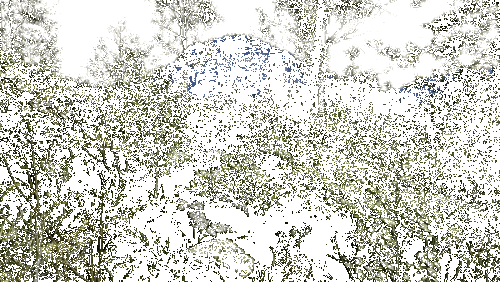
The 2026 foliage extension addresses the specific challenge of dense, animated vegetation. Forests contain millions of individual plants and trees, each with unique animation driven by wind, physics, or gameplay. Traditional bottom-level acceleration structures (BLAS) per object become prohibitive due to update frequency and memory pressure.
The new system introduces partitioned top-level acceleration structures. Instead of a single monolithic TLAS, the scene is divided into spatial partitions. Each partition can be instanced and updated independently every frame. This allows massive instancing of foliage while only updating the portions of the acceleration structure that have changed. The architecture supports real-time tessellation of high-detail geometry within these partitions, enabling path-traced leaves, branches, and grass with proper transparency, self-shadowing, and indirect lighting.
Remedy Entertainment’s integration into Alan Wake 2 (using existing assets) demonstrated both the performance gains and memory reduction. The upcoming CONTROL Resonant and CD PROJEKT RED’s The Witcher 4 will be the first titles to showcase the full foliage system in production.
ReSTIR PT in RTX Dynamic Illumination SDK
ReSTIR PT (Reservoir-based Spatiotemporal Importance Resampling for Path Tracing) extends the ReSTIR family of algorithms beyond direct lighting and shadows into full multi-bounce path tracing, with particular strength on glossy and mirror surfaces.
Traditional path tracers suffer from high variance on specular paths because valid light paths are rare. ReSTIR PT reuses complex paths across any bounce depth by maintaining reservoirs of high-contribution samples and resampling them spatially and temporally. The algorithm is specifically optimized for mirror-like reflections, enabling full-resolution path-traced reflections without the heavy denoising typically required.
The 2026.2 RTX Kit update integrates ReSTIR PT into the RTX Dynamic Illumination SDK alongside improvements to RTX Global Illumination (SHaRC + DLSS-RR integration), RTX Character Rendering (expanded geometry library and refactored tessellation API), RTX Path Tracing (memory footprint and frame-rate optimizations), and RTX Neural Shaders.
NVIDIA RTX Branch of Unreal Engine 5.7 (NvRTX 5.7)
Launching March 24, 2026, NvRTX 5.7 brings Linear Swept Sphere (LSS) primitive support in beta. LSS is a specialized acceleration primitive optimized for strand-based hair and fur, leveraging the increased Tensor Core and RT Core throughput of the GeForce RTX 50-series GPUs. It offers superior traversal speed and lower memory usage compared to previous curve representations. The branch also includes the latest DLSS 4.5 Super Resolution (text cuts off, but implied to include further neural upscaling improvements).
NVIDIA ACE On-Device AI Stack
NVIDIA ACE is expanding its on-device capabilities for responsive, low-latency AI characters. Key additions include:
- Production-quality on-device text-to-speech (TTS)
- Expanded language recognition support
- Nemotron 3 Nano 4B — a 4-billion-parameter small language model (SLM) with advanced agentic capabilities
Running these models locally on RTX GPUs removes cloud dependency for dialogue, emotion, and reactive behavior, enabling truly interactive NPCs with lower latency and better privacy characteristics. The 4B model size represents a careful balance between capability and real-time inference performance on consumer and laptop GPUs.
Enterprise and Cloud Infrastructure
- NVIDIA RTX PRO 6000 Blackwell Server Edition: Designed for centralized, virtualized game studio workflows. Allows studios to consolidate rendering, simulation, and AI training workloads on shared infrastructure.
- GeForce NOW Playtest: Enables large-scale cloud-based playtesting and player engagement across global regions.
- NVIDIA Enterprise AI Playbook: Provides blueprints for scaling AI coding assistants across development teams.
Performance Analysis
| Title / Integration | FPS Improvement | VRAM Savings | Notes |
|---|---|---|---|
| Alan Wake 2 (Mega Geometry) | +5–20% | -300 MB | Applied to existing assets |
| Dense Foliage Path Tracing | Not disclosed | Not disclosed | Millions of uniquely animated elements |
| ReSTIR PT Mirror Reflections | Not quantified | Lower variance | Full-resolution glossy reflections |
While specific absolute performance numbers for the new foliage system and ReSTIR PT are not yet disclosed, the Alan Wake 2 integration serves as a strong proxy for production applicability. The ability to retrofit existing assets and still achieve measurable gains suggests the foliage system will deliver even larger benefits in titles built from the ground up with the new partitioned TLAS approach.
Early indications from CD PROJEKT RED imply that path-traced forests in The Witcher 4 will be feasible at playable frame rates on RTX 50-series hardware, which was previously considered impractical due to acceleration structure update costs.
Technical Implications
These announcements signal a maturing ecosystem where full path tracing is becoming the default rather than a high-end toggle. The combination of Mega Geometry’s geometry compression, partitioned TLAS for dynamic foliage, and ReSTIR PT’s efficient path reuse lowers the computational barrier for photorealistic lighting and geometry complexity.
For developers, the tight integration with Unreal Engine 5.7 via the NvRTX branch lowers adoption friction. Studios can incrementally adopt individual RTX Kit components (ReSTIR PT, RTX Neural Shaders, LSS hair) without a full engine rewrite.
On the AI front, bringing high-quality TTS and a capable 4B SLM on-device via ACE changes the design space for NPCs. Game characters can now maintain persistent memory, emotional state, and reactive dialogue without server round-trips, enabling new gameplay mechanics around conversation depth and world reactivity.
Enterprise tools like the RTX PRO 6000 Blackwell Server Edition and GeForce NOW Playtest suggest NVIDIA is pushing studios toward hybrid cloud/on-prem workflows where rendering, AI training, and large-scale testing are centralized and scaled elastically.
Limitations and Trade-offs
- Memory vs. Quality: While Mega Geometry reduces VRAM pressure, path tracing dense foliage still requires substantial GPU memory for high-detail geometry and multiple BVH partitions. The exact memory scaling with millions of animated elements remains to be seen in production titles.
- Hardware Dependency: Features like Linear Swept Sphere for hair and optimal ReSTIR PT performance are tuned for RTX 50-series Tensor/RT Core architectures. Older RTX 40-series cards will likely see reduced gains or require fallback paths.
- Model Size vs. Intelligence: The Nemotron 3 Nano 4B model trades some reasoning depth for real-time on-device inference. Complex multi-turn dialogue or deep world knowledge may still benefit from larger cloud models.
- Early Stage: Many of the announced features (foliage system, LSS in beta, full Nemotron 3 Nano integration) are still in-development or beta. Production stability and tool integration maturity will only be proven once The Witcher 4 and other titles ship.
Expert Perspective
NVIDIA’s GDC 2026 announcements represent a pragmatic evolution rather than a revolutionary leap. The real significance lies in making previously academic or offline-only techniques (full path-traced dense vegetation, high-quality multi-bounce glossy reflections, on-device expressive AI characters) viable in shipping AAA titles.
The partitioned TLAS approach for foliage is particularly elegant — it directly attacks the core scalability problem of dynamic geometry in ray tracing. Combined with Mega Geometry’s compression, it closes one of the last major gaps preventing path tracing from becoming the universal lighting solution.
The emphasis on on-device AI via ACE and the 4B SLM is equally important. As games become more systemic and reactive, the ability to run capable language models locally will be a competitive differentiator. NVIDIA is positioning RTX GPUs as the ideal platform for both neural rendering and neural characters.
Overall, these technologies accelerate the industry’s transition toward “path-traced by default” visuals while simultaneously expanding the gameplay possibilities through AI. The next 12–24 months of game releases adopting these tools will determine how quickly the industry standard shifts.
Technical FAQ
How does the new RTX Mega Geometry foliage system compare to traditional instanced foliage rendering in UE5 Nanite?
The new system uses partitioned top-level acceleration structures that can be updated per-frame at massive scale, whereas traditional Nanite + instanced static meshes struggle with per-object animation and BVH rebuild costs. RTX Mega Geometry enables uniquely animated foliage with full path-traced lighting and self-shadowing, something not feasible at this density with prior real-time techniques.
What is the expected performance impact of enabling ReSTIR PT for mirror reflections?
Specific numbers are not yet disclosed, but ReSTIR PT’s reservoir-based resampling significantly reduces variance compared to naïve path tracing or even previous ReSTIR variants. It allows full-resolution reflections with fewer samples per pixel, likely improving both visual quality and frame rate on glossy surfaces versus standard denoising approaches.
Is the Nemotron 3 Nano 4B model intended to replace cloud-based LLMs for NPC dialogue?
Not entirely. The 4B model is optimized for on-device, low-latency, reactive interactions and emotional expression. Complex narrative, knowledge recall, or multi-character coordination may still leverage hybrid cloud/on-device architectures. NVIDIA positions it as a production-quality local component within a larger ACE stack.
Will Linear Swept Sphere (LSS) hair require RTX 50-series hardware?
LSS is designed to take advantage of the improved RT Core and Tensor Core architecture in the RTX 50 series for optimal performance and memory efficiency. Earlier RTX GPUs will likely support the feature via fallback methods, but with reduced speed and higher memory usage.
References
- NVIDIA RTX Kit 2026.2 Documentation
- NvRTX Unreal Engine 5.7 Branch Notes
- ReSTIR PT Research Papers (SIGGRAPH 2023–2025 extensions)
- NVIDIA ACE Developer Guide
Sources
- NVIDIA Technical Blog: NVIDIA RTX Innovations Are Powering the Next Era of Game Development
- NVIDIA Blog: Gaming Goodness: NVIDIA Reveals Latest Neural Rendering and AI Advancements Supercharging Game Development at GDC 2025
- NVIDIA Event: Game Developers Conference (GDC) 2026
- NVIDIA Newsroom: NVIDIA and Microsoft Open Next Era of Gaming With Groundbreaking Neural Shading Technology
All technical specifications, pricing, and benchmark data in this article are sourced directly from official announcements. Competitor comparisons use publicly available data at time of publication. We update our coverage as new information becomes available.