
Fifth Third CEO: AI Writing 40% of Bank’s Code
Key Facts
- What: Fifth Third Bancorp CEO Tim Spence revealed AI is now writing 40% of the bank’s code.
- Impact: The technology is enabling the company to nearly double in size while employing fewer people.
- Future Vision: Spence expects AI to evolve from assisting customers to autonomously executing financial tasks on their behalf.
- Context: The claim exceeds Microsoft’s reported 20-30% AI-generated code rate and aligns with broader industry trends of rapid AI adoption in software development.
Lead paragraph
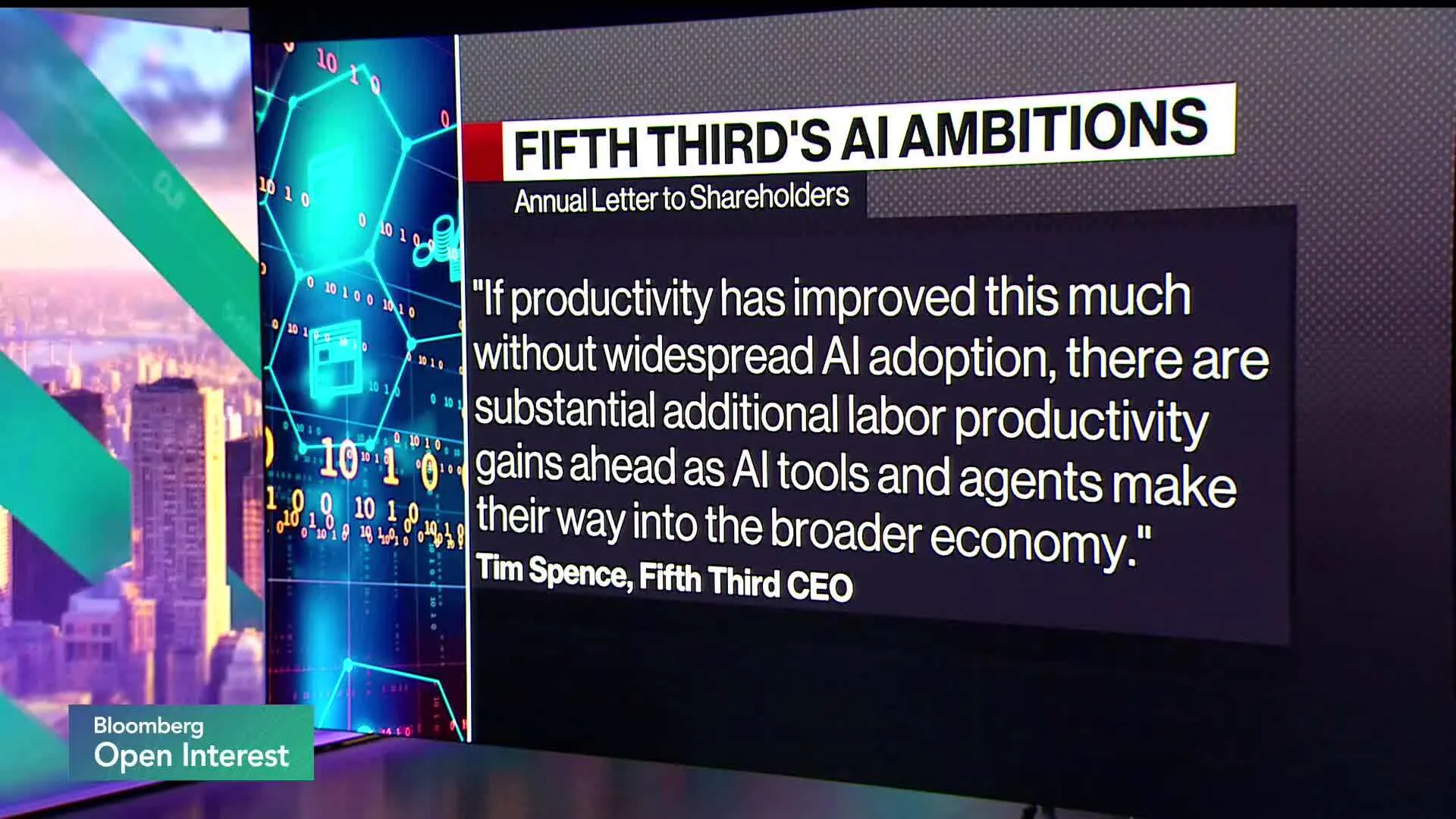
Fifth Third Bancorp CEO Tim Spence said artificial intelligence is already writing 40% of the regional bank’s software code and delivering meaningful productivity gains that are helping the company grow significantly larger with a smaller workforce. In a Bloomberg Open Interest interview, Spence dismissed AI as mere hype and described it as a core driver of long-term operational efficiency and accelerated growth. He outlined a future in which AI moves beyond support roles to directly executing financial transactions for customers.
Body
Spence’s comments, made during the March 11, 2026 Bloomberg interview, provide one of the highest publicly disclosed percentages of AI-generated code at a major financial institution. According to the Bloomberg report, the CEO stated that AI “isn’t hype” and is already producing 40% of Fifth Third’s code base. This figure surpasses recent disclosures from Microsoft, where CEO Satya Nadella revealed that AI is responsible for 20-30% of the tech giant’s new code, with some internal projects reportedly approaching 100% AI authorship.
The productivity impact at Fifth Third appears substantial. Spence told Bloomberg that AI tools are helping the bank “double the company’s size with fewer employees.” He emphasized that the gains are not short-term efficiencies but represent “meaningful, long-term productivity gains and a faster path to growth.” While specific headcount or asset-growth numbers were not detailed in the interview, the statement suggests AI is fundamentally reshaping the bank’s operating model.
Fifth Third’s experience reflects a broader trend across the technology and financial sectors. Multiple reports from 2025 documented accelerating AI adoption in software engineering. Microsoft’s disclosures at Meta’s inaugural LlamaCon event confirmed AI now generates roughly one-third of its code. Anthropic CEO Dario Amodei went further, predicting that within 3 to 6 months from his March 2025 remarks, AI could be writing 90% of the code that human developers previously handled. These statements indicate that Fifth Third’s 40% figure, while high for a traditional bank, sits within an industry trajectory that is moving quickly toward majority-AI code generation.
Spence’s vision for the next phase of AI deployment in banking is particularly notable. He described a transition from AI that merely supports customers to systems capable of executing financial tasks autonomously on their behalf. This shift would represent a significant evolution from today’s chatbots and recommendation engines toward agentic AI systems that can initiate wires, adjust investments, or manage routine banking operations with minimal human oversight. Such capabilities would carry important regulatory, security, and customer-trust implications that the industry will need to address.
Impact
For developers and technology teams at financial institutions, Spence’s comments signal that AI coding assistants have moved from experimental tools to production infrastructure. With 40% of code now machine-generated, engineering organizations must adapt their workflows around code review, security auditing, and quality assurance of AI-authored software. Banks that fail to integrate these tools risk falling behind competitors in both speed-to-market and cost efficiency.
The ability to grow business volume while reducing headcount also has significant implications for the broader labor market in financial services. Fifth Third’s experience suggests that AI-driven productivity gains could allow institutions to reallocate human talent toward higher-value activities such as complex risk analysis, customer relationship management, and regulatory compliance rather than routine coding tasks.
From an industry perspective, the disclosure adds to mounting evidence that generative AI is delivering tangible return on investment in enterprise settings. While many AI initiatives have faced scrutiny over inflated expectations, Spence’s emphasis on “meaningful, long-term productivity gains” provides a credible data point from a regulated financial institution that must meet strict audit and compliance standards.
What’s Next
Spence indicated that the next phase of AI integration at Fifth Third will focus on autonomous execution of financial tasks. The timeline for these capabilities was not specified in the Bloomberg interview, but the CEO’s tone suggested they are already on the roadmap rather than distant speculation.
As AI coding percentages continue to rise across the industry — with some executives forecasting near-total automation of routine programming — banks will likely face increasing pressure to modernize legacy systems and upskill workforces. Regulatory bodies may also begin scrutinizing how AI-generated code is tested, documented, and governed within highly regulated environments like banking.
Fifth Third’s progress will be closely watched by other regional and national banks evaluating their own AI strategies. The combination of substantial code-generation percentages and actual business expansion with reduced staffing could accelerate investment decisions across the sector.
Sources
- Bloomberg: Fifth Third CEO Tim Spence on AI Writing 40% of Code
- The National CIO Review: Microsoft confirms AI writing 20-30% of code
- Tom’s Hardware: Microsoft CEO reveals AI writes up to 30% of code
- Business Insider: Anthropic CEO on AI writing 90% of code in 3-6 months
(Word count: 842)