
- What: Formation of the Optical Compute Interconnect (OCI) Multi-Source Agreement (MSA) group.
- Who: Founding members include Nvidia, AMD, Broadcom, Cisco, Meta, Microsoft, and OpenAI.
- The Goal: To create an open, protocol-agnostic optical physical layer (PHY) to replace copper in AI data centers.
- Performance: Targeting speeds of 3.2Tb/s and beyond using wavelength-division multiplexing (WDM).
In a rare show of unified force, industry rivals Nvidia, AMD, and Broadcom have joined hyperscale giants Meta, Microsoft, and OpenAI to launch the Optical Compute Interconnect (OCI) Multi-Source Agreement (MSA). The alliance aims to replace traditional copper wiring in AI data centers with an open, high-speed optical physical layer (PHY) capable of delivering speeds of 3.2 terabits per second (Tb/s) and beyond, effectively breaking the physical bottleneck currently throttling the AI infrastructure buildout.
Breaking the Copper Ceiling
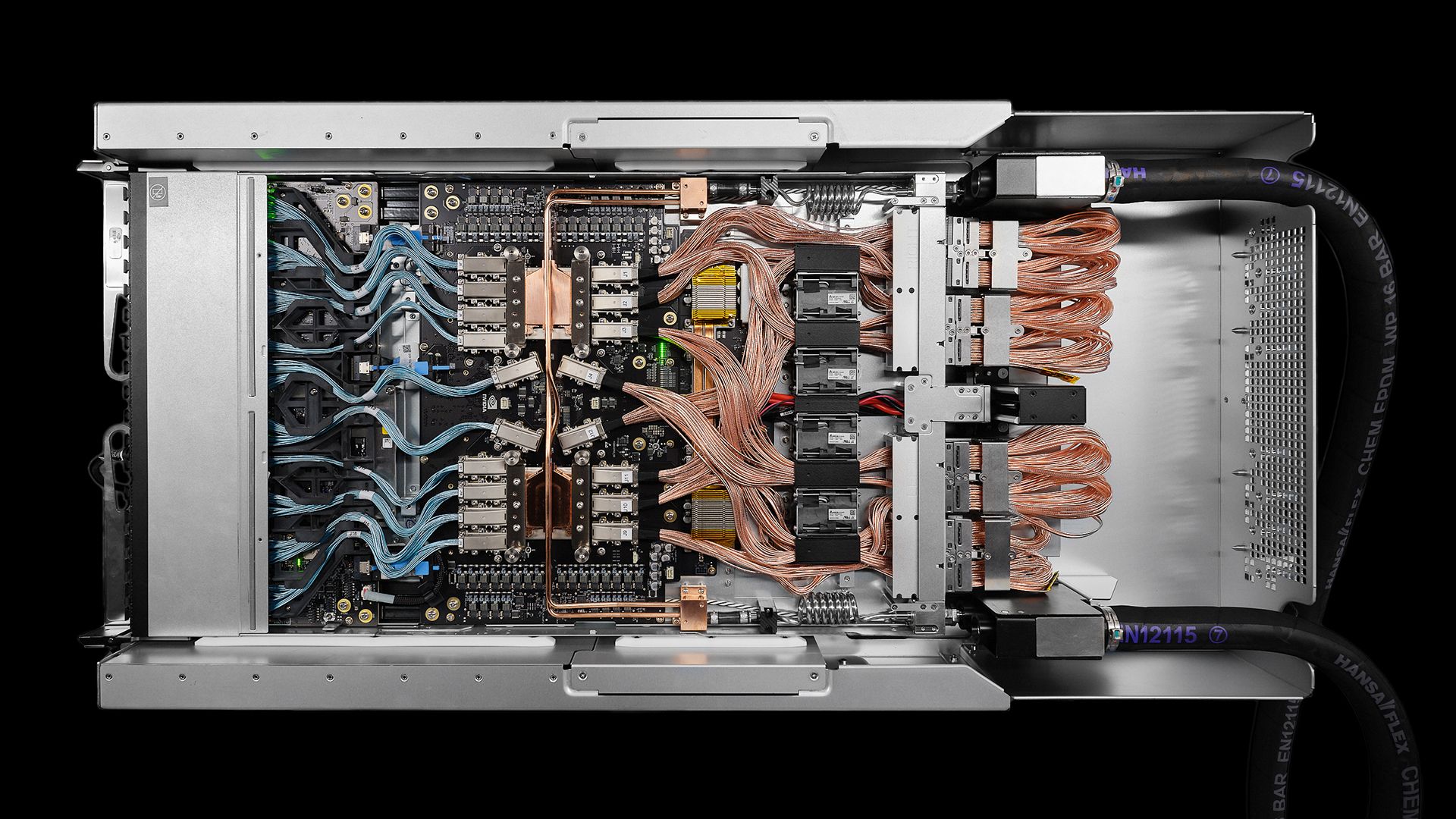
The industry's pivot toward optical interconnects comes as traditional copper cabling hits a hard physical limit. As data centers attempt to scale up to meet the demands of massive AI models like GPT-5 and beyond, copper has become a primary liability. At the high frequencies required for modern AI workloads, copper acts as a lossy, resistant medium, requiring massive amounts of power to push data even short distances without signal degradation.
According to the OCI MSA announcement, the transition to an optical physical layer will allow data centers to scale-up domain sizes far beyond current limitations. While copper is currently facing significant supply chain constraints and unsustainable power consumption metrics, optical interconnections offer a path toward higher-speed data transmission with a more predictable power profile.
"Fundamentally, the current copper-based interconnects just cannot meet that bandwidth requirement," said Vivek Raghunathan, CEO and co-founder of Xscape Photonics, in an interview regarding the limitations of electrical signaling.
A Protocol-Agnostic Revolution
Perhaps the most significant aspect of the OCI MSA is its protocol-agnostic nature. Unlike proprietary interconnects that lock customers into a specific hardware ecosystem, this new optical standard is designed to act as a universal "roadway" for data.
In practice, this means a single data center could run Nvidia’s NVLink for its H100 or Blackwell clusters and AMD’s UALink for its Instinct accelerators over the exact same underlying optical infrastructure. This interoperability is a massive win for hyperscalers like Microsoft and Meta, who currently face the prospect of building siloed, proprietary infrastructures for every different chip vendor they employ.
The OCI specification will focus on short-reach optical links used within AI racks and clusters. Technically, the group is defining a common PHY based on Non-Return-to-Zero (NRZ) signaling and wavelength-division multiplexing (WDM). This approach will start at four wavelengths per fiber at 50 Gb/s (200 Gb/s per direction) and is designed to scale rapidly to 800 Gb/s per fiber, ultimately reaching the 3.2Tb/s milestone.
De-risking the AI Supply Chain
By standardizing the optical components, the alliance intends to foster a multi-vendor supply chain, reducing the industry's reliance on any single manufacturer. Currently, advanced packaging solutions like TSMC’s COUPE (Compact Universal Photonic Engine) technology are seen as foundational to silicon photonics. However, the OCI MSA aims to ensure that chips using alternative Co-Packaged Optics (CPO) platforms remain interoperable.
This standardization is expected to drive down the cost of optics at scale—a necessary evolution given that optical technology currently carries higher upfront costs and higher failure rates than mature copper solutions. By creating an industry "rulebook," the OCI MSA prevents the market from fracturing into proprietary, incompatible silos that would further inflate the cost of AI compute.
Impact on the Industry
For developers and data center operators, the impact of this alliance cannot be overstated. The ability to connect more accelerators over greater distances without the power penalties of copper means that "scale-up" domains—the groups of GPUs that act as a single massive computer—can grow significantly larger.
This changes the fundamental math of AI training. If signal degradation is no longer a limiting factor, engineers can design more flexible, modular data centers where compute and memory are not physically tethered by the short reach of a copper cable.
"This alliance marks the moment the AI industry realized it can no longer innovate through brute-force electricity; the future of intelligence will be carried by light."
What’s Next
While the formation of the OCI MSA provides the roadmap, the road itself is still under construction. Optical technology in data centers is still maturing, and the group must now solve for increased heat output and the relatively high failure rates associated with nascent silicon photonics.
The OCI specification is currently available by request through the group’s official website (www.oci-msa.org). As the group moves from definition to implementation, the industry expects to see the first OCI-compliant components appearing in high-end AI clusters as the transition from 800G to 1.6T and 3.2T networking accelerates over the next 24 months.