
NVIDIA Crushes AI Leaderboards With New NeMo Agentic Retrieval Pipeline
- What: NVIDIA NeMo Retriever team launched a generalizable agentic retrieval pipeline.
- Performance: Ranked #1 on the ViDoRe v3 leaderboard and #2 on the reasoning-heavy BRIGHT leaderboard.
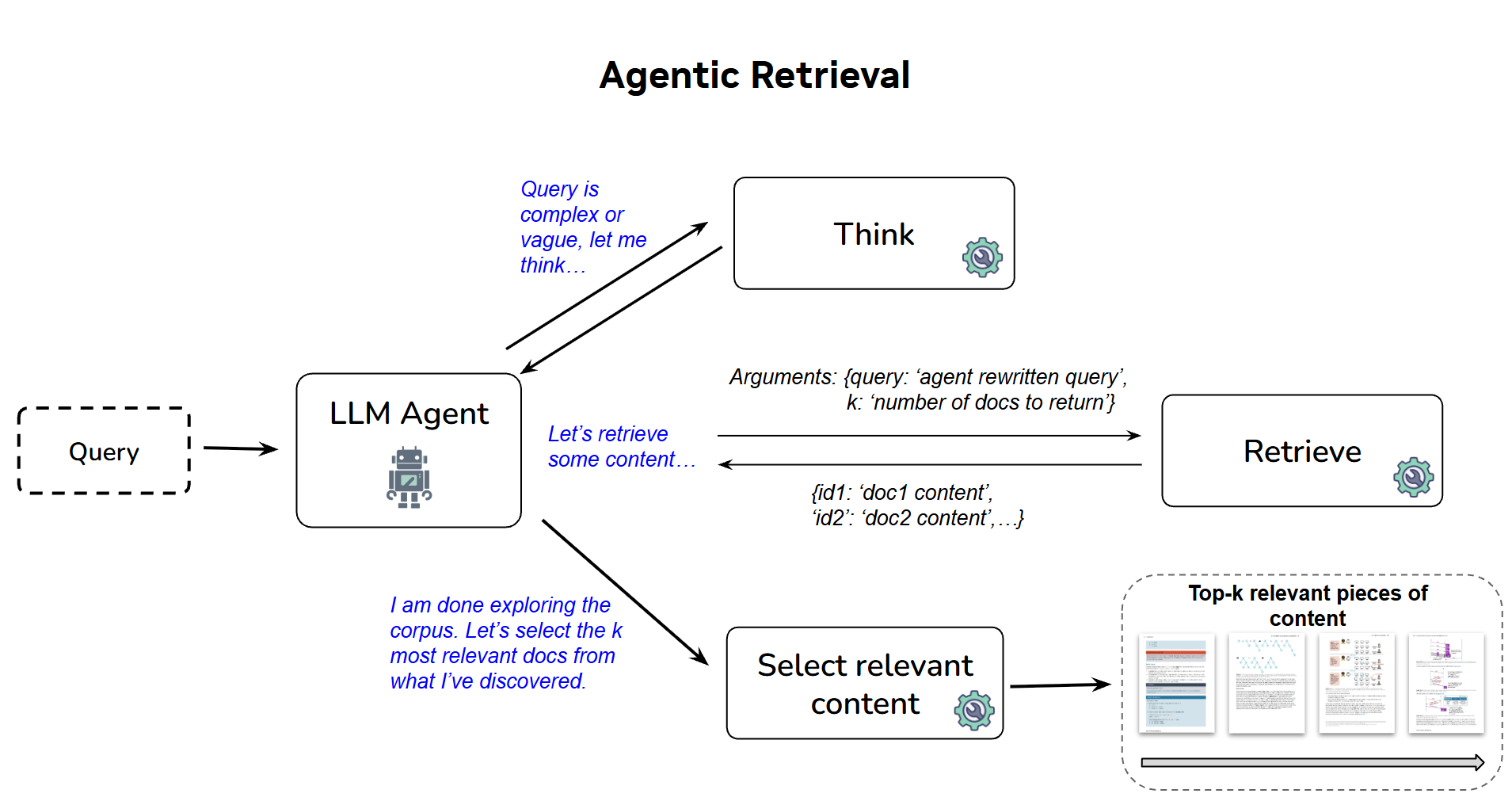
- Key Technology: Utilizes a ReACT architecture to create an iterative reasoning loop between LLMs and retrievers.
- Efficiency: Replaced Model Context Protocol (MCP) servers with in-process thread-safe singletons to eliminate latency and scaling bottlenecks.
NVIDIA has unveiled a breakthrough in how AI systems search and process information, announcing a new agentic retrieval pipeline for its NeMo Retriever platform that prioritizes reasoning over simple keyword matching. The system has already demonstrated industry-leading performance, securing the top spot on the ViDoRe v3 pipeline leaderboard and the second-place position on the high-difficulty BRIGHT leaderboard.
According to an official technical deep dive published on Hugging Face, the new pipeline moves beyond traditional "semantic similarity" to solve complex enterprise data challenges. By implementing an iterative "agentic loop," the system can now parse intricate visual layouts and execute deep logical reasoning across millions of documents without requiring task-specific manual tuning.
Moving Beyond Semantic Similarity
For years, the gold standard for AI retrieval has been dense retrieval based on semantic similarity—finding documents that "look" like the query. However, NVIDIA’s NeMo team argues that this approach is no longer sufficient for the demands of modern enterprise applications. While Large Language Models (LLMs) excel at reasoning, they cannot process millions of documents at once; conversely, traditional retrievers are fast but lack the "thinking" required to navigate complex information.
To bridge this gap, NVIDIA’s new pipeline employs a ReACT (Reasoning and Acting) architecture. Instead of a single "one-and-done" search, the system enters an active, iterative loop. The agent uses a set of built-in tools—including think for planning, retrieve for exploring the corpus, and final_results for output—to refine its search strategy in real-time.
"The agent dynamically adjusts its search queries based on newly discovered information," the NVIDIA team noted in the announcement. This allows the system to perform persistent rephrasing and break down multi-part, complex queries into simpler, achievable goals.
Engineering for Enterprise Scale
A common criticism of agentic workflows is that they are notoriously slow and resource-heavy. To make the pipeline viable for large-scale enterprise use and leaderboard-level evaluation, NVIDIA engineers overhauled the communication layer between the LLM and the retriever.
Initially, the team utilized a Model Context Protocol (MCP) server to allow the LLM to access external tools. While MCP is a standard for tool-calling, NVIDIA found it imposed a "compounding tax" on performance due to network round-trips and the cognitive overhead of managing separate server-client processes. Under high-volume requests, these configurations often suffered from latency or server freezes.
To resolve these bottlenecks, NVIDIA replaced the MCP server with a thread-safe singleton retriever that lives "in-process." This architectural shift allows the system to load model and corpus embeddings once into GPU memory, protecting access with a reentrant lock. This enables the retriever to handle multiple concurrent agent tasks with significantly reduced latency, making it fast enough to dominate competitive benchmarks.
Performance on ViDoRe and BRIGHT
The effectiveness of this generalizable approach is evidenced by its performance on two distinct, high-stakes benchmarks:
- ViDoRe v3 (#1 Rank): The Visual Document Retrieval Benchmark tests a system's ability to navigate complex layouts, charts, and figures. The NeMo pipeline's top ranking suggests it can "see" and understand document structure better than specialized visual models.
- BRIGHT (#2 Rank): This benchmark focuses on "reasoning-intensive" retrieval, where the answer isn't explicitly stated but must be inferred. Scoring second on this list highlights the pipeline's ability to perform deep logical deduction.
NVIDIA emphasizes that the exact same pipeline architecture was used for both leaderboards. This "generalizability" means enterprises do not need to build custom heuristics for different datasets; the agentic loop adapts itself to the data provided.
Impact on the AI Industry
This advancement signals a major shift in the Retrieval-Augmented Generation (RAG) landscape. For developers and enterprises, the move toward agentic retrieval means higher accuracy in "hallucination-prone" environments. By allowing the AI to "think" about its search results before presenting them, the likelihood of providing irrelevant or incorrect information is drastically reduced.
The integration with NVIDIA's broader ecosystem, including Nemotron models and NIM microservices, provides a clear path for companies to deploy these high-performance agents at scale.
"This changes how enterprises approach uncurated data; for the first time, a single pipeline can handle visual layouts and logical reasoning with world-class efficiency."
What’s Next
The NeMo Retriever’s agentic pipeline is expected to become a cornerstone of NVIDIA’s enterprise AI offerings. As the system moves from leaderboard success to general availability via NVIDIA NIM microservices, the industry will likely see a surge in "reasoning-first" RAG applications.
Future iterations will likely focus on further reducing the cost of the iterative loops and expanding the "toolset" available to the agent, potentially allowing it to interact with live APIs and structured databases alongside static document corpuses.
Sources
- Hugging Face: Beyond Semantic Similarity: Introducing NVIDIA NeMo Retriever’s Generalizable Agentic Retrieval Pipeline
- NVIDIA Developer: NeMo Retriever Overview
- NVIDIA Technical Blog: Build a RAG Agent with NVIDIA Nemotron
All technical specifications, pricing, and benchmark data in this article are sourced directly from official announcements. Competitor comparisons use publicly available data at time of publication. We update our coverage as new information becomes available.