
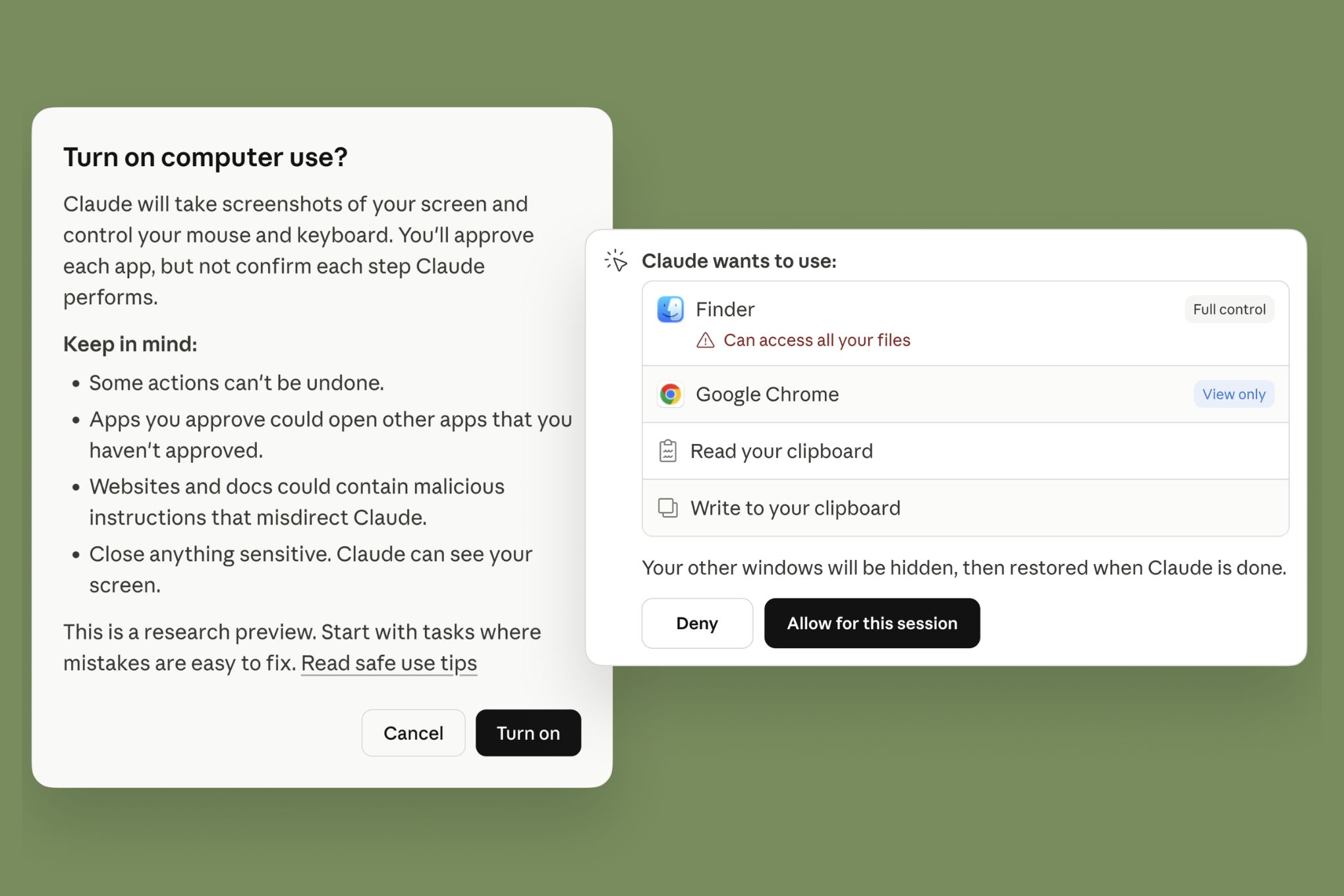
Executive Summary
- Technical Summary: Claude Code and Cowork are agentic AI tools integrated into the Claude ecosystem that leverage a refined "Computer Use" framework to autonomously control macOS environments via direct API connectors or visual-spatial reasoning (mouse/keyboard/screen control).
- Platform & Access: Currently a research preview limited to macOS for Claude Pro and Max subscribers, requiring the Claude desktop app paired with a mobile device for remote orchestration.
- Hybrid Execution: The system utilizes a "connector-first" architecture, prioritizing direct service integrations (Slack, Google Workspace) before falling back to pixel-based computer vision and system-level event injection.
- Orchestration: Introduces "Dispatch," a cross-device protocol allowing users to trigger complex, multi-step desktop workflows from a mobile interface.
Technical Architecture: The Agentic OS Layer
Anthropic’s latest update transforms Claude from a passive Large Language Model (LLM) into an active Action Agent. The architecture is built upon the foundational "Computer Use" capabilities first introduced in Claude 3.5 Sonnet in late 2024, but it has been significantly hardened for production-level developer workflows.
1. Dual-Path Execution Engine
The system operates on a hierarchical execution logic designed to minimize latency and maximize reliability:
- Layer 1: Service Connectors: Claude first attempts to resolve tasks via "Connectors." These are structured API integrations with platforms like Slack and Google Workspace. This bypasses the need for visual processing, reducing token spend and error rates.
- Layer 2: Visual Action Transformation (VAT): If no connector is available, Claude switches to its visual-spatial engine. It captures screenshots of the macOS environment, interprets the UI hierarchy, and maps natural language goals to system-level events (e.g.,
cliccoordinates,key_downevents, orscrolldeltas).
2. The "Dispatch" Cross-Device Protocol
A standout technical component is Dispatch. This feature functions as a remote procedure call (RPC) bridge between the Claude mobile app and the macOS desktop client.
- Workflow: A user inputs a prompt on mobile ("Find the Q3 budget spreadsheet on my desktop and Slack the summary to the team").
- Orchestration: The mobile app transmits the high-level intent to Anthropic’s servers, which then wake the authenticated Claude Desktop instance on the Mac to begin autonomous execution.
3. Permission and Security Sandboxing
Anthropic has implemented a "Human-in-the-loop" (HITL) requirement. Unlike traditional background scripts, Claude’s computer control requires explicit permissions for exploring and clicking. The system utilizes macOS’s native Accessibility and Screen Recording APIs to observe and interact with the UI, ensuring that the AI operates within the same permission boundaries as the logged-in user.
Performance Analysis: Benchmarking Autonomy
Anthropic admits that while the tool is revolutionary, there is a distinct performance delta between "Direct Integration" and "Visual Control." Based on the announcement data, we can categorize performance across three primary vectors:
Table 1: Performance Comparison by Execution Path
| Metric | Direct API Connectors | Visual Screen Control |
|---|---|---|
| Latency | Low (< 2 seconds per action) | High (5–15 seconds per action) |
| Reliability | ~98% success rate | Variable (Tasks often need a "second try") |
| Setup Required | Authentication only | None (Zero-shot UI navigation) |
| Context Window Usage | Minimal (JSON payloads) | Heavy (High-res screenshot encoding) |
| Complexity Limit | High (Structured data) | Medium (Prone to "visual drift") |
Table 2: Capability Matrix: Claude Code vs. Claude Cowork
| Feature | Claude Code | Claude Cowork |
|---|---|---|
| Primary Target | IDEs, Terminal, Git | Browsers, Office Suites, Slack |
| File Manipulation | Edit/Refactor source code | Spreadsheet filling, File transfers |
| Execution Environment | Dev Tools / Local Compilers | General macOS GUI |
| Remote Triggering | Supported via Dispatch | Supported via Dispatch |
| Permissions | Granular (per directory) | Broad (Screen/Mouse/Keyboard) |
Technical Implications for the Ecosystem
1. The UI as a Universal API
Anthropic is doubling down on the philosophy that the User Interface is the ultimate API. By mastering "Computer Use," Claude bypasses the "walled garden" problem of SaaS platforms. If an app doesn't have an API, it doesn't matter—Claude can see the buttons and click them. This significantly lowers the barrier for automating legacy or proprietary software.
2. Shift in Developer Productivity
For senior developers, Claude Code represents a shift from "AI-assisted coding" to "AI-managed engineering." The ability for Claude to run dev tools, execute tests, and fix bugs while the developer is away from their desk creates a continuous integration/continuous deployment (CI/CD) cycle that lives on the local machine rather than just the cloud.
3. Infrastructure Demands
The transition to visual-based agents places massive demands on multimodal inference. Processing high-frequency screenshots and translating them into precise coordinate-based actions requires significantly more compute than standard text-based RAG (Retrieval-Augmented Generation) workflows.
Limitations and Trade-offs
- Latency vs. Accuracy: Anthropic explicitly notes that "working through your screen is slower than using a direct integration." The overhead of capturing, encoding, and reasoning over pixels introduces a "thought lag" that makes real-time collaboration difficult.
- OS Lock-in: The current limitation to macOS suggests the system relies heavily on specific macOS Accessibility APIs. Porting this to Windows (Win32/UWP) or Linux (Wayland/X11) presents a significantly different set of visual-spatial challenges.
- The "Second Try" Problem: Complex tasks frequently fail on the first attempt. This suggests the agent’s "memory" of previous UI states may be volatile, leading to loops or dead-ends if a popup or system notification interrupts the flow.
- Security Risk: Granting an AI full control of a display and keyboard is inherently risky. While Anthropic mandates "explicit permission," the potential for prompt injection attacks that lead to unauthorized file deletion or data exfiltration remains a theoretical concern.
Expert Perspective: The Dawn of the "Action Era"
The release of Claude Code and Cowork marks a pivotal moment in the transition from Generative AI to Agentic AI. For years, we have used LLMs to write about work; Anthropic is now asking us to let LLMs do the work.
The technical brilliance here isn't just in the model's reasoning, but in the orchestration. Integrating a mobile "Dispatch" feature solves the "tethering" problem of desktop agents. By allowing a user to assign a task from their phone to their workstation, Anthropic is positioning Claude as a remote-controlled digital twin.
However, the "Research Preview" tag is a necessary caution. The visual processing of a desktop is infinitely more complex than a structured terminal. Until the "Visual Action Transformation" engine achieves parity with direct API reliability, this will remain a power-user tool rather than a mass-market solution.
Technical FAQ
How does this compare to previous "Computer Use" implementations on Claude 3.5?
The 2024 implementation was a raw API capability primarily for developers to build upon. The 2026 update integrates this directly into the Claude Code and Cowork products, adds the Dispatch cross-device protocol, and introduces the Connector-First logic to improve speed and reliability.
Is the system backwards-compatible with existing Claude API integrations?
While Claude Code and Cowork are standalone tools for Pro/Max users, the underlying "Computer Use" improvements are expected to be available via the API. However, the specific "Dispatch" orchestration is currently proprietary to the Anthropic app ecosystem.
How does Claude handle UI changes during a task (e.g., a pop-up)?
Claude captures screenshots periodically. If a pop-up appears, the next "Perceive" cycle identifies the new UI element. The agent must then re-plan its steps. Anthropic notes that complex tasks may require retries, suggesting that unexpected UI changes are still a primary failure point.
What are the data privacy implications of "Screen Recording" permissions?
The Claude desktop app requires macOS Screen Recording permissions to "see" the interface. According to Anthropic, the AI always asks for permission before beginning a task. However, developers should be aware that sensitive data visible on the screen during a task execution is processed by the multimodal model.
References
- Anthropic: Introducing Claude Computer Use
- macOS Accessibility API Documentation
- Agentic Workflows and Multimodal LLMs: A Survey (2025)