
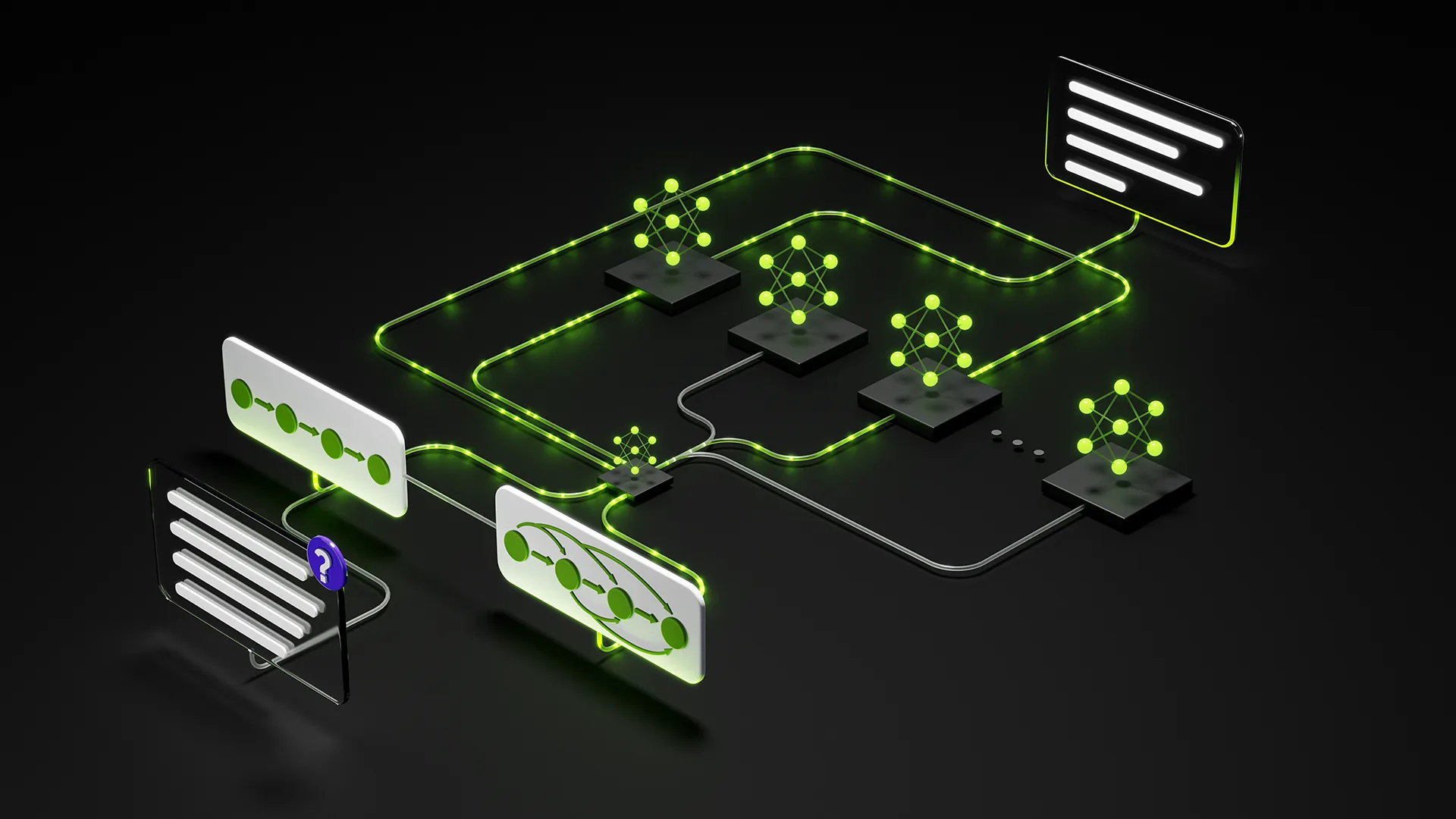
The era of the "single model prompt" is over. As introduced at GTC 2026, the industry is shifting toward Agentic AI—a sophisticated ecosystem where specialized models collaborate to handle planning, reasoning, retrieval, and safety. NVIDIA Nemotron 3 is the toolkit designed specifically for this transition, offering open frontier models that rival proprietary giants in reasoning and multimodal accuracy.
"Agentic AI is an ecosystem where specialized models work together to handle planning, reasoning, retrieval, and safety guardrailing. As these systems scale, developers need models that can understand real-world multimodal data." — NVIDIA
For builders, this isn't just another model drop; it’s a blueprint for building "Sovereign AI" that runs with enterprise-grade safety and local control.
Why this matters for builders
NVIDIA Nemotron 3 lets you build autonomous, multimodal agentic systems using a suite of specialized models optimized for reasoning, visual RAG, and low-latency voice interactions.
Previously, builders had to choose between the high reasoning of massive closed models and the speed of smaller open models. Nemotron 3 breaks this trade-off by offering:
- Ultra Reasoning: Nemotron 3 Ultra (a Mixture-of-Experts hybrid) provides frontier-level accuracy for complex planning.
- Visual Intelligence: Multimodal RAG capabilities (Embed VL and Rerank VL) allow agents to "see" and retrieve information from images and charts as easily as text.
- Safety at Scale: Dedicated Content Safety models that understand cultural nuances across languages, ensuring agents don't hallucinate or violate policy in global deployments.
- Human-Like Voice: The VoiceChat model enables full-duplex, low-latency conversations, meaning your agent can listen and speak simultaneously, just like a human.
When to use it
Use NVIDIA Nemotron 3 when your application requires more than a simple text response. It is the ideal stack for:
- Enterprise-Grade Voice Agents: Customer service or technical support where low latency and natural "interruptible" speech are required.
- Multimodal Visual RAG: Internal knowledge bases that rely on complex diagrams, blueprints, or medical imaging.
- Global Compliance Applications: Products operating in multiple regions that need localized, culturally aware safety guardrails.
- Complex Task Planning: Agents tasked with multi-step reasoning, such as supply chain optimization or automated software engineering.
Phase 1: Define the Agent Mesh
Before you write a single line of code, you must architect the "Agent Mesh." In a Nemotron 3 workflow, you aren't calling one model; you are orchestrating several.
- The Brain (Nemotron 3 Ultra): Use this for the high-level planning and final reasoning.
- The Eyes (Llama Nemotron Embed/Rerank VL): Use these to index and retrieve visual/textual data from your vector database.
- The Guard (Nemotron 3 Content Safety): Use this as an input/output filter to catch safety violations.
- The Voice (Nemotron 3 VoiceChat): Use this for the interface layer if your application is audio-centric.
The Builder Goal: Create a clear flow where the Safety model checks the user prompt before the Brain processes it, and the RAG model provides the Brain with visual context.
Phase 2: Implement Multimodal RAG (The "Visual Brain")
A common pitfall in RAG is ignoring images. Nemotron 3 fixes this with specialized embedding and reranking models.
The Workflow:
- Ingest: Convert your PDFs, charts, and text into embeddings using
NVIDIA Llama Nemotron Embed VL. - Retrieve: When a user asks a question, perform a similarity search.
- Rerank: Use
NVIDIA Llama Nemotron Rerank VLto reorder the results. This is critical because relevance often depends on visual content that standard text-based rerankers miss.
Vibe Coding Tip: When prompting your coding assistant (like Cursor or GitHub Copilot) to build this, tell it: "Use a two-stage retrieval process. First, fetch top 20 candidates using Embed VL, then rerank them using Rerank VL to find the most visually relevant context for the LLM."
Phase 3: Scaffold the Reasoning and Safety Layer
Once your data is retrieved, the Nemotron 3 Ultra model needs to process it. However, you must wrap this in the Content Safety model.
Starter Template: Safety-First Reasoning Prompt
### System Prompt for Nemotron 3 Content Safety
Check the following input for:
1. Multilingual hate speech or harassment.
2. Culturally insensitive terminology in [Target Region].
3. Proprietary data leaks.
If the input is unsafe, return: { "status": "blocked", "reason": "[reason]" }.
Otherwise, return: { "status": "safe" }.

### System Prompt for Nemotron 3 Ultra (The Planner)
You are an expert technical agent.
Context: [Insert Reranked Multimodal Context Here]
Goal: [User Query]
Instructions:
- Analyze the visual data provided in the context.
- Outline your reasoning steps before providing a final answer.
- Ensure the output is concise and grounded strictly in the context.
Phase 4: Implement the Voice Interface
If you are building a voice agent, leverage Nemotron 3 VoiceChat (currently in early access). Unlike traditional TTS/STT pipelines that feel "robotic" due to high latency, VoiceChat is designed for full-duplex interaction.
Validation Checklist for Voice:
- Latency Check: Is the response-to-speech delay under 200ms?
- Barge-in Testing: Can the user interrupt the agent mid-sentence?
- Nuance Check: Does the agent handle "um" and "ah" naturally without breaking the reasoning flow?
Pitfalls and Guardrails
What if the agent's reasoning is slow?
Nemotron 3 Ultra is a high-accuracy model, which can be slower than smaller models. If latency is an issue for simple tasks, use Nemotron 3 Nano Omni for the "quick thinking" tasks and only route complex queries to Ultra. This is called "Model Routing" and it saves both time and compute costs.
How do I handle multimodal "hallucinations"?
Even with Rerank VL, an LLM might misinterpret a chart. The Guardrail: Implement a "Chain of Verification" (CoVe). Ask the model to extract specific data points from the image first, then use those points to answer the question. If the data points don't match the image description, flag it for human review.
Why use Nemotron Content Safety over a generic filter?
Generic filters often fail at cultural nuance or specialized technical jargon. Nemotron 3 Content Safety is specifically trained to be multimodal and multilingual, catching visual "dog whistles" or offensive context that text-only filters miss.
What to do next
- Audit your current RAG pipeline: Identify how much visual information (charts, tables, images) you are currently throwing away.
- Test the Benchmarks: Compare your current reasoning model against Nemotron 3 Ultra using your own internal datasets.
- Apply for Early Access: If you are building voice-first applications, head to the NVIDIA Developer portal to request access to the
VoiceChatandNano Omnimodels. - Ship a "Safety Layer" first: You don't need to replace your whole LLM today. Start by using the
Nemotron 3 Content Safetymodel as a firewall in front of your existing agents.