
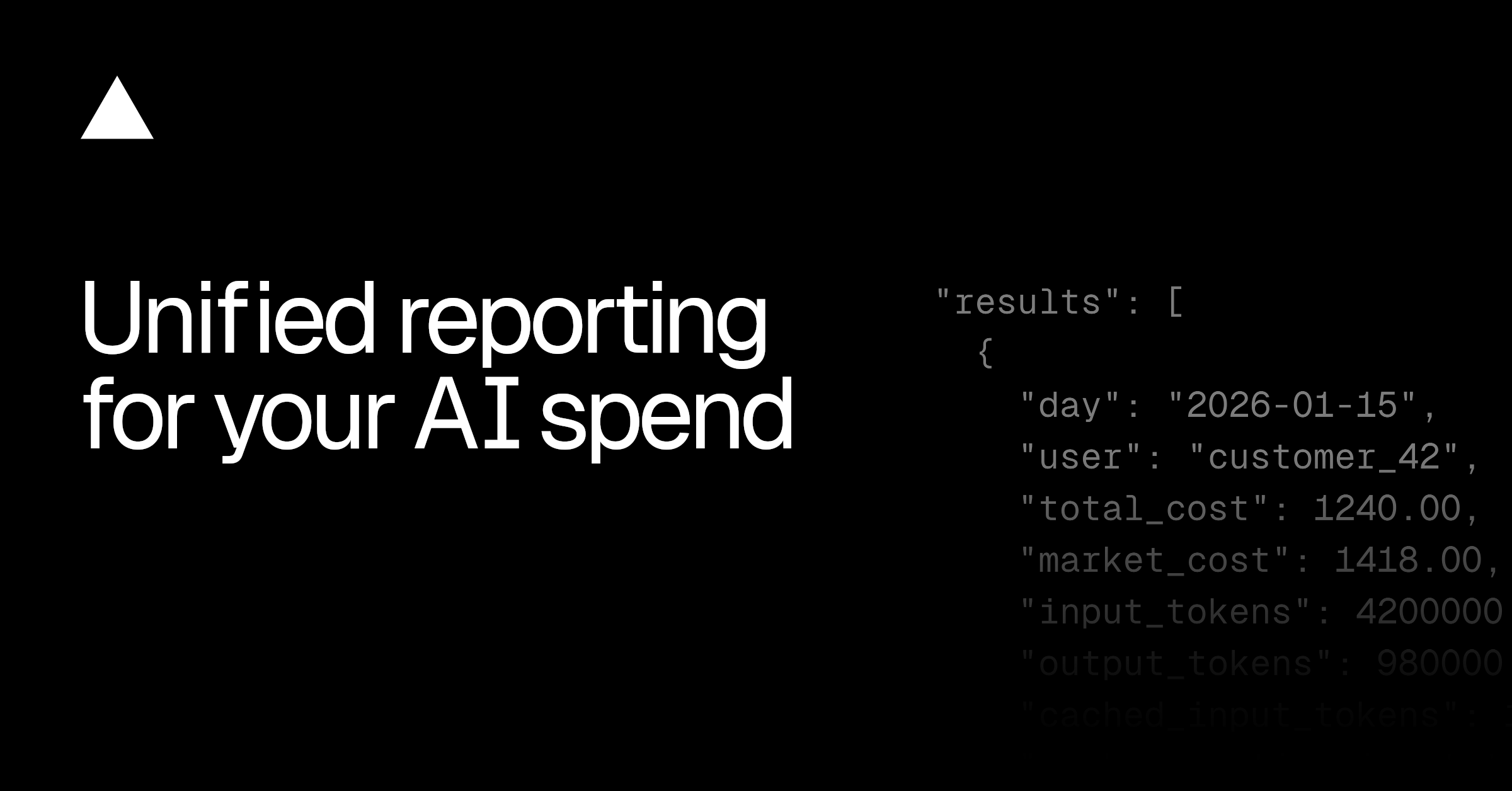
- What: Vercel released the Custom Reporting API for AI Gateway in beta.
- Who: Available immediately for teams on Pro and Enterprise plans.
- Key Feature: Programmatic access to costs, token usage, and request volume across all AI providers.
- Compatibility: Supports Vercel AI SDK, OpenAI, Anthropic, and "Bring Your Own Key" (BYOK) requests.
- Impact: One early adopter reported saving $80,000 by consolidating their tracking infrastructure.
Vercel has launched a new Custom Reporting API for its AI Gateway, aiming to solve the "billing fragmentation" crisis facing developers who deploy features across multiple AI providers. The new tool provides a single programmatic endpoint to track costs, token usage, and request volume, effectively eliminating the need for manual CSV exports and spreadsheet reconciliation.
The feature, currently in beta for Pro and Enterprise users, allows developers to treat AI spend as a standard production metric. By centralizing data from disparate sources—including OpenAI, Anthropic, and user-provided keys—Vercel is positioning itself as the central nervous system for AI financial operations (FinOps).
Ending the "After-the-Fact" Reconciliation Era
According to Vercel’s announcement, the current state of AI development is plagued by fragmented data. When a company ships AI features using multiple models, usage data is typically split across various provider consoles and dashboards. This "drift into after-the-fact reconciliation" makes it nearly impossible for teams to understand their unit economics until the monthly bill arrives.
The problem is exacerbated by "Bring Your Own Key" (BYOK) architectures, where spend and usage scatter across whatever credentials end-users provide. Vercel's new API addresses this by capturing data in one place regardless of whether the developer uses system credentials or user-provided keys.
The Custom Reporting API allows teams to break down spend by:
- Specific AI models and providers
- Internal user IDs
- Custom tags (e.g., specific features or customer segments)
- Credential types
Real-World Impact: How One Platform Saved $80,000
The financial implications of unified reporting are already becoming clear. Vercel highlighted a private beta participant—an AI platform serving over 200,000 users—that previously relied on a complex, third-party proxy layer just to track costs across different providers.
By switching to the AI Gateway’s Custom Reporting API, the platform was able to decommission its third-party proxy entirely. This consolidation of cost tracking and request management resulted in over $80,000 in savings. The company now uses custom tags and user IDs to track individual customer costs in real-time, gaining programmatic access to spend data in the same environment where their inference actually runs.
Technical Integration and Tagging
Vercel has designed the reporting API to be highly extensible. Developers can tag requests with specific metadata, such as a customer’s plan or a particular feature ID. This tagging system is compatible with several major interfaces, including:
- Vercel AI SDK
- Chat Completions API
- Responses API and OpenResponses API
- Anthropic Messages API
Once tagged, this data can be queried live. Vercel even noted that the API can be queried via Claude Code, allowing developers to ask natural language questions about their usage and spend directly within their development environment.
Impact on the AI Industry Landscape
For developers and finance teams, this move changes how AI products are priced and managed. By having granular visibility into the cost of a single feature across all enterprise teams, companies can calculate per-request unit economics with precision before committing to new pricing tiers.
In the competitive landscape, Vercel is moving to compete more directly with other AI gateway providers like Cloudflare and Databricks. While Cloudflare’s AI Gateway offers real-time usage statistics and logging, Vercel’s deep integration with its own deployment platform and the Vercel AI SDK provides a more seamless experience for frontend and full-stack developers.
"Once your traffic runs through a single reporting endpoint, you can treat AI spend like any other production metric," Vercel stated in their official blog. This shifts AI management from reactive troubleshooting to proactive budgeting.
What's Next
The Custom Reporting API remains in beta for Pro and Enterprise plans. Vercel's roadmap suggests a deeper push into AI observability and control, allowing teams to catch usage spikes before they manifest as unexpected costs. As more companies move from experimental AI features to large-scale production, the ability to monitor internal usage across dozens of models and providers from a single endpoint is likely to become a standard requirement for enterprise-grade AI infrastructure.