
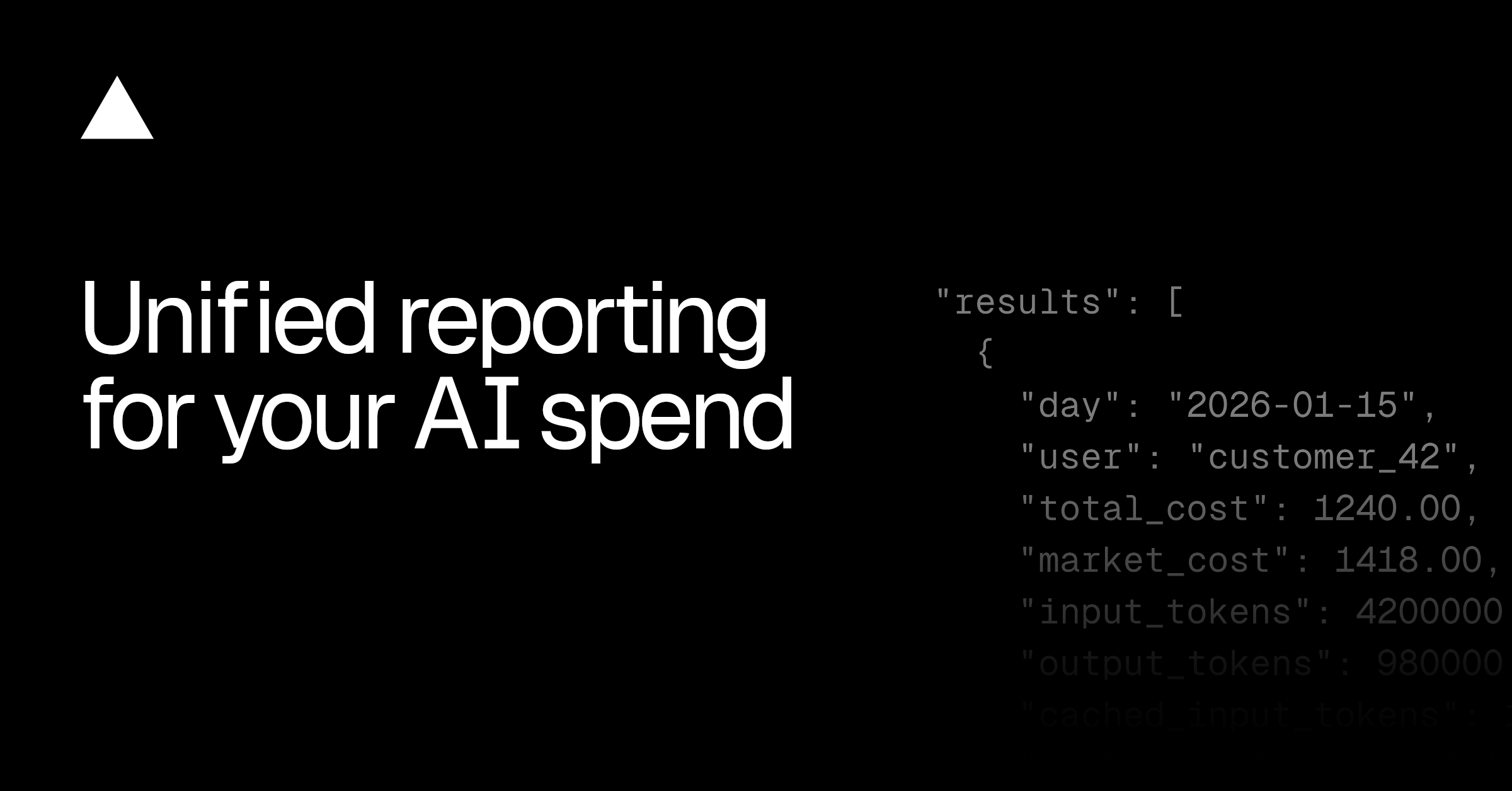
- What: Vercel launched the Custom Reporting API for AI Gateway in beta.
- Who: Available immediately for teams on Vercel Pro and Enterprise plans.
- Cost Impact: One beta participant reportedly saved $80,000 by consolidating tracking.
- Key Capability: Programmatic access to cost, token usage, and request volume across all AI providers and Bring Your Own Key (BYOK) requests.
Vercel announced the beta launch of its Custom Reporting API for AI Gateway today, providing developers with a single, programmatic endpoint to monitor AI expenditures across multiple providers. The new tool aims to solve the "after-the-fact reconciliation" problem by centralizing usage data that is typically fragmented across various provider dashboards, API keys, and internal spreadsheets.
The release marks a significant move for Vercel as it matures its AI infrastructure stack, moving beyond simple hosting to provide the governance and observability tools required by enterprise-level AI applications. By offering a unified view of spend, Vercel is positioning itself as the central nervous system for companies shipping multi-model AI features.
Solving the "Spreadsheet Nightmare" of AI Spend
As developers increasingly "ship" AI features, they often find their usage data scattered across disparate platforms. According to Vercel’s announcement, the current industry standard involves exporting CSVs from multiple provider consoles—such as OpenAI, Anthropic, and Google—and manually rebuilding views in spreadsheets. This manual process often lacks the critical context needed for business decisions, such as internal user IDs, feature boundaries, or specific customer tags.
The problem is exacerbated when companies implement "Bring Your Own Key" (BYOK) architectures, where end-users provide their own API credentials. In these scenarios, spend and usage data scatter even further across whatever keys the users bring, making it nearly impossible for platforms to maintain a clear picture of their ecosystem's health.
The new Custom Reporting API addresses this by capturing data at the gateway level. It provides programmatic access to token usage and request volumes, regardless of whether the requests use system credentials or user-provided keys.
Technical Implementation and Case Study: $80,000 in Savings
The API allows developers to break down spend by model, provider, user ID, custom tag, or credential type. This level of granularity is designed to help teams calculate unit economics in real-time. Vercel highlighted a specific case study involving an AI platform that aggregates models for over 200,000 users.
Previously, this platform relied on a separate, third-party proxy layer to track costs across providers. During the private beta of Vercel’s Custom Reporting API, the team consolidated its cost tracking and request management into Vercel's native system. By replacing the third-party proxy entirely, the platform reportedly saved $80,000 in operational costs while gaining deeper insights into customer usage patterns through custom tags and user IDs.
For developers, implementation involves tagging requests at the source. The reporting system is compatible with several major interfaces, including:
- Vercel AI SDK
- OpenAI Chat Completions API
- Anthropic Messages API
- OpenResponses API
By tagging each request with metadata like customer_id, plan_type, or feature_name, companies can attribute costs in terms that both product and finance teams can understand.
Impact: Treating AI Spend as a Production Metric
The launch of the Custom Reporting API shifts AI cost management from a monthly accounting task to a real-time engineering metric. For the first time, developers can query their spend data live via tools like Claude Code to answer complex questions before a bill arrives.
"Once your traffic runs through a single reporting endpoint, you can treat AI spend like any other production metric," the company stated in its official documentation. This allows teams to:
- Monitor Unit Economics: Calculate the exact margin of a single feature across different customer tiers.
- Predictive Budgeting: Catch usage spikes or anomalies before they turn into "bill shock" at the end of the month.
- Strategic Pricing: Use real-world usage data to determine where free-tier users should be pushed toward upgrades.
For the broader AI industry, this move places Vercel in direct competition with specialized AI observability and LLM (Large Language Model) gateway providers. By building these features directly into the Vercel platform, the company is reducing the "tooling tax" on developers who would otherwise have to pay for and maintain separate monitoring services.
What’s Next for AI Gateway
The Custom Reporting API is currently in beta for Pro and Enterprise users. Vercel indicates that this is part of a broader push to make AI Gateway the standard entry point for production AI applications.
As the API evolves, the industry can expect more integrations with budgeting and alerting systems. The ability to set automated "kill switches" or rate limits based on real-time dollar spend rather than just token counts is a likely future iteration for the platform. For now, teams can begin integrating the API to gain programmatic control over their AI margins and operational efficiency.