
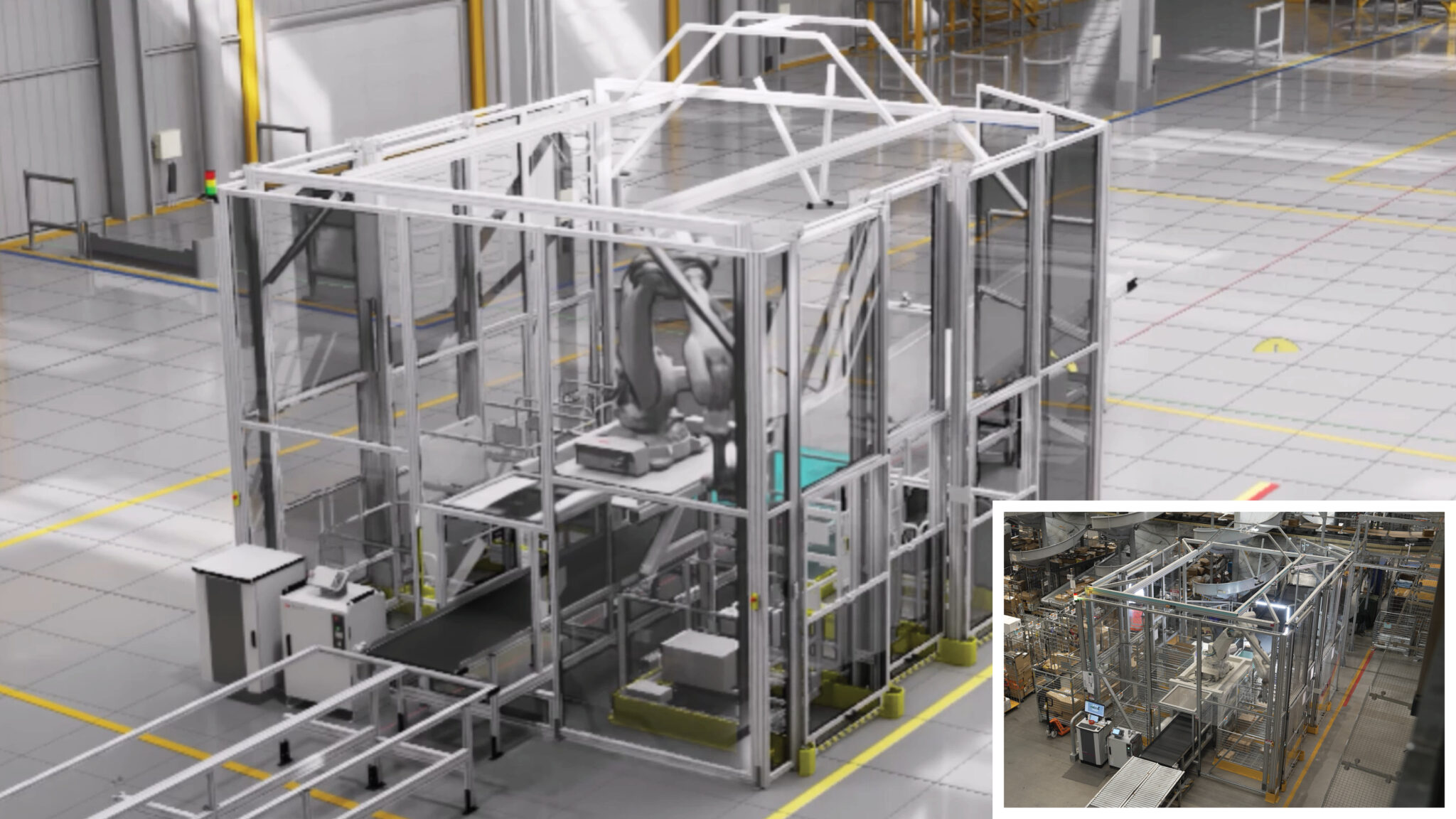
ABB Robotics Taps NVIDIA Omniverse to Deliver Industrial-Grade Physical AI at Scale
Key Facts
- What: ABB Robotics integrates NVIDIA Omniverse libraries into its RobotStudio suite, launching RobotStudio HyperReality with physically accurate, photorealistic simulation.
- Impact: Reduces deployment costs by up to 40%, accelerates time to market by up to 50%, and cuts setup and commissioning times by up to 80%.
- Technical Details: Achieves 99% correlation between simulation and real-world behavior; uses synthetic data for AI vision training; combines with ABB’s Absolute Accuracy technology to reduce positioning errors from 8-15 mm to around 0.5 mm.
- Availability: RobotStudio HyperReality expected in the second half of 2026.
- Early Adopters: Pilots underway with Foxconn and Workr; integration of NVIDIA Jetson edge AI platform into ABB’s Omnicore controller under exploration.
ABB Robotics and NVIDIA announced a major partnership today that integrates NVIDIA Omniverse libraries directly into ABB’s RobotStudio programming and simulation platform, aiming to close the persistent “sim-to-real” gap in industrial robotics and deliver industrial-grade physical AI at scale.
The collaboration introduces RobotStudio HyperReality, a new offering that provides manufacturers with physically accurate, photorealistic simulation capabilities within the tools already used by more than 60,000 robotics engineers worldwide. By enabling virtual design, programming, testing and validation of entire automation cells, the solution is expected to dramatically reduce engineering time, lower deployment costs and speed up product launches for factories.
The partnership marks a significant step for the industrial sector, which has long struggled to reliably transfer AI-trained robotic behaviors from simulation to real-world factory floors. According to ABB Robotics President Marc Segura, the integration “closed technology’s long-standing ‘sim-to-real’ gap – a huge milestone to deploying physical AI with industrial-grade precision, for real-world customer applications.”
A Breakthrough in Physical AI for Industry
The core technical advance comes from exporting a fully parameterized robot station — including robots, sensors, lighting, kinematics and parts — as a Universal Scene Description (USD) file into NVIDIA Omniverse. Within this environment, ABB’s virtual controller runs the identical firmware used by physical robots, creating a high-fidelity digital twin.
This setup delivers 99% correlation between simulated and actual robot behavior, according to the companies. Synthetic images generated in Omniverse can be fed directly into AI training pipelines, allowing vision models to be developed entirely in simulation before deployment. The solution also leverages ABB’s Absolute Accuracy technology, which improves positioning precision from typical errors of 8-15 mm down to approximately 0.5 mm.
For decades, simulation environments have fallen short due to inaccurate lighting, material behaviors and real-world variability. NVIDIA Omniverse libraries address these limitations by providing physics-rich, photorealistic rendering. Deepu Talla, vice president of robotics and edge AI at NVIDIA, emphasized the importance of this capability: “The industrial sector needs high-fidelity simulation to bridge the gap between virtual training and real-world deployment of AI-driven robotics at scale.”
Real-World Benefits and Customer Pilots
Manufacturers using RobotStudio HyperReality will be able to validate complete production lines virtually, eliminating many physical prototypes and reducing setup and commissioning times by as much as 80%. These gains are particularly valuable in high-mix, high-precision industries such as consumer electronics.
Early pilots demonstrate strong industry interest. Foxconn, the world’s largest electronics manufacturer, is testing the platform for assembly of delicate metal components with frequent product variations. The company is using synthetic data generated in Omniverse to train robots virtually, expecting significant reductions in setup time and elimination of costly physical testing.
Workr, a California-based company focused on bringing advanced automation to small and medium-sized manufacturers, is integrating its WorkrCore physical AI platform with ABB robots. The system uses synthetic data from Omniverse to enable rapid onboarding of new parts. Workr plans to demonstrate AI-powered robotic systems capable of onboarding new parts in minutes — without requiring specialized programming expertise — at NVIDIA GTC 2026 in San Jose.
ABB is also exploring deeper integration by embedding the NVIDIA Jetson edge AI platform into its Omnicore controller. This would bring real-time AI inference capabilities across its entire robot portfolio, further enhancing on-device intelligence.
Competitive Context and Industry Implications
The announcement arrives as manufacturers increasingly seek to deploy AI-powered automation amid labor shortages and demands for greater flexibility. Traditional simulation tools have often required extensive real-world tuning and physical testing, slowing deployment and increasing costs. By combining ABB’s domain expertise in industrial robotics with NVIDIA’s leadership in accelerated computing and simulation, the partnership aims to make physical AI practical at global scale.
The solution targets a broad range of industries beyond electronics, including automotive, logistics and general manufacturing. The ability to train vision systems entirely on synthetic data could significantly lower barriers for companies that previously lacked access to large, diverse real-world datasets.
Impact on Developers, Manufacturers and the Industry
For robotics engineers and system integrators, RobotStudio HyperReality promises a unified workflow that removes the traditional disconnect between digital design and physical deployment. The platform’s ability to export complete, parameterized environments into Omniverse streamlines collaboration between design, simulation and operations teams.
Manufacturers stand to benefit from faster product ramps, lower capital expenditure on physical prototypes, and higher reliability of AI-driven systems. The projected 40% reduction in deployment costs and 50% faster time to market could meaningfully improve return on investment for automation projects.
The partnership also highlights the growing convergence of industrial automation and AI technologies. NVIDIA’s Omniverse platform, originally developed for 3D design and collaboration, continues to expand its reach into industrial applications, while ABB strengthens its position in the competitive robotics market through advanced digital capabilities.
What’s Next
RobotStudio HyperReality is scheduled for availability in the second half of 2026. In the meantime, selected customers including Foxconn and Workr will continue pilot programs to refine the technology for production environments.
The companies plan to showcase progress at NVIDIA GTC 2026, including demonstrations by Workr. NVIDIA founder and CEO Jensen Huang is expected to address broader breakthroughs in AI and accelerated computing during his keynote on March 16 at the SAP Center in San Jose.
Longer term, the integration of NVIDIA Jetson into ABB’s Omnicore controllers could open new possibilities for edge AI capabilities in industrial robots, potentially enabling more adaptive and intelligent behaviors on the factory floor.
As the industrial sector accelerates its adoption of physical AI, partnerships like this between established automation leaders and AI infrastructure providers are likely to become increasingly common. The ability to reliably bridge simulation and reality represents a critical enabler for scaling AI across global manufacturing operations.
Sources
- NVIDIA Blog - ABB Robotics Taps NVIDIA Omniverse to Deliver Industrial‑Grade Physical AI at Scale
- The AI Insider - ABB Robotics Partners with Nvidia to Deliver Industrial-Grade Physical AI at Scale
- MLQ.ai - ABB Robotics and NVIDIA Partner to Bridge Virtual-to-Real AI Deployment Gap
- Reuters - ABB teams up with Nvidia to improve factory robot training
- Parameter - ABB (ABBN) Stock: NVIDIA Partnership Aims to Revolutionize Robot Simulation Training
- tEDmag - ABB Teams With Nvidia On Industrial Robotic Training