
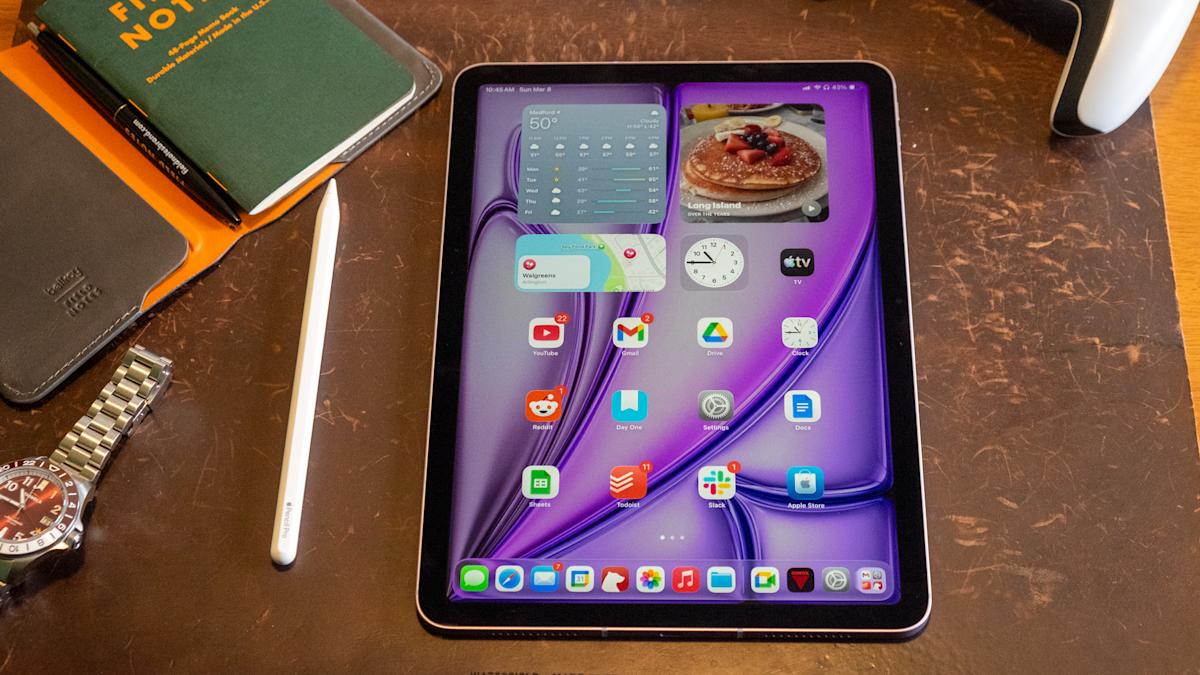
iPad Air M4 vs Competitors: Which Tablet Should You Choose?
Overview
Apple has released the iPad Air M4, its latest mid-range tablet featuring the same powerful M4 chip found in last year’s iPad Pro. While the design remains largely unchanged from the 2024 M2/M3 models, the upgrade brings 12GB of RAM (up from 8GB), improved GPU performance, and better support for demanding tasks like gaming and AI workloads. Priced starting at $599 for the 11-inch model and $799 for the 13-inch, the iPad Air M4 positions itself as Apple’s “best overall tablet” — more capable than the base iPad but significantly cheaper than the iPad Pro.
This review, based on Engadget’s hands-on testing, highlights that while the M4 delivers strong performance gains (especially in graphics), the lack of meaningful design or display upgrades makes the device feel like a mature, incremental refresh rather than a revolutionary one. It still lacks Face ID (reserved for models $1,000+), uses the same display technology introduced in 2020 for the 11-inch model, and can become expensive once you add the Apple Pencil Pro and Magic Keyboard.
To help buyers decide, we compare the iPad Air M4 against its main competitors: Apple’s own base iPad (A16), the iPad Pro M4/M5, and leading Android alternatives like the Samsung Galaxy Tab S10 series and Lenovo Tab Extreme. We’ll examine performance, display quality, accessories, software, pricing, and ideal use cases.
Feature Comparison Table
| Feature | iPad Air M4 (11") | Base iPad (A16) | iPad Pro M4/M5 (11") | Samsung Galaxy Tab S10+ | Lenovo Tab Extreme |
|---|---|---|---|---|---|
| Chip | M4 | A16 | M4/M5 | Snapdragon 8 Gen 3 | MediaTek Dimensity 9000 |
| RAM | 12GB | 6GB? | 8GB–16GB | 12GB–16GB | 12GB–16GB |
| Display | Liquid Retina (IPS) | Liquid Retina (IPS) | Tandem OLED (Ultra Retina XDR) | AMOLED, 120Hz | OLED, 120Hz |
| Face ID / Biometrics | Touch ID | Touch ID | Face ID | Fingerprint + Face Unlock | Fingerprint |
| Storage Options | 128GB–1TB+ | 128GB–512GB | 256GB–2TB | 256GB–1TB + microSD | 256GB–1TB + microSD |
| Starting Price | $599 | $349 | $999 | $999 | ~$850 |
| Max Refresh Rate | 60Hz | 60Hz | 120Hz ProMotion | 120Hz | 120Hz |
| Apple Pencil Support | Pencil Pro | 1st Gen | Pencil Pro | S Pen included | Stylus support |
| Keyboard Support | Magic Keyboard | Basic Smart Keyboard | Magic Keyboard | Book Cover Keyboard | Optional |
| Multitasking | iPadOS 26 (improved) | iPadOS 26 | iPadOS 26 | Android 14 + One UI | Android 14 |
| AI Performance | Strong Neural Engine | Basic | Best-in-class | Good | Moderate |
Note: Pricing and specs pulled from Apple announcements and recent reviews. Check latest official pricing/specs for Android models as they vary by region and configuration.
Detailed Analysis
Performance and Chip Power
The M4 chip gives the iPad Air a significant leap over the base iPad’s A16 processor. According to Apple, the M4 is up to 2.3x faster than the M1 Air and offers 30% better performance than the M3 model. Geekbench results from Engadget showed 23% higher single-core, 12% higher multi-core, and a massive 39% GPU improvement over the M3 Air. This makes the Air excellent for gaming (Resident Evil 2, Control) and future AI features in iPadOS.
In comparison, the base iPad remains adequate for media consumption, web browsing, and light productivity but struggles with intensive creative work or high-end gaming. The iPad Pro’s M4/M5 variants edge out the Air slightly in sustained workloads and have superior thermal design. Android rivals like the Galaxy Tab S10+ use Snapdragon 8 Gen 3, which delivers strong performance but generally trails Apple Silicon in optimized creative apps and battery efficiency for long sessions.
Display Quality
This is one of the iPad Air M4’s biggest caveats. It retains the same Liquid Retina IPS panel used since 2020 — sharp and bright enough for most tasks, but lacking the contrast, color accuracy, and 120Hz smoothness of the Pro’s Tandem OLED. Engadget notes that after six years, it’s time for a better screen on the Air.
Samsung’s Galaxy Tab S10+ and Lenovo’s OLED panels offer richer blacks, higher refresh rates, and more vibrant visuals, making them preferable for movie watching and digital art. The base iPad shares the same IPS limitations as the Air. For users who prioritize display quality, the Pro or high-end Android tablets are clearly superior.
Design, Biometrics, and Build
The iPad Air M4 maintains Apple’s premium aluminum build and slim profile. It supports the excellent Apple Pencil Pro and Magic Keyboard, turning it into a laptop replacement for many. However, it still uses Touch ID on the top button instead of Face ID, a feature locked to the Pro line.
Android competitors often include microSD card slots for expandable storage and more port options. Samsung’s DeX mode provides a desktop-like experience that some users prefer over iPadOS 26’s improved-but-still-limited multitasking.
Software and Longevity
iPadOS 26 brings meaningful multitasking improvements across Apple’s lineup, benefiting the Air M4 most due to its 12GB RAM. Apple’s ecosystem integration, long software support (typically 6–7 years), and optimized apps give it an edge for users already in the Apple world.
Android tablets have improved but still suffer from shorter update cycles on many models and fewer tablet-specific apps. Samsung offers strong One UI features and S Pen integration, making the Tab S10 series a solid alternative for Android loyalists.
Accessories and Expandability
The Air’s accessory ecosystem is a strength — Pencil Pro and Magic Keyboard are class-leading. However, as Engadget points out, the total cost rises quickly. A fully loaded 13-inch Air with keyboard and pencil easily exceeds $1,200, narrowing the price gap with the Pro.
Samsung includes the S Pen with many models, reducing extra costs. The base iPad’s accessory support is more limited and lower quality.
Pricing Comparison
- iPad Air M4: Starts at $599 (11") / $799 (13"). Excellent value until accessories are added.
- Base iPad: $349 — Best budget option for casual use.
- iPad Pro: Starts at $999 — Premium choice for professionals needing OLED and Face ID.
- Galaxy Tab S10+: Around $999 — Competitive with Pro but often goes on sale.
- Lenovo Tab Extreme: ~$850 — Good mid-to-high-end Android option with OLED.
The Air M4 offers the best balance of price and performance within Apple’s ecosystem, but buyers should calculate total ownership cost including accessories.
Use Case Recommendations
- Casual users, students, media consumption: Go with the base iPad to save money.
- Power users wanting Apple ecosystem + good performance without Pro price: iPad Air M4 is ideal, especially if upgrading from an M1 or older model.
- Professional creatives, photographers, filmmakers: Choose the iPad Pro for the superior display and Face ID.
- Android users or those wanting stylus included + expandable storage: Samsung Galaxy Tab S10+ or Lenovo Tab Extreme provide better value in the Android space.
- Gaming enthusiasts: The Air M4 or Pro deliver the smoothest experience thanks to Apple’s GPU optimizations.
Verdict
The iPad Air M4 remains Apple’s best overall tablet for most people — it delivers flagship-level performance at a more accessible price and benefits greatly from iPadOS 26’s multitasking upgrades. However, the stagnant display technology, lack of Face ID, and incremental design changes prevent it from feeling truly exciting in 2026.
If you already own a 2024 iPad Air, the upgrade may not be worth it unless you need the extra RAM and GPU power for AI or gaming. For new buyers, it strikes an excellent middle ground between the basic iPad and the expensive Pro, provided you value Apple’s software ecosystem and accessories over cutting-edge display tech.
Those prioritizing screen quality or lower cost should strongly consider the Samsung Galaxy Tab S10 series or even the base iPad. Ultimately, the iPad Air M4 is a safe, highly capable choice — just not a revolutionary one.
(Word count: 912)
Sources
- iPad Air M4 review: Apple's best overall tablet, with a few caveats
- Apple introduces the new iPad Air, powered by M4
- M4 iPad Air vs. Entry-Level iPad: Apple's Sneaky Upsell or Smart Upgrade?
- Apple just revealed the iPad Air M4
- M4 iPad Air: A Complete Overview
- Apple just announced a new iPad Air with M4 — here's what's changed