
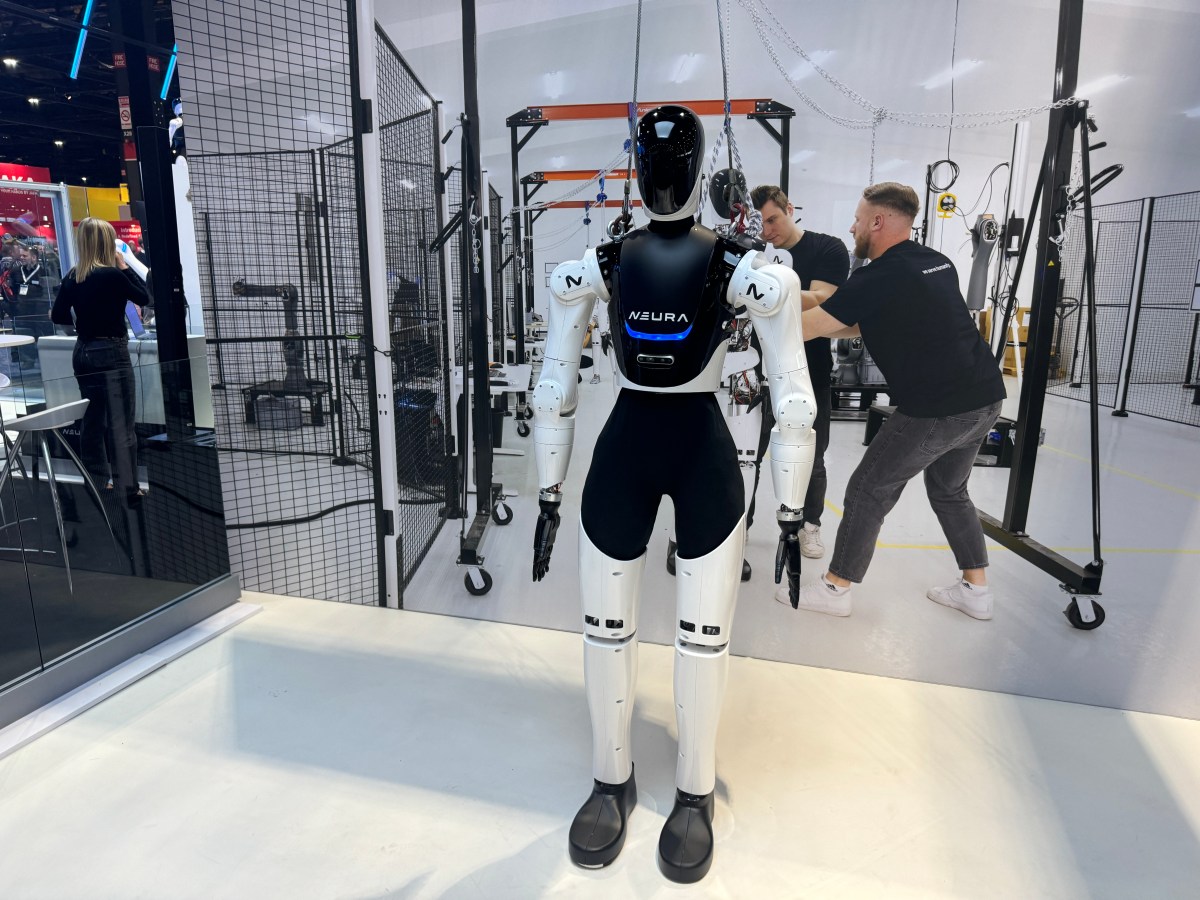
Qualcomm-Neura Robotics Partnership: A Technical Deep Dive
Executive Summary
Qualcomm and Neura Robotics announced a long-term strategic collaboration to co-develop the “brain and nervous system” for next-generation cognitive robots using Qualcomm’s Dragonwing Robotics IQ10 series processors as reference designs. Neura will integrate its Neuraverse simulation and training platform with the IQ10 SoCs to accelerate development of scalable, edge-native physical AI systems for both industrial and domestic humanoid and general-purpose robots. This partnership represents a classic hardware-software co-design play in the emerging physical AI sector, mirroring recent moves by Boston Dynamics + Google DeepMind and Nvidia’s expanding robotics ambitions. Key technical outcome: tighter integration between embodied AI software stacks and power-efficient, real-time edge AI silicon optimized for autonomous mobile robots (AMRs) and humanoids.
Technical Architecture
The collaboration centers on pairing Qualcomm’s Dragonwing Robotics IQ10 series — announced at CES 2026 — with Neura Robotics’ cognitive robotics software platform and Neuraverse simulation environment.
The IQ10 series is Qualcomm’s dedicated robotics processor family designed for the demanding compute, vision, and real-time control requirements of AMRs and full-size humanoids. While exact transistor counts and process node remain undisclosed in the announcement, the platform is built on Qualcomm’s proven edge AI heritage (derived from Snapdragon and previous robotics accelerators). It combines:
- Heterogeneous compute cores optimized for AI inference, classical robotics control, and sensor fusion.
- Dedicated neural processing units (NPUs) capable of running transformer-based vision and policy models at low latency on-device.
- Integrated connectivity (5G, Wi-Fi 7, and ultra-wideband) for fleet-level coordination.
- Hardware-level safety and real-time determinism features critical for human-robot interaction.
Neura’s contribution is its “embodied AI software stack” and the Neuraverse platform released in June 2025. Neuraverse functions as a high-fidelity robotic simulation and training environment that allows large-scale reinforcement learning, imitation learning, and sim-to-real transfer for policies running directly on the IQ10 reference designs. By using the actual target silicon as the reference during simulation, Neura can reduce the sim-to-real gap that has historically plagued robotics deployment.
The architecture follows a classic “brain + nervous system” model:
- Brain: Neura’s cognitive AI models (likely mixture-of-experts or hierarchical transformer policies) running on the IQ10’s NPU for high-level task planning, semantic understanding, and long-horizon reasoning.
- Nervous System: Low-level real-time control loops, proprioception, force-torque processing, and safety-critical reflexes handled by the IQ10’s real-time cores and dedicated accelerators, minimizing latency between perception and actuation.
This tight hardware-software co-design allows Neura to optimize model architectures specifically for the IQ10’s memory hierarchy, quantization formats, and on-chip interconnect — a significant advantage over running generic models on off-the-shelf silicon.
Performance Analysis
Specific benchmark numbers were not released in the March 2026 announcement. However, Qualcomm’s earlier CES 2026 robotics suite launch positioned the Dragonwing platform as a competitor to Nvidia’s Jetson Orin and Thor lines, Intel’s neuromorphic and Core Ultra offerings, and emerging dedicated robotics chips from startups.
Qualcomm’s traditional strengths in power efficiency suggest the IQ10 series targets a sweet spot for battery-powered humanoids and mobile manipulators: high TOPS per watt for vision-language-action (VLA) models while maintaining real-time control loops below 5–10 ms. The integration with Neuraverse implies Neura will publish comparative sim-to-real transfer metrics once initial robots are deployed, likely focusing on:
- End-to-end latency from perception to actuation
- Energy consumption per task (kWh per hour of operation)
- Success rate in zero-shot or few-shot sim-to-real transfer
- Scalability across heterogeneous robot fleets
Compared to Nvidia’s dominant position in physical AI training and inference (especially with Project GR00T and Isaac platforms), Qualcomm’s play is edge-first and cost-sensitive. While Nvidia excels at high-performance training clusters and high-TOPS inference on Thor, Qualcomm is optimizing for deployable, price-sensitive robots that must operate for extended periods without tethered power or cloud dependency — critical for both industrial AMRs and domestic use cases.
Technical Implications
This partnership accelerates several important trends in the physical AI ecosystem:
-
Hardware-Software Co-Design Becomes Table Stakes
Pure software robotics companies are discovering they need deep silicon partnerships to achieve the efficiency required for commercial viability. Neura gains early access to reference silicon and co-optimization opportunities; Qualcomm gains real-world robot workloads to further tune its architecture. -
Edge-Centric Physical AI
By emphasizing on-device intelligence with the IQ10, the collaboration pushes back against cloud-heavy architectures. This has major implications for latency, privacy, reliability in industrial settings, and deployment in homes where constant high-bandwidth cloud connectivity is unrealistic. -
Simulation-Driven Development
Neuraverse’s role as a training platform tightly coupled to specific silicon suggests a future where major robotics platforms ship with their own high-fidelity simulators (similar to Nvidia Isaac Sim). This could fragment the simulation landscape but dramatically improve time-to-deployment for each vendor’s ecosystem. -
Competitive Response
The deal puts pressure on Nvidia, AMD, Intel, and emerging players like Hailo, Groq (in robotics), and even Apple’s rumored robotics silicon efforts. Expect increased activity in “robotics silicon + embodied AI stack” bundles.
Limitations and Trade-offs
Several unknowns remain. The announcement provides no details on:
- Exact TOPS, power envelope, or memory bandwidth of the IQ10 series
- Whether Neura is exclusively committed to Qualcomm silicon or using it as one of several platforms
- The size and architecture of Neura’s foundation models (parameter count, training data scale, mixture-of-experts vs dense)
- Long-term licensing and IP arrangements
Power-performance trade-offs will be critical. Humanoids require both high-peak compute for vision and planning and ultra-low latency deterministic control. Balancing these on a single SoC is challenging; many competitors use heterogeneous multi-chip designs. Qualcomm’s ability to deliver competitive performance-per-watt while maintaining hard real-time guarantees will determine the partnership’s ultimate success.
Additionally, sim-to-real transfer success is still the biggest open problem in robotics. Even with silicon-specific simulation, the gap remains substantial for complex dexterous tasks.
Expert Perspective
This partnership is technically significant because it formalizes the maturing of the physical AI stack. The era of bolting generic AI accelerators onto existing robot platforms is ending. Successful commercial robots will require co-designed silicon, simulation, and policy architectures — exactly what Qualcomm and Neura are building.
For ML engineers and robotics developers, this signals that target-aware model optimization and hardware-in-the-loop training are becoming mainstream. Developers should expect future robotics platforms to ship with optimized inference runtimes, quantization recipes, and simulation environments tuned to specific silicon, similar to how mobile ML development coalesced around TensorFlow Lite and Qualcomm’s AI Stack.
The move also validates the “physical AI” narrative that Nvidia has heavily promoted. As more semiconductor giants enter the space, we will see a proliferation of specialized robotics processors, each with its own software ecosystem. This fragmentation may slow standardization but will accelerate innovation and cost reduction.
Technical FAQ
How does the IQ10 series compare to Nvidia’s Jetson Thor or Orin in robotics workloads?
Specific benchmarks were not disclosed. Qualcomm is expected to emphasize superior power efficiency and integrated connectivity for mobile and humanoid applications, while Nvidia currently leads in raw compute and ecosystem maturity with Isaac Sim and GR00T. Real-world deployment metrics will be the ultimate arbiter.
Will Neuraverse support other hardware platforms or is it Qualcomm-specific?
The announcement positions Neuraverse as the training and testing environment for robots running on Qualcomm IQ10 processors, but Neura has not publicly ruled out multi-platform support. Silicon-specific optimizations suggest deep integration with Dragonwing architecture.
What level of model optimization will be required to run Neura’s cognitive stack on the IQ10?
Expect heavy use of 4-bit and 8-bit quantization, pruning, distillation, and custom operators. The partnership will likely produce reference implementations and compiler tools that abstract some of this complexity for developers.
Is this a one-off deal or the start of broader industry consolidation?
The article and supporting releases explicitly frame this as “just the beginning.” Similar hardware-software robotics partnerships are expected to accelerate throughout 2026–2027 as more chipmakers compete for share in the physical AI market.
References
- Qualcomm & Neura Robotics Joint Announcement (March 2026)
- Qualcomm Dragonwing Robotics Technologies Launch (CES 2026)
- Neura Robotics Neuraverse Platform Release (June 2025)
- Boston Dynamics + Google DeepMind Partnership (January 2026)