
Headline:
ChatGPT Adds Interactive Visuals for Math and Science Learning
Key Facts
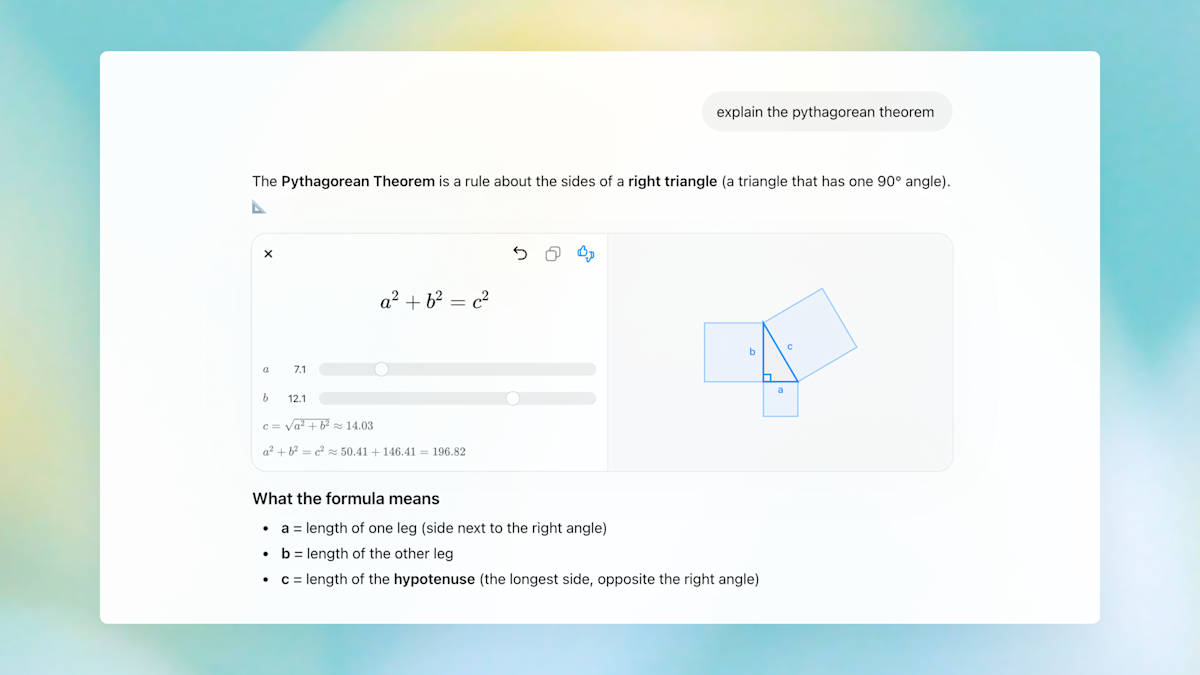
- What: ChatGPT now generates dynamic, interactive visuals for over 70 math and science concepts, letting users adjust variables and equations in real time.
- When: Rolling out starting today to all users.
- Availability: Free for every ChatGPT user regardless of subscription tier.
- Examples: Pythagorean theorem, Coulomb’s law, lens equations, and Ohm’s law.
- Context: Follows last summer’s launch of Study Mode, which guides students toward solutions rather than giving direct answers.
Lead paragraph
OpenAI has begun rolling out interactive visual responses in ChatGPT to help users better understand mathematical and scientific concepts. Starting today, when users ask the chatbot to explain topics such as the Pythagorean theorem, Coulomb’s law or lens equations, ChatGPT can respond with dynamic visuals that allow real-time manipulation of variables and equations. The new feature is available immediately to all ChatGPT users, free and paid alike, with more than 70 concepts supported at launch and additional topics planned for the future.
New Interactive Learning Tool
The update marks the latest step in OpenAI’s effort to make ChatGPT a more effective educational companion. According to the company, the interactive visuals are designed to give learners a hands-on way to explore how changes in variables affect outcomes, something static textbooks or simple diagrams cannot easily provide.
For instance, a student studying Ohm’s law can now see a visual representation of the relationship between voltage, current and resistance. By adjusting any of those values directly in the ChatGPT interface, the visual and calculated solution update instantly. The same interactivity applies to geometry problems involving the Pythagorean theorem, electrostatics problems governed by Coulomb’s law, and optics scenarios using lens equations.
OpenAI says high school and college students are expected to benefit most from the feature, though it is available to anyone using ChatGPT. The visuals appear automatically when the system determines they would help illustrate the requested concept.
Building on Study Mode
This release follows the introduction of Study Mode last summer. That feature was developed in response to widespread use of ChatGPT by students seeking to complete coursework. Instead of simply providing answers, Study Mode guides users through a step-by-step reasoning process to arrive at solutions themselves.
The new interactive visuals complement that approach by offering a different kind of engagement. While Study Mode emphasizes active problem-solving, the visuals focus on conceptual understanding through experimentation and immediate feedback.
"This is just the beginning," OpenAI stated in its announcement. "Over time, we plan to expand interactive learning with additional subjects and continue building tools that strengthen learning with ChatGPT."
Technical and Educational Context
The feature arrives at a time when AI tools are increasingly integrated into education. Many educators have expressed concern about students using generative AI to bypass learning, but OpenAI has positioned these updates as ways to enhance genuine understanding rather than replace it.
By making responses interactive, ChatGPT encourages users to test hypotheses and observe cause-and-effect relationships directly. This aligns with modern pedagogical approaches that emphasize active learning and visualization in STEM subjects.
The visuals are generated dynamically by the underlying models rather than pulled from a static library, allowing the system to tailor them to specific user queries. OpenAI has not disclosed technical details about how the interactive elements are created or which models power the feature, but the capability is now live across the ChatGPT platform.
Competitive Landscape and Industry Trends
OpenAI’s move reflects a broader industry push to make AI assistants more useful for education and complex reasoning. Competitors including Google, Anthropic and emerging education-focused AI startups have also introduced visualization and tutoring features in recent months.
However, OpenAI’s decision to make the interactive visuals available to all users — not just those on paid plans — sets it apart. This broad accessibility could accelerate adoption among students who cannot afford premium subscriptions.
The timing also follows the full release of the o1 reasoning model, which has shown stronger performance on math and science problems. While the interactive visuals appear to be a separate feature, they may benefit from the improved reasoning capabilities of newer models.
Impact on Students, Teachers and Developers
For students, the feature offers an on-demand interactive tutor that can illustrate difficult concepts without requiring additional software or specialized tools. Learners can experiment safely with mathematical and physical systems, potentially deepening their intuition in ways that traditional homework problems do not allow.
Teachers may find the tool useful for classroom demonstrations or as a resource students can use independently. The ability to modify variables in real time could support inquiry-based learning activities.
Developers building educational applications on top of the ChatGPT API may eventually gain access to similar visualization capabilities, though OpenAI has not yet announced API support for the interactive visuals.
Potential limitations include the current scope of only 70 concepts and the fact that complex or highly specialized topics may not yet be covered. OpenAI has indicated that support will expand over time.
What’s Next
OpenAI has signaled that today’s launch represents an early step in its interactive learning roadmap. The company plans to add more subjects and refine the tools based on user feedback.
Future updates could include support for additional branches of science and mathematics, more sophisticated three-dimensional visualizations, or integration with other ChatGPT features such as voice mode and image analysis.
As generative AI continues to evolve, tools like these interactive visuals may help address concerns about AI’s role in education by shifting the focus from providing answers to facilitating deeper conceptual understanding.
The feature is available now at chatgpt.com and in the ChatGPT mobile apps for all users.
Sources
- Engadget - ChatGPT will now generate interactive visuals to help you with math and science concepts
- OpenAI official announcement referenced in the Engadget report