
The short version
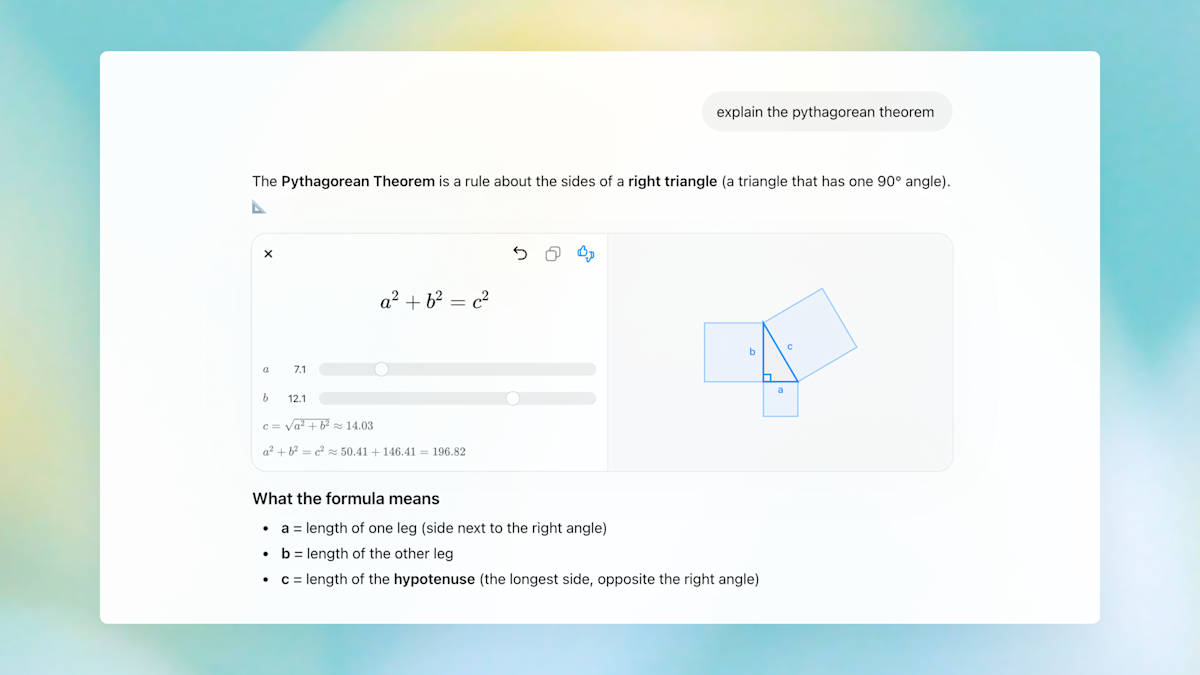
ChatGPT now creates interactive visuals to explain tough math and science ideas, like the Pythagorean theorem or how electricity works. You can tweak numbers and variables right in the visual to see changes happen live, making it easier to grasp concepts. This free update is rolling out to all users today and targets students, but anyone curious about science can benefit.
What happened
Imagine you're trying to understand why a right triangle's sides follow a specific rule—the Pythagorean theorem. Before, ChatGPT might just describe it in words or show a static picture. Now, it generates a live, interactive diagram where you can drag sliders to change the triangle's sides and watch the math update in real time. It's like having a hands-on science kit on your screen.
OpenAI, the company behind ChatGPT, announced this update today. When you ask about over 70 specific concepts—like Coulomb's law (how charged particles push or pull each other) or lens equations (how cameras focus light)—ChatGPT responds with these dynamic visuals. You can play with the variables yourself, seeing exactly how tweaking one thing ripples through the equation. No subscription needed; it's for free ChatGPT users too. They say high school and college kids will love it most, building on last summer's "Study Mode" that nudges you to solve problems step-by-step instead of spoon-feeding answers. OpenAI calls this "just the beginning," with more topics and subjects coming soon.
Think of it like video games for learning: instead of reading a dry textbook, you're experimenting in a sandbox where the rules of math and science come alive. No more staring at confusing formulas—now you see and touch the "why" behind them.
Why should you care?
Learning math and science often feels abstract and frustrating, like trying to picture a black box without opening it. This changes that by turning ChatGPT into a personal tutor with visual demos you control. For everyday people, it means quicker understanding of real-world stuff: Why does your phone battery drain faster in the cold? (That's Ohm's law in action.) How do eyeglasses bend light? These visuals make "aha!" moments faster, saving time and reducing homework headaches.
It's a big deal because AI is already everywhere in education—kids use it for homework, adults for DIY projects or career upskilling. This makes ChatGPT smarter at teaching, not just answering, so you're less likely to copy-paste wrong info. And since it's free and expanding, it democratizes tough subjects—no fancy apps or tutors required.
What changes for you
- Students and parents: Homework help just got visual. Ask ChatGPT to explain algebra or physics, tweak the demo, and actually get it. No more "I don't understand the picture"—you build it yourself.
- Lifelong learners: Curious about science on your phone? Cooking with measurements, fixing gadgets, or prepping for a job interview? Interactive visuals clarify without overwhelming.
- Teachers and hobbyists: Use it to demo concepts in class or projects. Upload nothing extra—it's built-in.
- Daily apps: Nothing disrupts your current ChatGPT flow. Just ask naturally, like "Show me Pythagorean theorem interactively," and it appears. Works on web or mobile, for all users.
- Future-proofing: More subjects soon means broader help—biology, chemistry? Stay tuned. Things might feel more intuitive, like having a science fair in your pocket.
No costs, no sign-ups beyond your existing ChatGPT account. If you're a free user, you get it now; paid users see no change but same access.
Frequently Asked Questions
Is this feature free for everyone?
Yes, interactive visuals are available to all ChatGPT users, free or paid. No upgrade needed—just start chatting about supported math or science topics.
What exactly can it explain?
Right now, over 70 concepts like the Pythagorean theorem (triangle math), Coulomb's law (electric charges), lens equations (optics), and Ohm's law (electricity flow). More topics are coming soon, expanding to other subjects.
How do I use it?
Type a question like "Explain the Pythagorean theorem with an interactive visual" in ChatGPT. It'll show a tweakable diagram—adjust sliders for sides or values and watch results change live. Works on chatgpt.com or the mobile app.
Is this just for students?
It's aimed at high school and college learners but helpful for anyone. Parents helping kids, adults learning for work or fun, or curious folks—all benefit from the hands-on visuals.
How is this different from regular ChatGPT answers?
Before, you'd get text or static images. Now, it's interactive: change variables and see instant effects, like a simulator. It builds on Study Mode by encouraging experimentation over quick answers.
The bottom line
ChatGPT's new interactive visuals turn abstract math and science into playable demos you control, making learning feel like a game instead of a chore. For regular people, this means easier homework, faster skill-building, and real-world insights without confusion—all free and starting today. If you've ever scratched your head over equations, fire up ChatGPT and try it; it's a game-changer for making smarts accessible. OpenAI's push shows AI evolving from chat buddy to true teacher—watch for even more tools ahead.