
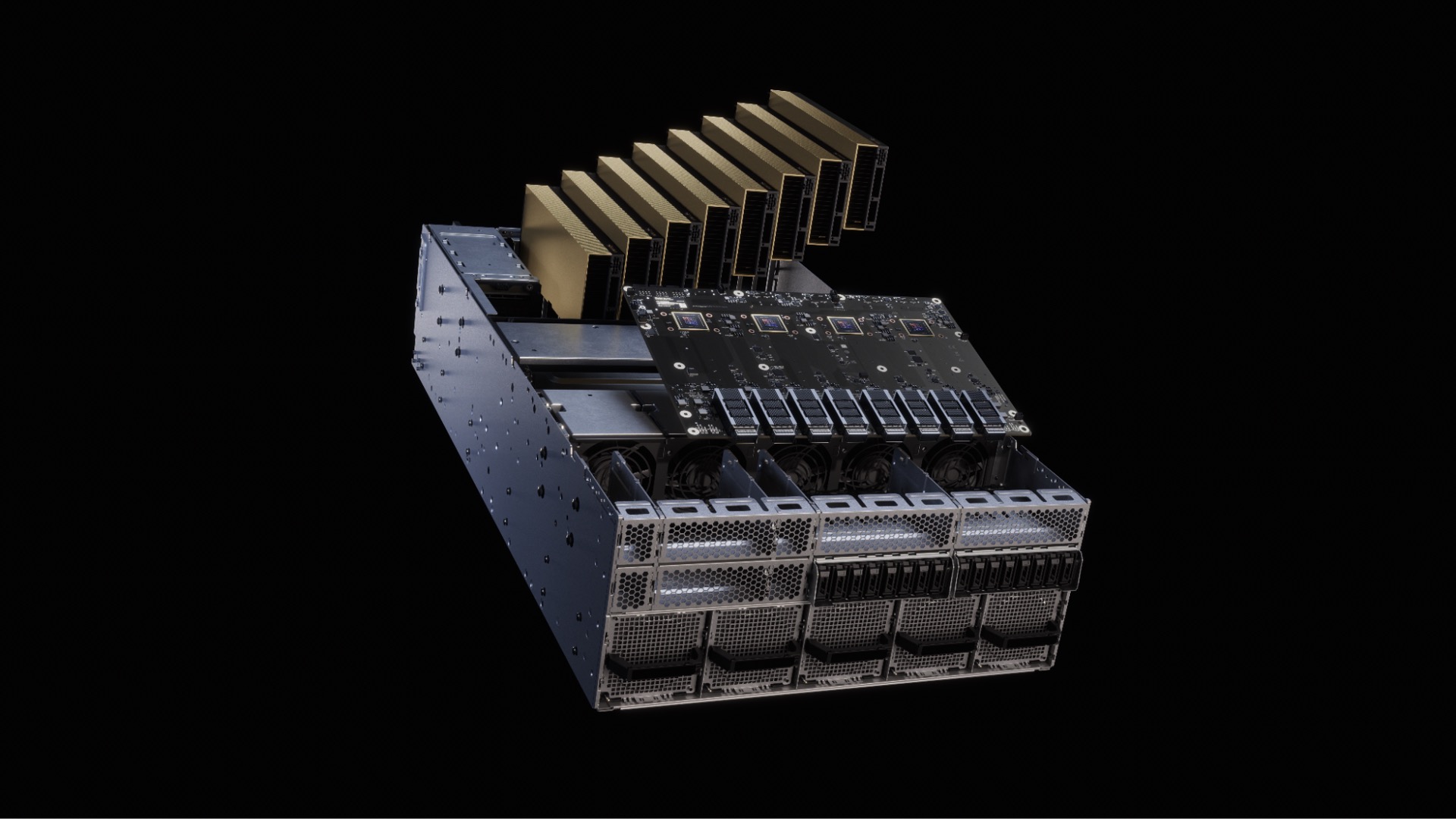
NVIDIA Virtualizes Game Development With RTX PRO Server
Key Facts
- What: NVIDIA launched the RTX PRO Server for virtualized game development, powered by RTX PRO 6000 Blackwell Server Edition GPUs with 96GB memory and NVIDIA vGPU software.
- When: Announced and showcased at Game Developers Conference (GDC) 2026 in San Francisco this week.
- How it works: Centralizes creative, engineering, AI research, and QA workflows on shared data center GPU infrastructure, replacing distributed workstation hardware.
- Key features: Supports up to 48 concurrent users per GPU via MIG + vGPU, enables dynamic day/night workload reallocation, and provides consistent Blackwell architecture matching GeForce RTX 50 Series GPUs.
- Benefits: Improves utilization, scalability, data security, collaboration across distributed teams, and eliminates hardware divergence issues.
Lead paragraph
NVIDIA is introducing a new virtualized approach to game development with the RTX PRO Server, aiming to help studios manage increasingly complex pipelines and distributed teams by centralizing GPU resources in the data center. Unveiled at the Game Developers Conference in San Francisco, the solution combines NVIDIA RTX PRO 6000 Blackwell Server Edition GPUs featuring 96GB of memory with NVIDIA vGPU software. This allows artists, developers, AI researchers, and QA teams to access responsive, workstation-class performance for 3D graphics and AI workloads from shared infrastructure, addressing underutilization, hardware inconsistency, and siloed AI systems common in modern game studios.
Centralizing Complex Game Development Workflows
Game development today involves larger worlds, more intricate production pipelines, and teams spread across locations and contractors. Despite this evolution, many studios continue to rely on fixed, desk-bound GPU workstations for critical tasks. According to NVIDIA's announcement, this leads to several inefficiencies: hardware sitting idle in one area while other teams wait for access, difficulty scaling QA capacity quickly, diverging workstation hardware/drivers/tools that complicate bug reproduction, and isolated AI infrastructure that adds operational overhead.
The RTX PRO Server enables studios to shift from scaling workstation-by-workstation to centralized GPU infrastructure. Resources can be pooled and allocated dynamically by workload, supporting parallel development, testing, and AI tasks without expanding physical hardware sprawl. A key operational advantage is the ability to run AI training, simulation, and game automation workloads overnight, then reallocate the same GPUs to interactive development during business hours. This improves overall utilization and reduces idle capacity.
The platform supports virtualized workflows across the entire game development lifecycle:
- Artists: Virtual RTX workstations for traditional 3D content creation and generative AI tools.
- Developers: Consistent, high-performance environments for coding and 3D development.
- AI researchers: Large-memory GPU profiles optimized for fine-tuning, inference, and AI agents.
- QA teams: Scalable game validation and performance testing on the same NVIDIA Blackwell architecture used in consumer GeForce RTX 50 Series GPUs.
By standardizing on one common GPU platform, studios can better support multi-site teams and external contractors while reducing debugging issues caused by hardware differences.
Supporting AI and Traditional Graphics on Shared Infrastructure
AI has become integral to game development, touching coding assistance, content generation, testing, and live operations. However, studios often struggle to integrate these emerging workloads without creating separate, siloed AI systems. The RTX PRO Server addresses this by allowing AI tasks such as coding agents, internal model experimentation, and AI-assisted production to run alongside traditional graphics work on the same infrastructure.
At the heart of the solution is the NVIDIA RTX PRO 6000 Blackwell Server Edition GPU. It features a massive 96GB memory buffer, enabling multiple demanding applications to run simultaneously while supporting AI inference on larger models directly alongside real-time graphics workflows. This unified approach reduces the need for dedicated AI clusters.
NVIDIA Multi-Instance GPU (MIG) technology further enhances efficiency by partitioning a single physical GPU into multiple isolated instances. Each instance receives dedicated memory, compute, and cache resources. When combined with NVIDIA vGPU software, this configuration allows a single RTX PRO 6000 Blackwell Server Edition GPU to support up to 48 concurrent users. The setup maintains performance isolation and security while maximizing hardware utilization.
Enterprise-Ready Deployment and Existing Adoption
NVIDIA designed the RTX PRO Server for seamless integration into enterprise data center operations. Studios can deploy virtual workstations through NVIDIA vGPU software on supported hypervisors and remote workstation platforms. This compatibility allows the solution to fit into existing IT practices rather than requiring specialized or one-off deployments.
The announcement notes that major game publishers already leverage NVIDIA vGPU technology to scale centralized development infrastructure and improve efficiency at studio scale. This existing adoption provides a foundation for broader implementation of the RTX PRO Server approach.
Additional context from NVIDIA's related announcements shows the RTX PRO Blackwell series represents a broader push into professional AI-driven workloads. The company has introduced new workstation and server GPUs alongside AI-powered tools, libraries, and software development kits. Cloud providers are also beginning to offer instances based on the RTX PRO 6000 Blackwell Server Edition, with Google Cloud introducing G4 VMs powered by the GPU.
Technical Advantages and Competitive Context
The RTX PRO Server builds on NVIDIA's leadership in both professional visualization and AI acceleration. By using the same Blackwell architecture found in GeForce RTX 50 Series consumer GPUs, the server solution ensures QA teams test on hardware representative of target player platforms. The 96GB memory capacity is particularly significant for AI researchers handling large models and for artists using memory-intensive generative AI tools.
MIG technology, originally developed for NVIDIA's data center AI workloads, now brings fine-grained resource partitioning to creative and game development environments. This capability allows studios to securely allocate portions of GPU capacity to different users and teams without performance interference.
In the competitive landscape, NVIDIA's virtual GPU technology has long been used in industries like architecture, engineering, and media & entertainment. The extension to game development comes as studios face growing pressure to integrate AI throughout their pipelines while controlling infrastructure costs. The ability to dynamically reallocate resources between AI training at night and interactive creative work during the day offers a compelling efficiency argument compared to maintaining separate workstation and AI clusters.
Impact on Developers, Studios, and the Industry
For game developers and artists, the RTX PRO Server promises greater consistency and accessibility. Team members can access high-performance virtual workstations from various locations without being tied to specific physical machines. This is particularly valuable for distributed teams and studios working with remote contractors.
QA teams benefit from scalable testing capacity that can expand more easily than physical hardware deployments. Because testing occurs on the same Blackwell architecture as consumer GPUs, results should more accurately reflect real-world performance and compatibility.
AI researchers gain access to large-memory GPU profiles without needing dedicated infrastructure, potentially accelerating experimentation and integration of AI tools into production workflows. The unified platform may reduce the operational friction that currently exists between creative teams and AI specialists.
From an industry perspective, the announcement signals NVIDIA's continued expansion of its professional GPU lineup into new workflows. The RTX PRO Server positions the company to serve the unique needs of game development studios that require both high-end interactive graphics performance and growing AI capabilities. As game scopes continue to increase and AI becomes more central to production, centralized virtualized infrastructure could become a competitive necessity for larger studios.
What's Next
NVIDIA is demonstrating these virtualized game development workflows live at its booth 1426 during GDC this week. The company also invites interested parties to explore the technology at NVIDIA GTC, scheduled for March 16-19 in San Jose, California.
Studios can learn more about the RTX PRO Server through NVIDIA's resources and evaluate how virtualized GPU infrastructure might fit into their existing pipelines. As cloud providers like Google Cloud begin offering VMs based on the RTX PRO 6000 Blackwell Server Edition, additional deployment options are expected to become available.
The solution represents part of NVIDIA's broader RTX PRO Blackwell series rollout, which includes new tools and microservices designed to accelerate AI development on professional hardware. Future updates may bring additional capabilities for multi-agent AI systems and further integration between creative tools and AI agents.
Game studios interested in transitioning to centralized infrastructure can begin planning deployments using existing NVIDIA vGPU-supported hypervisors and management practices. The combination of high memory capacity, resource partitioning through MIG, and dynamic workload allocation positions the RTX PRO Server as a comprehensive response to the evolving infrastructure challenges facing modern game development.
Sources
- NVIDIA Blog: Game Development Virtualized With RTX PRO Server
- NVIDIA RTX PRO Server Product Page
- NVIDIA GDC 2026 Event Page
- NVIDIA Newsroom: NVIDIA Blackwell RTX PRO for Workstations and Servers
- Google Cloud Blog: Introducing G4 VM with NVIDIA RTX PRO 6000
- NVIDIA Blog: Accelerating AI Development With NVIDIA RTX PRO Blackwell Series