
Meta Reveals Four Broadcom-Built Custom AI Chips, Claims Some Outperform Commercial Silicon
Key Facts
- What: Meta unveiled four new chips in its MTIA (Meta Training Inference Accelerator) series — MTIA 300, 400, 450, and 500 — developed in partnership with Broadcom for AI inference and recommendation workloads.
- Performance Claims: MTIA 400 offers raw performance competitive with leading commercial products; MTIA 450 and 500 claim performance “much higher” than existing leading commercial silicon through significantly increased HBM bandwidth.
- Timeline: MTIA 300 is already in production; MTIA 400 is on path to data center deployment; MTIA 450 and 500 scheduled for mass deployment in early 2027 and 2027 respectively.
- Scale: Broadcom states Meta will install “multiple gigawatts” of these chips in 2027 and beyond; Meta plans to release a new chip roughly every six months using a modular chiplet design.
- Design Approach: All chips use reusable modular chiplet architectures sharing the same chassis, rack, and network infrastructure.
Lead
Meta has disclosed details of four previously undisclosed custom AI chips developed in close partnership with Broadcom, with some of the new silicon claimed to outperform leading commercial AI accelerators on inference and recommendation tasks. The chips, part of the MTIA series, target the massive scale of Meta’s recommendation systems and generative AI workloads across its social platforms. According to Meta’s official post, the MTIA 300 is already in production while the more advanced MTIA 400, 450 and 500 are progressing toward deployment in 2026–2027 as the company prepares to install multiple gigawatts of custom silicon.
Technical Details of the Four Chips
Meta described the four chips in detail in its announcement, emphasizing a modular chiplet-based design that allows rapid iteration.
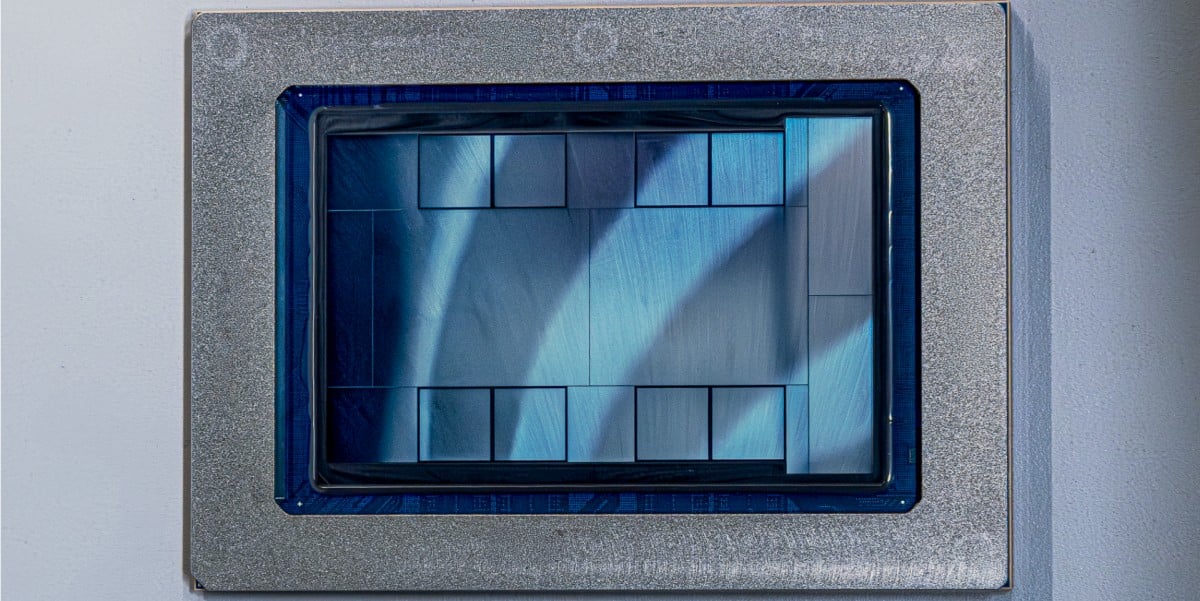
The MTIA 300 serves as a communications-focused chip optimized specifically for ranking and recommendation (R&R) workloads. It consists of one compute chiplet, two network chiplets, and several HBM (High Bandwidth Memory) stacks. Each compute chiplet contains a grid of processing elements (PEs), with redundant PEs included to improve manufacturing yield. Every PE integrates a pair of RISC-V vector cores. This chip is already in production.
The MTIA 400 represents an evolution of the 300, adding support for generative AI models alongside continued R&R capabilities. It employs two compute chiplets and is described by Meta as the first in the series with “raw performance competitive with leading commercial products.” A single rack containing 72 MTIA 400 devices, connected via a switched backplane, forms one scale-up domain. Meta stated that testing has concluded and the chip is “on the path to deploying it in our data centers.”
The MTIA 450 introduces specific optimizations for GenAI inference. According to Meta, it doubles the HBM bandwidth compared to the MTIA 400, resulting in performance that is “much higher than that of existing leading commercial products.” Mass deployment is scheduled for early 2027.
The MTIA 500 further increases efficiency for GenAI inference. It boosts HBM bandwidth by an additional 50 percent over the MTIA 450. The design uses a 2x2 configuration of smaller compute chiplets surrounded by several HBM stacks, along with two network chiplets and an SoC chiplet that provides PCIe connectivity to the host CPU and scale-out NICs. Mass deployment is planned for 2027.
Meta also published specifications for the chips, though detailed numerical benchmarks against specific competitors such as Nvidia’s H100 or H200 were not disclosed in the announcement.
Modular Design Enables Rapid Iteration
A key theme in Meta’s announcement is design velocity. The company stated it now has the capacity to ship a new chip “roughly every six months.” This speed is achieved through “a reusable and modular design across all levels: chiplets, chassis, racks, and network infrastructure.” Importantly, the MTIA 400, 450, and 500 all utilize the same chassis, rack, and network infrastructure, reducing deployment complexity and cost at massive scale.
Broadcom has publicly confirmed that Meta will install “multiple gigawatts” of its custom chips in 2027 and beyond. This aligns with Meta’s aggressive capital expenditure plans, with the company projecting $115–$135 billion in capex for 2026 according to reports covering the announcement.
The partnership with Broadcom and TSMC gives Meta greater control over its silicon supply chain. As one Meta executive noted in related coverage, the custom approach “provides us with more diversity in terms of silicon supply, and insulates us from price changes to some extent.”
Competitive Context and Industry Trend
Meta’s aggressive push into custom silicon reflects a broader industry shift among hyperscalers seeking to reduce dependence on commercial AI accelerators, particularly Nvidia’s dominant GPUs. By designing chips tailored specifically to its recommendation systems and generative AI inference workloads, Meta aims to achieve better performance-per-dollar and performance-per-watt at the extreme scale of its data centers.
The announcement positions Meta alongside other major tech companies developing custom AI silicon, including Google’s TPUs, Amazon’s Trainium and Inferentia chips, and Microsoft’s Maia accelerators. Unlike some competitors, Meta’s MTIA series focuses heavily on inference rather than training, reflecting the fact that the majority of its AI compute demand comes from serving recommendations and content to billions of users.
The chips’ use of RISC-V vector cores in the processing elements is notable, signaling Meta’s willingness to move away from traditional x86 or Arm architectures in specialized accelerators.
Impact on Developers, Users, and the Industry
For Meta, successful deployment of these chips at gigawatt scale could significantly lower the cost of running its AI-powered features across Facebook, Instagram, WhatsApp, and Threads. This includes both traditional ranking and recommendation systems that drive engagement as well as newer generative AI capabilities.
The modular design approach may allow Meta to iterate faster than competitors locked into longer semiconductor development cycles. By reusing chassis, racks, and networking infrastructure across multiple chip generations, the company can reduce the operational overhead of introducing new silicon generations.
For the broader AI chip market, Meta’s claims that its newer MTIA chips outperform “leading commercial products” — widely understood to include Nvidia’s offerings — represent a challenge to the current dominance of general-purpose AI GPUs. However, without independent third-party benchmarks, these performance claims remain unverified by external sources.
The announcement also highlights the growing importance of memory bandwidth for modern AI inference. Both the MTIA 450 and 500 emphasize substantial increases in HBM bandwidth, suggesting that memory access is becoming a primary bottleneck for the types of models Meta runs in production.
What’s Next
Meta has signaled that the current four chips are only the beginning of a sustained effort in custom silicon. With a new chip planned roughly every six months, the company is building internal expertise and infrastructure that could lead to even more specialized accelerators in coming years.
Mass deployment of the MTIA 450 is expected in early 2027, with the MTIA 500 following later that year. Broadcom’s statement about “multiple gigawatts” of capacity suggests these chips will be deployed at a scale rarely seen outside the largest hyperscalers.
The company’s focus remains on inference and recommendation workloads rather than large-scale training, though future generations may expand capabilities. Meta has not yet disclosed whether these chips will be made available to third parties or remain strictly for internal use.
Sources
- The Register - Meta reveals four Broadcom-built custom AI chips
- WIRED - Meta Is Developing 4 New Chips to Power Its AI and Recommendation Systems
- Interesting Engineering - Meta debuts new AI silicon to power platform recommendations
- CoinCentral - Meta Stock: Company Reveals Custom AI Chip Plans as Data Center Expansion Accelerates
- Investing.com - Meta unveils four custom AI chips for data center growth