
Meta Reveals Four Custom MTIA AI Chips, Claims Performance Edge Over Commercial Silicon
Key Facts
- What: Meta unveiled four new chips in its Meta Training Inference Accelerator (MTIA) series: MTIA 300, 400, 450, and 500.
- Partnership: Chips developed in close partnership with Broadcom.
- Timeline: MTIA 300 already in production; MTIA 400 on path to data center deployment; MTIA 450 and 500 scheduled for mass deployment in early 2027 and 2027 respectively.
- Scale: Broadcom has stated Meta will install “multiple gigawatts” of these chips in 2027 and beyond.
- Design Approach: Meta says it can now ship a new chip roughly every six months using a reusable, modular chiplet-based architecture that shares chassis, rack, and network infrastructure across models.
Lead paragraph
Meta has disclosed details of four previously unknown custom AI chips designed to power its vast recommendation and generative AI workloads, claiming several now outperform leading commercial silicon. The chips, part of the Meta Training Inference Accelerator (MTIA) family, were developed in close partnership with Broadcom and are already entering production as the social media giant prepares to deploy them at massive scale. According to Meta, the move is part of an accelerated silicon development cadence that allows the company to release a new chip approximately every six months.
Technical Specifications and Chip Breakdown
Meta’s blog post provides detailed descriptions of each chip in the MTIA series, highlighting a clear evolutionary path from recommendation-focused silicon to optimized generative AI inference accelerators.
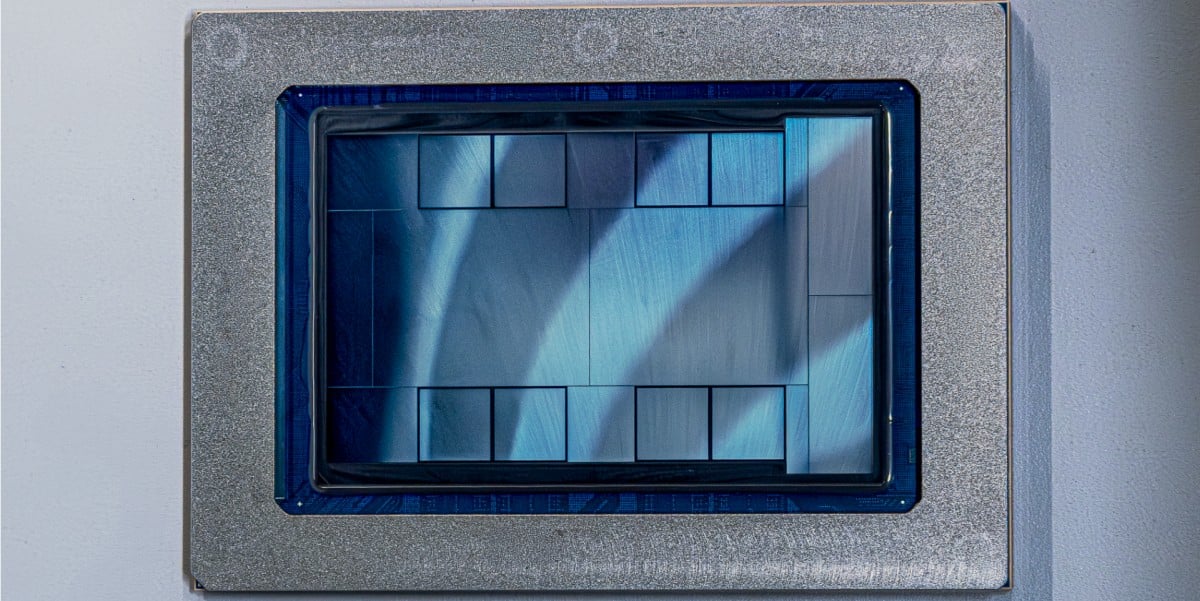
The MTIA 300 is a communications chip optimized specifically for ranking and recommendation (R&R) workloads. It consists of one compute chiplet, two network chiplets, and several HBM (high-bandwidth memory) stacks. Each compute chiplet contains a grid of processing elements (PEs), with some redundant PEs included to improve manufacturing yield. Every PE includes a pair of RISC-V vector cores. This chip is already in production, according to Meta.
The MTIA 400 represents a significant evolution. It supports both generative AI models and traditional R&R workloads. Meta describes it as the first in its custom lineup to deliver “raw performance competitive with leading commercial products.” The design uses two compute chiplets instead of one. A single rack containing 72 MTIA 400 devices, connected via a switched backplane, forms one large scale-up domain. Meta states that testing has concluded and the chip is “on the path to deploying it in our data centers.”
The MTIA 450 focuses on generative AI inference with substantial memory bandwidth improvements. It doubles the HBM bandwidth compared to the MTIA 400, which Meta claims results in performance that is “much higher than that of existing leading commercial products.” Mass deployment is scheduled for early 2027.
The MTIA 500 further increases efficiency for GenAI inference. It boosts HBM bandwidth by an additional 50 percent over the MTIA 450. The design adopts a 2x2 configuration of smaller compute chiplets surrounded by several HBM stacks, plus two network chiplets and an SoC chiplet that provides PCIe connectivity to the host CPU and scale-out NICs. Mass deployment is planned for 2027.
Meta also published specifications for the chips, though detailed numerical benchmarks were not included in the announcement beyond the qualitative performance claims.
Accelerated Development Cadence
A notable aspect of Meta’s announcement is the company’s assertion that it has built the internal capability to ship a new chip “roughly every six months.” The blog post states: “We achieve high velocity through a reusable and modular design across all levels: chiplets, chassis, racks, and network infrastructure.” Importantly, the MTIA 400, 450, and 500 all utilize the same chassis, rack, and network infrastructure, which should simplify deployment at scale.
Broadcom, Meta’s close partner on these designs, has publicly stated that Meta will install “multiple gigawatts” of its chips in 2027 and beyond. This signals the enormous power scale at which Meta intends to operate these custom accelerators inside its data centers.
Competitive Context and Industry Trends
Meta’s aggressive custom silicon push comes as major cloud and social media companies increasingly design their own AI chips to reduce dependence on Nvidia, AMD, and other commercial vendors. The announcement arrives weeks after Meta signed massive deals with both Nvidia and AMD, illustrating a hybrid strategy of buying commercial GPUs while rapidly expanding its in-house accelerator fleet.
The MTIA series builds on Meta’s earlier custom silicon efforts. The company first signaled its intention to roll out more custom inferencing chips in 2024. Industry observers note that Meta’s claimed six-month chip development cadence is unusually rapid compared to the typical one-to-two-year industry development cycle for complex AI accelerators.
The chips target two primary workloads that dominate Meta’s infrastructure: the massive ranking and recommendation systems that power its social feeds, and the rapidly growing generative AI inference demands of models like Llama.
Impact on Developers, Users, and the Industry
For Meta, successful deployment of these chips at gigawatt scale could significantly reduce the cost of running its AI services and lessen reliance on third-party silicon vendors. Lower inference costs could allow the company to offer more advanced AI features across its family of apps — Facebook, Instagram, WhatsApp, and Threads — without proportional increases in infrastructure spending.
The broader industry impact is significant. Meta’s progress adds to the growing list of hyperscalers (including Google, Amazon, Microsoft, and now Meta) developing competitive AI silicon. This trend puts pressure on traditional semiconductor companies to continue innovating while simultaneously creating new partnership opportunities, as evidenced by Broadcom’s deep collaboration with Meta.
The reusable modular design approach Meta highlights could become an important model for other companies seeking to accelerate their own silicon roadmaps without reinventing infrastructure for every new chip generation.
What’s Next
Meta plans to continue its rapid development pace. With MTIA 300 already in production and MTIA 400 heading to data centers, the company expects MTIA 450 to reach mass deployment in early 2027, followed by the MTIA 500 later that year.
Broadcom’s statement about “multiple gigawatts” of deployment in 2027 and beyond suggests Meta is preparing for an enormous build-out of AI infrastructure. The company has not disclosed exact performance numbers, power consumption figures, or pricing details for the chips themselves, as they are for internal use.
The announcement reinforces Meta’s commitment to building a diverse AI infrastructure stack that combines commercial GPUs with highly optimized custom silicon tailored to its specific workloads.
Note on Separate Oversight Board Criticism
The same week as the chip announcement, Meta’s Oversight Board issued a report criticizing the company’s handling of AI-generated content during conflicts. The Board highlighted deficiencies in how Meta flags misleading AI-generated material, particularly during the 2025 Israel-Iran conflict. This criticism is separate from the silicon announcement but underscores ongoing challenges Meta faces in managing AI-generated content on its platforms. Meta ended its third-party fact-checking program last year in favor of user-led reporting.
Sources
- The Register - Meta reveals four custom AI chips
- WIRED - Meta Is Developing 4 New Chips to Power Its AI and Recommendation Systems
- CNBC - Meta rolls out in-house AI chips weeks after massive Nvidia, AMD deals
- Wccftech - Meta 'Sprays Out' Four MTIA AI Chips in Two Years
- Investing.com - Meta unveils four custom AI chips for data center growth