
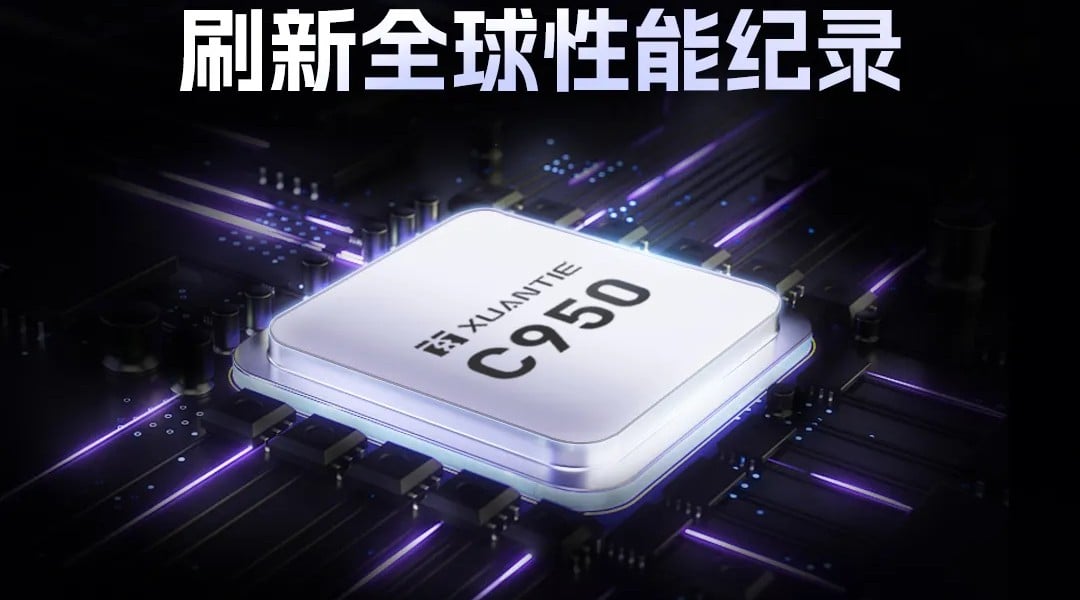
- What: Alibaba's DAMO Academy unveiled the XuanTie C950, a high-performance RISC-V server processor.
- Technical Specs: Manufactured on a 5nm process, featuring a dedicated Tensor Processing Engine (TPE) delivering 8 TOPS.
- AI Optimization: Native support for large language models (LLMs) including Qwen3 and DeepSeek V3.
- Performance: Claims a single-core SPECint 2006 benchmark score exceeding 70 points, comparable to 2020-era Western silicon.
Alibaba has officially revealed the XuanTie C950, a next-generation server chip that the company claims is the most powerful processor ever built using the RISC-V instruction set architecture. Announced by Alibaba’s DAMO Academy at its annual ecosystem conference in Shanghai, the chip is specifically designed to power "agentic AI" and cloud-based generative AI workloads.
The launch represents a significant milestone in China’s efforts to achieve semiconductor self-sufficiency by leveraging the open-standard RISC-V architecture. By optimizing the hardware specifically for its own Qwen3 models and the popular DeepSeek V3, Alibaba aims to bridge the performance gap between domestic hardware and Western-designed AI accelerators.
Technical Specifications and AI Acceleration
The XuanTie C950 is built on a 5nm process, a sophisticated manufacturing node that pushes the current limits of domestic Chinese fabrication capabilities. While Alibaba did not explicitly name the foundry, industry analysts note that 5nm production remains a challenge for large-scale domestic volume.
At the heart of the C950 is the XuanTie Tensor Processing Engine (TPE). According to Alibaba’s technical documentation, each TPE can achieve 8 TOPS (Tera Operations Per Second) and supports a wide array of data formats essential for modern AI. These include FP16, INT4, and FP8, as well as emerging micro-scaling formats like MXFP8, MXFP4, and RVFP4. This flexibility allows the chip to natively support large models with hundreds of billions of parameters.
The chip’s architecture utilizes the RISC-V RVA 23.1 profile, a minor update proposed in August 2025. Technical analysis by researchers, including Google’s Laurie Kirk, noted that Alibaba’s implementation of this recent standard was surprisingly rapid. The memory subsystem features a high-performance multi-level cache hierarchy with a 4-cycle load-to-use L1 data cache latency. Furthermore, the XL-300 interconnect allows the processor to form clusters of up to eight cores in a multi-processor configuration.
Performance Benchmarks and Competitive Landscape
Alibaba claims the XuanTie C950 has set new records for RISC-V performance. The company reported a single-core general-purpose performance score exceeding 70 points in the SPECint 2006 benchmark. Independent analysis of the Tuesday event suggests the chip operates at clock speeds between 2.6GHz and 3.2GHz.
While these figures represent a breakthrough for RISC-V, they also highlight the remaining distance between Chinese domestic silicon and leading Western processors. Research suggests the C950’s performance is roughly on par with Apple’s M1 chip, which was released in late 2020.
Alibaba CEO Yongming Wu addressed this disparity during the launch, acknowledging that Chinese chips currently lag behind those from Western competitors. He argued that Alibaba’s competitive edge lies in the "co-design" of hardware and software.
"Our response is to engage in more profound co-design with Alibaba's cloud infrastructure and the Qwen model to provide improved cost effectiveness," Wu stated. "This is one key differentiator… that sets us apart from other chip companies."
Impact on the AI Industry and Developers
The introduction of the XuanTie C950 is a strategic bet on "Agentic AI"—AI systems capable of performing autonomous tasks rather than just generating text. For developers, the C950 offers a specialized environment for running Alibaba’s Qwen3 and DeepSeek V3 models with higher efficiency than general-purpose CPUs.
For the broader industry, the C950 demonstrates that RISC-V is maturing into a viable architecture for high-end server and AI applications. As Western export restrictions on high-end GPUs and x86/ARM technology continue to tighten, RISC-V provides a royalty-free, open-standard alternative that is harder to restrict via international sanctions.
"This chip represents the first time a RISC-V processor has natively supported large models with hundreds of billions of parameters," according to DAMO Academy’s social media announcement. This capability could significantly lower the cost of deploying sophisticated AI agents within the Alibaba Cloud ecosystem.
What’s Next for the XuanTie Series
Alibaba intends to integrate the XuanTie C950 into its cloud data centers to satisfy the surging demand for AI computing power. However, the company faces immediate hurdles regarding production volume. While the 5nm design is a technical feat, the ability of Chinese foundries to produce these chips in the millions remains unverified.
In the near term, the C950 will likely serve as a specialized accelerator within Alibaba’s infrastructure, primarily supporting its internal LLM development and external cloud customers. As the RISC-V ecosystem continues to expand, Alibaba is positioning the XuanTie series to move beyond edge computing and into the heart of the global AI server market.