
- What: Granola secured $125 million in Series C funding to expand from a meeting notetaker to an enterprise AI platform.
- Valuation: $1.5 billion, a sixfold increase from its previous $250 million valuation.
- Key Investors: Led by Index Ventures, with participation from Kleiner Perkins, Lightspeed, Spark, and NFDG.
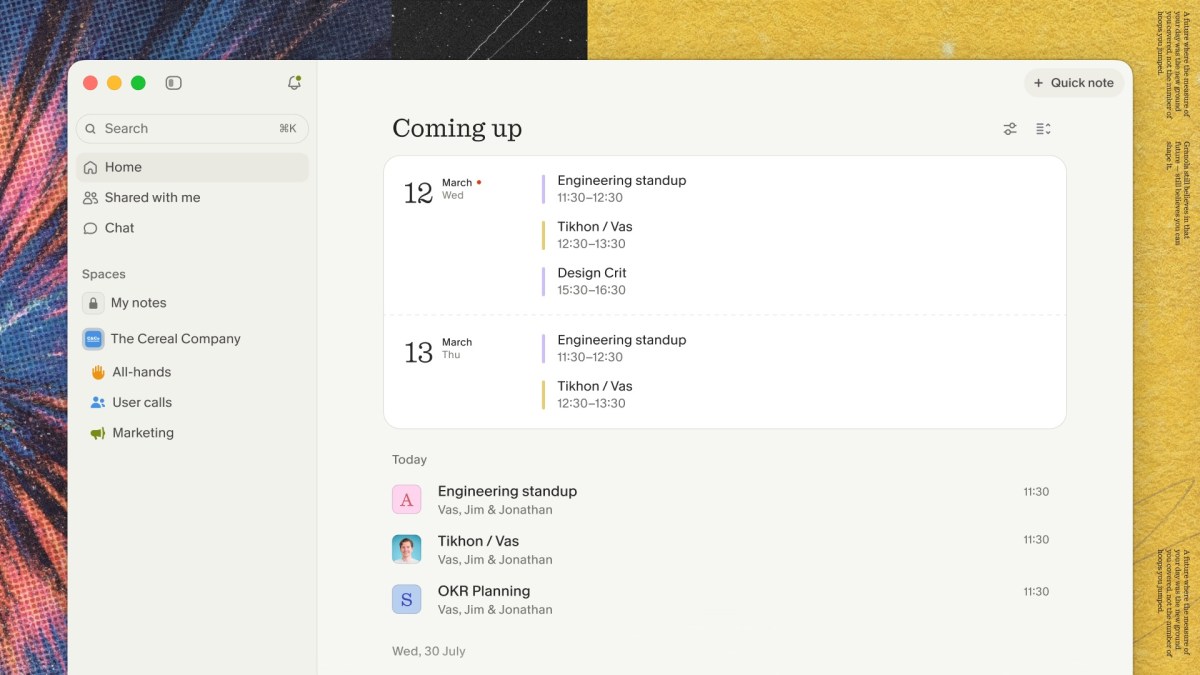
- New Features: Launch of "Spaces" for team collaboration and new APIs for AI workflow integration.
- Enterprise Footprint: New clients include Mistral AI, Asana, Vanta, and Gusto.
Granola, the AI-powered notepad that built a loyal following by eschewing intrusive meeting bots, has raised $125 million in a Series C funding round led by Index Ventures. The investment vaults the startup to a $1.5 billion valuation, signaling a major strategic shift from a prosumer utility to a core piece of the enterprise AI stack. The funding arrives less than a year after a $43 million round, bringing the company’s total capital raised to $192 million.
From Notetaker to Enterprise Hub
The funding round, led by Danny Rimer at Index Ventures with participation from Mamoon Hamid at Kleiner Perkins, underscores the rapid ascent of Granola in a crowded productivity market. Unlike traditional AI meeting assistants that join calls as visible participants, Granola operates locally on a user’s computer, transcribing system audio and generating notes without the friction of a "bot" presence.
This "invisible" approach has proven highly effective for adoption within high-stakes corporate environments. According to the company, it has successfully transitioned from a personal productivity app to an enterprise solution, securing a roster of high-profile clients that includes Mistral AI, Asana, Vanta, Gusto, Thumbtack, Cursor, Lovable, and Decagon.
Existing investors, including Lightspeed, Spark, and NFDG, also participated in the round, demonstrating continued confidence in Granola’s ability to compete with both established players and emerging AI startups.
Introducing Spaces and Granular Workspaces
To support its enterprise expansion, Granola is launching "Spaces," a dedicated workspace environment designed for team collaboration. This feature allows users to organize meeting intelligence into specific Folders with granular access controls, ensuring that sensitive information remains restricted to authorized personnel.
Within these Spaces, teams can query their collective meeting history. Instead of searching through individual transcripts, users can ask questions across entire folders or workspaces to extract themes, decisions, or action items. This move is intended to transform Granola from a passive archive of past conversations into an active knowledge base for organizations.
Navigating the API and Data Controversy
The fundraising announcement follows a period of friction with Granola's power-user community. Earlier this year, several users—including a partner at Andreessen Horowitz (a16z)—expressed frustration after Granola locked down its local database, which inadvertently broke custom on-device AI agent workflows that users had built on top of the app's data.
Granola co-founder Chris Pedregal clarified that the move was not an intentional "lock-in" strategy but a necessary technical change. He explained that the app's local cache was never designed to support heavy AI workflows, leading the startup to re-architect its data storage.
To address these concerns and formalize third-party access, Granola is introducing two new APIs:
- Personal API: Available to users on Business and Enterprise plans, allowing individuals to access their own notes and those shared with them.
- Enterprise API: Reserved for Enterprise-tier users, providing administrators with the ability to programmatically manage and integrate team-wide context.
Additionally, Granola is updating its Model Context Protocol (MCP) server, originally introduced in February. The update allows users to view shared notes and folders directly through the protocol, further bridging the gap between meeting data and external AI tools.
The Push for Actionable AI
Granola acknowledges that AI meeting summaries have become a "commodity" as competitors like Read AI, Fireflies, and Quill offer similar transcription features. To differentiate itself, Granola is focusing on the "post-meeting" phase—enabling users to take immediate action based on transcripts.
The startup’s app already integrates with a wide range of AI and development tools, including Claude, ChatGPT, Lovable, Figma Make, Replit, Manus, v0, Bolt.new, Duckbill, and Dreamer. By connecting meeting context to these platforms, Granola aims to automate tasks such as drafting follow-up emails, scheduling subsequent meetings, and syncing insights with company CRMs or databases to accelerate sales leads.
Impact on the Industry
For developers and enterprise leaders, Granola's $1.5 billion valuation represents a bet that the most valuable AI tools will be those that integrate seamlessly into existing workflows without disrupting the social dynamics of a meeting.
"This changes how developers will interact with meeting data," as the launch of formal APIs marks the transition from closed data silos to extensible platforms. By moving the processing to the edge (on the user's device) while providing cloud-based enterprise controls, Granola is carving out a middle ground between privacy-focused local apps and collaborative SaaS platforms.
What’s Next
Granola’s roadmap involves deeper integration into the enterprise stack. The company has stated its intention to move beyond simple note-taking to uncover "team-wide conversation insights" and automate complex post-meeting workflows.
As the company scales its engineering and product teams with the new $125 million infusion, the focus will remain on expanding its partner ecosystem and refining its MCP server to ensure meeting context can be utilized by the next generation of AI agents and autonomous tools.