
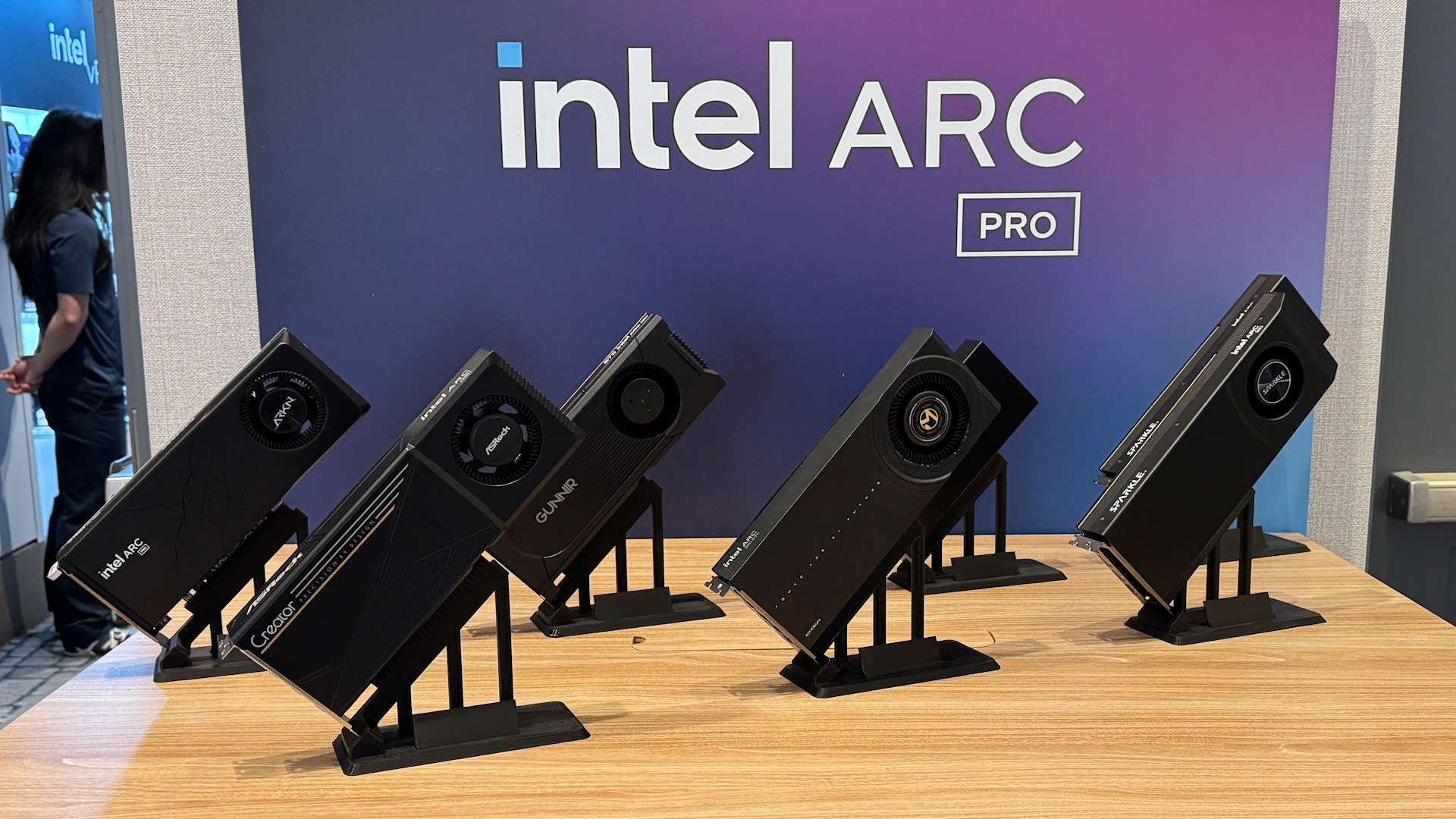
- What: Intel released the Arc Pro B70 and Arc Pro B65 "Big Battlemage" workstation GPUs.
- Key Feature: Both models feature 32GB of GDDR6 memory, optimized for AI inference and professional workloads.
- Pricing: The flagship Arc Pro B70 starts at $949, significantly undercutting competitors from Nvidia and AMD.
- Availability: Partner cards for the B70 are launching now; the B65 is scheduled for availability in mid-April.
Intel has officially unveiled its long-anticipated "Big Battlemage" GPU architecture, but in a strategic shift, the high-end silicon is debuting for workstations and local AI inference rather than gaming. The new Arc Pro B70 and B65 cards offer 32GB of memory capacities designed to handle Large Language Models (LLMs) and professional creative applications at a price point that aggressively challenges Nvidia’s dominance in the entry-to-mid-tier professional market.
The Specs: 32GB VRAM Takes Center Stage
The centerpiece of the announcement is the Arc Pro B70, which utilizes 32 Xe Cores running at a rated clock speed of 2800 MHz. This configuration delivers a theoretical 22.9 TFLOPS of FP32 compute performance. To support memory-intensive AI tasks, Intel has equipped the card with 32GB of 19 Gbps GDDR6 memory on a 256-bit bus, providing 608 GB/s of bandwidth.
According to Intel, the B70 is designed with a flexible power envelope ranging from 160W to 290W. This wide range allows hardware partners to adapt the card for various form factors, from slim workstations to high-performance towers.
The Arc Pro B65, meanwhile, presents a unique value proposition for AI enthusiasts. While it drops the compute capacity to 20 Xe Cores (matching the existing B60), it retains the massive 32GB memory buffer and 608 GB/s bandwidth of its larger sibling. This suggests the B65 is specifically targeted at users who need high VRAM capacity for fitting large AI models but do not require the raw processing horsepower of the B70.
Challenging Nvidia and AMD on Price-to-Performance
Intel is positioning the $949 Arc Pro B70 as a direct disruptor to Nvidia’s workstation lineup. Specifically, Intel benchmarks the B70 against Nvidia’s RTX Pro 4000 (Blackwell), which retails for approximately $1,800. At nearly half the price, Intel claims the B70 offers superior "cost-per-token" for AI inference.
In performance comparisons, Intel highlighted the B70’s advantages in handling larger context windows and achieving lower time-to-first-token latency when serving multiple concurrent users. However, it is important to note that Intel’s benchmarks primarily used BF16 (Bfloat16) quantizations. While this highlights accuracy, it may sidestep some of the performance advantages Nvidia’s Blackwell architecture gains through lower-precision formats like NVFP4.
The Arc Pro B70 also undercuts AMD’s professional offerings. AMD’s Radeon AI Pro R9700, which also offers 32GB of VRAM, currently retails for approximately $1,299, making Intel’s new flagship the most affordable path to 32GB of local AI memory on the market today.
Technical Capabilities and Software Integration
The "Battlemage" architecture includes XMX (Xe Matrix eXtensions) acceleration, which Intel says supports FP16 and INT8 data types. This is critical for accelerating the matrix multiplication at the heart of modern AI workloads.
Intel also emphasized the scalability of its software stack. The Arc Pro cards support multi-GPU configurations, allowing developers to pool memory across up to four GPUs to handle massive LLMs or exceptionally large context windows.
Key technical specifications for the Arc Pro B70 include:
- Compute: 32 Xe Cores
- Clock Speed: 2800 MHz
- FP32 Performance: 22.9 TFLOPS
- Memory: 32GB GDDR6 (ECC support reported by secondary sources)
- Bandwidth: 608 GB/s
- Bus Width: 256-bit
- Price: $949 (Reference design)
Impact: Democratizing Local AI Inference
This launch represents a significant moment for the AI industry, moving high-capacity VRAM out of the exclusive "ultra-premium" price bracket. For developers and researchers working with local LLMs, the 32GB buffer is a game-changer, as it allows for running more complex models without the heavy quantization that can degrade performance.
"By offering 32GB of VRAM for under $1,000, Intel is effectively lowering the barrier to entry for professional-grade local AI development," said a technical analyst following the launch.
For the broader industry, this move puts pressure on Nvidia to justify the high premiums on its professional RTX series. While Nvidia still holds an advantage in software ecosystem maturity and support for specialized low-precision data types, Intel’s hardware-software stack is rapidly closing the gap for standard inference tasks.
What’s Next
The Arc Pro B70 is available starting now through Intel's reference design and partners including ARKN, ASRock, Gunnir, Maxsun, and Sparkle. The more budget-conscious Arc Pro B65 is slated for a mid-April release, though its exact pricing has not yet been disclosed.
As Intel continues to roll out its vPro and Xeon platforms alongside these GPUs, the industry will be watching to see if "Big Battlemage" can capture significant market share in the enterprise sector before a potential gaming-focused version of the architecture is revealed.