
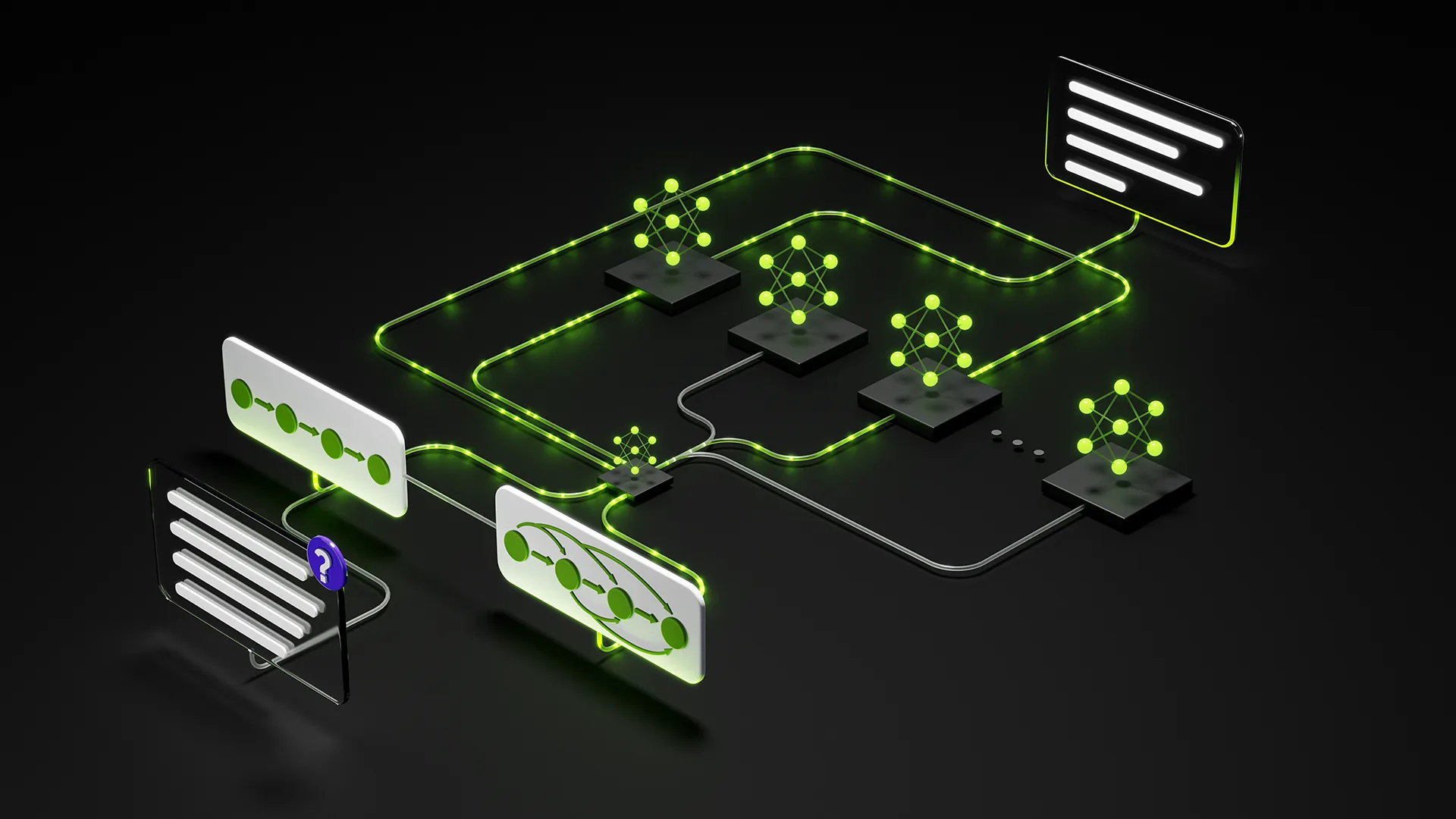
The transition from monolithic Large Language Models (LLMs) to specialized, agentic ecosystems has officially accelerated. With the announcement of the NVIDIA Nemotron 3 family at GTC 2026, NVIDIA has pivoted its strategy toward "Agentic AI"—a paradigm where specialized models collaborate to manage planning, reasoning, retrieval, and safety.
Executive Summary
- NVIDIA Nemotron 3 is a suite of specialized foundation models built on a Mixture-of-Experts (MoE) hybrid architecture, designed to power autonomous agents with multimodal reasoning, full-duplex voice interaction, and multilingual safety guardrails.
- Key Finding 1: The flagship Nemotron 3 Ultra utilizes an MoE hybrid reasoning structure to achieve "highest reasoning accuracy" among open frontier models while maintaining inference efficiency.
- Key Finding 2: The ecosystem introduces Multimodal RAG (Retrieval-Augmented Generation) through dedicated Embed VL and Rerank VL models, allowing agents to process and prioritize visual and textual data simultaneously.
- Key Finding 3: Specialized modules like VoiceChat (low-latency, full-duplex) and Content Safety (multilingual/multimodal) decouple the "brain" of the agent from its "senses" and "filters," enabling a more modular and scalable deployment.
Technical Architecture: The MoE Hybrid and Agentic Orchestration
Under the hood, Nemotron 3 represents a departure from the "one model fits all" philosophy. The architecture is built around a Mixture-of-Experts (MoE) Hybrid Reasoning Model. While specific parameter counts for each expert were not explicitly disclosed in the announcement, the architecture emphasizes a modular approach to computation.
1. The Reasoning Core (Nemotron 3 Ultra)
The Ultra model serves as the primary reasoning engine. By employing an MoE architecture, NVIDIA allows the model to activate only a subset of its parameters for any given token. This is particularly critical for "Agentic AI," where the model must perform high-level planning and recursive reasoning without the prohibitive latency costs of a traditional dense model.
2. Multimodal Perception (Nano Omni)
The Nemotron 3 Nano Omni is the edge-ready, multimodal variant. Its architecture is optimized for "enterprise-grade multimodal understanding," implying a compact footprint designed to run on workstation-class GPUs (RTX) or edge devices while maintaining the ability to process image and text inputs natively.
3. The Vision-Language RAG Pipeline
NVIDIA has re-engineered the RAG stack specifically for multimodal agents:
- NVIDIA Llama Nemotron Embed VL: Generates joint embeddings for both text and images, placing them in a shared vector space.
- NVIDIA Llama Nemotron Rerank VL: A specialized cross-encoder that reorders candidates based on visual context, solving the "lost in the middle" problem for images in complex retrieval tasks.
4. Full-Duplex Voice (VoiceChat)
The Nemotron 3 VoiceChat model is designed for full-duplex interaction. Unlike traditional turn-based ASR/TTS pipelines, this model is built for low-latency, natural conversation where the AI can be interrupted and respond with human-like prosody.
Performance Analysis: Benchmarks and Capabilities
NVIDIA claims that Nemotron 3 Ultra achieves the highest reasoning accuracy among "open frontier models." While specific leaderboard scores (like MMLU or HumanEval) were indicated as part of the GTC 2026 rollout, the focus is on "efficiency-to-accuracy" ratios.
| Model Variant | Primary Function | Key Performance Metric | Availability |
|---|---|---|---|
| Nemotron 3 Ultra | Complex Reasoning | "Benchmark-leading" Reasoning Accuracy | Coming Soon |
| Nemotron 3 Nano Omni | Multimodal Edge | Enterprise-grade Vision/Text | Coming Soon |
| Nemotron 3 VoiceChat | Real-time Voice | Low-latency, Full-duplex | Early Access |
| Content Safety | Moderation | Multilingual/Multimodal Guardrailing | Available |
| Embed/Rerank VL | Retrieval | Visual Context-Aware Ranking | Available |
"Agentic AI is an ecosystem where specialized models work together to handle planning, reasoning, retrieval, and safety guardrailing." — NVIDIA Technical Analysis
The performance of the Rerank VL model is particularly noteworthy for developers. In standard RAG, visual data is often relegated to simple metadata. Nemotron 3's Rerank VL allows for visual relevance to dictate the final output, which NVIDIA suggests significantly improves accuracy in technical documentation retrieval (e.g., matching a circuit diagram to a specific repair step).
Technical Implications: The Shift to Specialized Agents
The release of Nemotron 3 signals a significant shift in how enterprise AI will be built:
- Decoupled Intelligence: By providing a separate "Content Safety" model and "VoiceChat" model, NVIDIA allows developers to swap the "Reasoning Core" (Ultra) without rebuilding the safety or interface layers. This modularity reduces the "brittleness" of AI agents.
- Multilingual/Multicultural Nuance: The Content Safety model is specifically tuned for cultural nuances across languages. This suggests a training regimen that included high-quality localized datasets, moving beyond simple translation-based safety filters.
- The End of Text-Only RAG: The introduction of Embed VL and Rerank VL as first-class citizens in the Nemotron ecosystem means that multimodal grounding is now the baseline for "Enterprise RAG."
Implementation Example: Agentic Voice RAG
A developer building a voice-powered technician assistant would orchestrate the models as follows:
# Conceptual Agentic Pipeline
agent = NemotronAgent(
    reasoning_core="nemotron-3-ultra",
    voice_interface="nemotron-3-voicechat",
    retrieval_engine="llama-nemotron-rerank-vl",
    guardrails="nemotron-3-content-safety"
)

# The agent can now see a photo of a broken part,
# retrieve the manual via VL Rerank,
# and discuss the fix via low-latency voice.
Limitations and Trade-offs
- Ecosystem Lock-in: While the models are described as "open frontier," the optimal performance for Nemotron 3 is tightly coupled with the NVIDIA AI Enterprise stack and Blackwell/Hopper architecture.
- Complexity of Orchestration: Moving from a single LLM to an agentic ecosystem of 4-5 specialized models increases the complexity of the deployment pipeline. Developers must now manage the latency of the "handshakes" between the reasoning, safety, and voice modules.
- "Coming Soon" Components: Many of the most anticipated models, including the Ultra and Nano Omni, are not yet in general availability, making it difficult to verify performance claims against competitors like GPT-4o or Claude 3.5 Sonnet.
Expert Perspective
The announcement of Nemotron 3 highlights NVIDIA's dominance not just in hardware, but in the software orchestration layer. By focusing on a MoE Hybrid Reasoning Model, NVIDIA is addressing the biggest bottleneck in agentic AI: the high cost of "thinking."
The real winner here is the Multimodal RAG stack. Most current RAG systems struggle with non-textual data; by providing a dedicated Rerank VL model, NVIDIA is giving developers the tools to build agents that truly "see" their environment. This is a 9/10 significance event because it provides a blueprint for the "Agentic Operating System" of the future.
Technical FAQ
How does Nemotron 3 Ultra compare to Llama 3 or GPT-4 on reasoning?
NVIDIA positions Nemotron 3 Ultra as having the "highest reasoning accuracy" among open frontier models. While exact parity with closed-source models like GPT-4o is not yet fully benchmarked in the available data, the MoE hybrid architecture suggests it aims to match frontier-level reasoning with superior inference efficiency on NVIDIA hardware.
Is the Content Safety model restricted to text?
No. The Nemotron 3 Content Safety model is explicitly multimodal and multilingual. It can detect safety violations in both text and visual inputs, making it suitable for grounding agents that interact with real-world camera feeds or user-uploaded images.
What makes the "VoiceChat" model different from standard TTS?
Traditional pipelines use a Whisper (ASR) -> LLM -> ElevenLabs (TTS) stack, which introduces significant latency. Nemotron 3 VoiceChat is designed for "full-duplex" interaction, meaning the model can handle the timing and interrupts of natural human speech in a single, low-latency loop.
How does the Rerank VL model handle visual context?
Unlike standard rerankers that only look at text embeddings, NVIDIA Llama Nemotron Rerank VL is a cross-encoder that takes both the text query and the retrieved image/text candidates as input. It re-scores candidates based on the actual visual content of the images, rather than just the associated captions.
References
- NVIDIA Developer Blog: Building Nemotron 3 Agents
- NVIDIA Nemotron Product Page
- NVIDIA Technical Paper: Efficient, Accurate MoE Hybrid Reasoning Model