
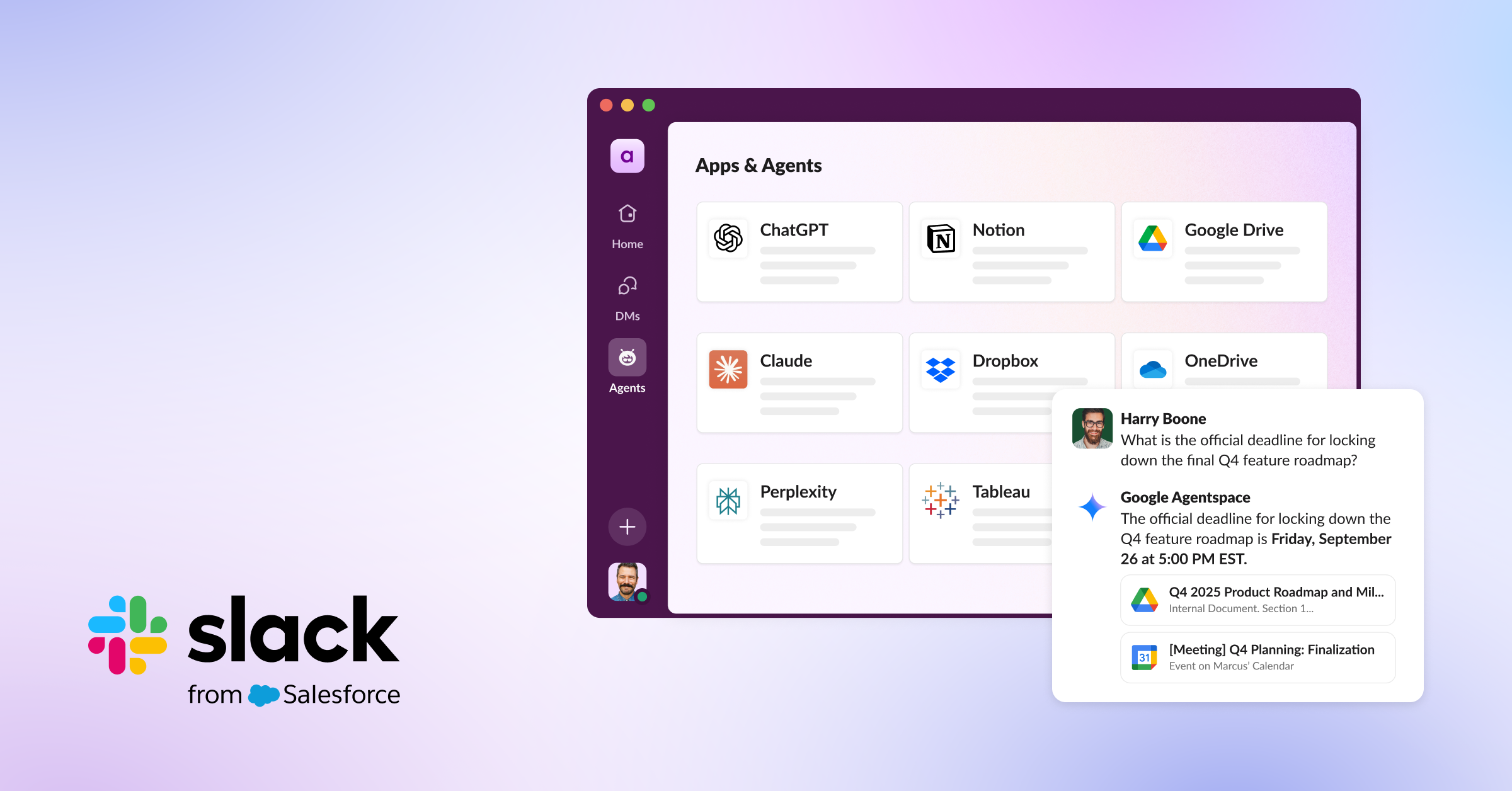
- What: Slack launched new platform tools, including the Real-Time Search (RTS) API and Model Context Protocol (MCP) server, to integrate AI agents.
- Key Partners: OpenAI, Anthropic, Google, Perplexity, Notion, and Cognition are already building on the new infrastructure.
- Impact: Early data suggests teams save an average of 97 minutes per week and see 37% faster decision-making using these integrated tools.
- Security: New protocols allow agents to access data without bulk downloads, maintaining existing enterprise permissions and privacy.
Slack announced a major evolution of its platform today, introducing specialized tools designed to turn the workplace communication hub into a primary operating system for AI agents. By launching the new Real-Time Search (RTS) API and a Model Context Protocol (MCP) server, Slack is providing developers with the secure, context-rich data necessary to move AI beyond generic chatbots and into the "agentic era" of autonomous productivity.
The move addresses a critical bottleneck in the AI industry: context. While large language models (LLMs) are powerful, they often lack the specific, real-time details of a company's internal decisions, cultural nuances, and project histories. Slack argues that this conversational data is a "goldmine" that has historically been locked away, making it difficult for automated tools to provide relevant assistance.
Unlocking the "Goldmine" of Conversational Data
The centerpieces of this announcement are the RTS API and the MCP server. These tools are designed to give AI agents a way to "listen" and "learn" from the flow of work without compromising security.
The RTS API provides apps with real-time access to current discussions, files, and channels. Unlike traditional data integration methods that might require bulk-downloading information to a third-party server, the RTS API is built with enterprise security at its core. It allows agents to retrieve only the specific messages or files relevant to a particular query, respecting all existing user permissions and data silos.
"The best work happens when context and execution aren’t separate," according to a statement from Notion, one of the early partners leveraging the platform. By connecting Notion AI with Slack, the company claims teams can turn every conversation into an actionable step without leaving the chat interface.
Massive Productivity Gains and Partner Momentum
Slack’s shift toward an agentic platform is backed by a roster of AI industry titans. Companies including OpenAI, Anthropic, Google, Perplexity, Writer, Dropbox, Notion, Cognition, Vercel, and Cursor have already begun building new AI and agent app experiences using these innovations. These apps are expected to debut on the Slack Marketplace in the near future.
The business case for this integration is rooted in the "app overload" currently facing most enterprises. Slack reports that the average enterprise juggles over 1,000 applications, leading to a productivity drain of up to 40% as employees constantly switch contexts. Nearly half of all SaaS licenses go unused because of this fragmentation.
By unifying these tools within Slack, the company claims significant performance improvements:
- 97 minutes saved per week by teams using existing data intelligently.
- 37% faster decision-making across teams.
- 36% faster response times to customers.
Slack frames this as a massive multiplier for IT spending, stating that Slack represents "the 2% of your IT budget that amplifies the other 98%."
Technical Flexibility: The MCP Server
The inclusion of the Model Context Protocol (MCP) server is a strategic move to standardize how AI agents interact with data. This provides a flexible, agent-ready gateway to conversational data that is both secure and customizable.
For developers, this means they no longer have to build bespoke connectors for every type of data interaction. The MCP server provides a standardized way for agents to understand the structure of Slack conversations, making it easier to build "context-aware" agents that understand who said what, when, and in what specific project channel. This level of granularity is what allows an agent to, for example, analyze campaign performance or update CRM records like Salesforce's Agentforce Sales, without a human needing to pull a single report manually.
Impact on the Enterprise Landscape
For developers and industry leaders, this announcement signals a shift in where the "brain" of the enterprise will live. Rather than AI being a standalone destination, Slack is betting that AI will be most effective where the conversations are already happening.
For the end-user, this means a future where filing an IT ticket or searching for a specific project decision becomes a conversation with an agent rather than a manual search. "Imagine a seller simply asking an agent to update CRM records, an employee resolving an IT issue without filing a ticket, or a marketing leader analyzing campaign performance without pulling a single report," the company stated in its announcement.
The focus on "unstructured data"—the informal chats and files that make up the bulk of daily work—is what separates this strategy from traditional database-driven AI. By making this data accessible to agents, Slack is turning the "noise" of daily chat into a structured asset for automation.
What’s Next
The new RTS API and MCP server are currently being utilized by Slack’s elite partner group. Users can expect a wave of "agentic" apps to hit the Slack Marketplace soon, featuring deep integrations from the likes of Google and Anthropic.
As Salesforce continues to roll out its Agentforce initiative, the integration between Slack's conversational context and Salesforce's structured CRM data is expected to tighten further. This evolution suggests a future where the distinction between "chatting" and "working" disappears entirely, replaced by a single interface where human and AI agents collaborate side-by-side.