
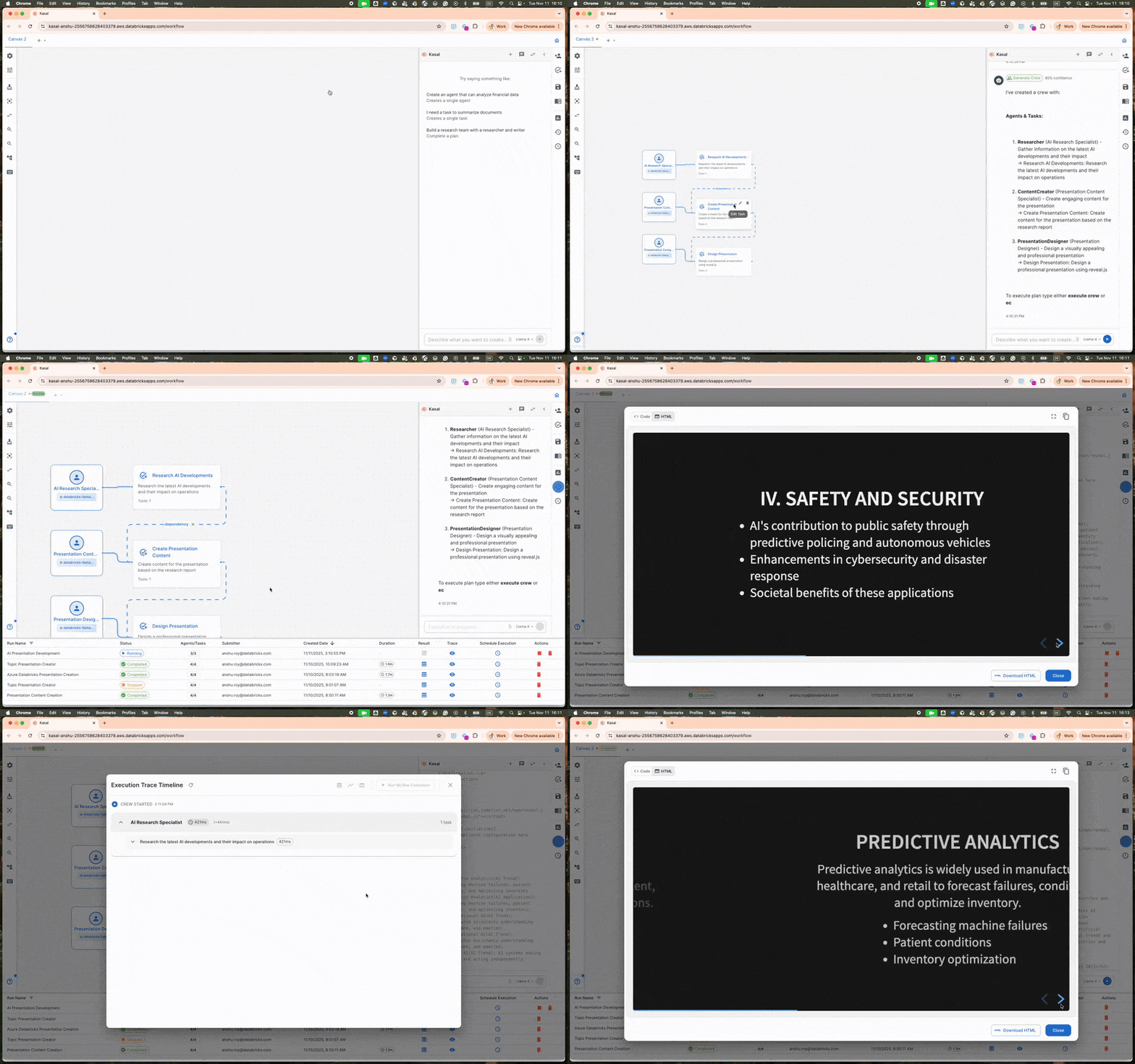
Headline: Databricks Launches Kasal for Agentic AI Orchestration
Key Facts
- What: Databricks introduced Kasal, an open-source project from Databricks Labs designed to simplify the creation and management of agentic AI workflows through visual orchestration.
- When: Announced in September 2025, with initial GitHub repository activity beginning mid-September 2025.
- Platform Support: Officially supports Windows and Ubuntu (Linux) platforms as of September 2025.
- Focus: Transforms complex AI agent orchestration into an intuitive visual experience while delivering enterprise-grade capabilities.
- Availability: Open source via the GitHub repository github.com/databrickslabs/kasal.
Lead paragraph
Databricks has released Kasal, a new open-source project from its Databricks Labs initiative that aims to make building intelligent AI agent workflows significantly easier. The tool combines visual simplicity with enterprise power, allowing developers and organizations to orchestrate complex agentic AI systems through an intuitive interface rather than extensive coding. As agentic AI adoption accelerates across industries, Kasal addresses a key pain point: the difficulty of designing, deploying, and managing sophisticated multi-agent workflows at scale.
Body
Agentic AI systems — autonomous agents capable of planning, reasoning, and executing tasks with minimal human intervention — are being adopted by a growing number of organizations. They boost productivity and enable new use cases in areas ranging from data analysis and software development to business operations and customer support. However, building reliable agentic systems remains challenging due to the complexity of coordinating multiple specialized agents, managing their interactions, handling state, and ensuring robust error recovery.
According to Databricks, Kasal was created specifically to tackle these orchestration challenges. The project transforms what is typically a highly technical and code-heavy process into a more accessible visual experience. Users can design agent workflows using visual tools while still maintaining the full power and flexibility required for production enterprise deployments.
The GitHub repository for Kasal (github.com/databrickslabs/kasal) describes the project as: “Build intelligent AI agent workflows with visual simplicity and enterprise power. Kasal transforms complex AI orchestration into an intuitive visual experience.”
As a Databricks Labs project, Kasal benefits from the company’s deep expertise in data and AI infrastructure. Databricks has positioned itself as a major player in the enterprise AI space through its Mosaic AI platform, Unity Catalog, and vector search capabilities. Kasal appears to extend this foundation into the emerging agentic AI layer, providing orchestration tools that can integrate with Databricks’ existing data and AI ecosystem.
Technical Context and Features
While detailed technical specifications remain limited in the initial announcement, available information indicates Kasal focuses on visual workflow design for multi-agent systems. This approach is part of a broader industry trend toward low-code and no-code tools for AI development, making advanced AI capabilities accessible to a wider range of developers and data practitioners.
The project has already seen active development. GitHub issues show activity beginning in early September 2025, with engineers opening enhancement requests and feature discussions. By mid-September, the project reached an important milestone when support for both Windows and Ubuntu (Linux) platforms was officially added, broadening its potential user base across different enterprise environments.
The inclusion of platform support for major operating systems suggests Kasal is being built with production deployment in mind. Enterprise organizations typically run diverse infrastructure, and cross-platform compatibility is essential for adoption in large-scale environments.
Kasal joins a growing ecosystem of tools aimed at agentic AI development. Companies across the industry are racing to provide better frameworks for building, testing, and monitoring autonomous agents. Databricks’ entry into this space is notable given its strong position in data engineering and machine learning operations (MLOps). The company’s ability to combine data governance, security, and scalability with agent orchestration could prove particularly compelling for organizations already invested in the Databricks platform.
Impact
For developers and data scientists, Kasal could significantly reduce the time and expertise required to build production-ready agentic systems. Visual orchestration tools often improve collaboration between technical and non-technical stakeholders, allowing domain experts to participate more directly in workflow design.
Enterprise users stand to benefit from Kasal’s focus on both simplicity and power. While many visual tools sacrifice flexibility, Databricks’ approach appears designed to deliver the robustness required for mission-critical applications. This balance is crucial as organizations move beyond experimental agent deployments toward production use cases that demand reliability, observability, and integration with existing data pipelines.
The open-source nature of the project is also significant. By releasing Kasal through Databricks Labs on GitHub, the company invites community contribution and feedback. This approach has proven successful for Databricks in the past with other open-source projects, helping accelerate development while building an ecosystem of users and contributors.
In the broader AI industry context, Kasal reflects the shift from single-model applications toward sophisticated multi-agent systems. As large language models become more capable, the focus is increasingly moving to how these models can be orchestrated into intelligent workflows. Tools like Kasal that simplify this orchestration layer could play an important role in accelerating enterprise adoption of agentic AI.
What's Next
The project remains in active development, with multiple open issues and enhancement requests visible on the GitHub repository. Early indications suggest the team is prioritizing platform stability, feature additions, and community engagement.
Organizations interested in agentic AI should monitor Kasal’s progress closely. As more features are added and documentation improves, the tool could become a standard option for building visual agent workflows, particularly within Databricks environments.
Given Databricks’ track record, Kasal may eventually integrate more deeply with core platform services such as Unity Catalog for governance, Mosaic AI for model management, and Databricks’ workflow orchestration tools. Such integration would make it even more attractive to existing Databricks customers looking to add agentic capabilities.
The release also signals Databricks’ strategic focus on the agentic AI layer. As competition intensifies in this space, the company’s combination of open-source innovation and enterprise platform strength could prove to be a powerful differentiator.
Sources