
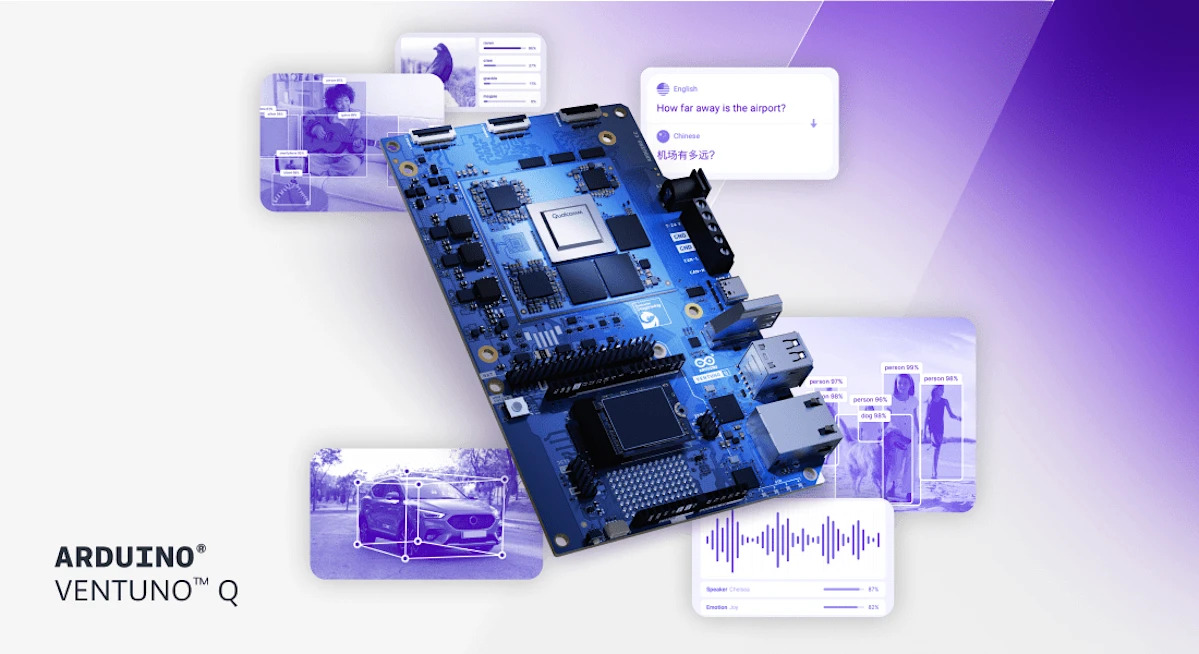
Qualcomm's Arduino Ventuno Q Brings Edge AI to Robotics on a Single Board
Qualcomm, which acquired Arduino last year, has unveiled the Arduino Ventuno Q, a new single-board computer designed specifically for AI-powered robotics and edge applications. The board combines Qualcomm's Dragonwing IQ8 processor with a dedicated STM32H5 microcontroller to deliver both high-performance AI inference and low-latency real-time control. It will launch in the second quarter of 2026 for under $300, according to the companies.
The Ventuno Q targets developers, educators, and innovators building systems that must perceive, decide, and act in the physical world. Unlike traditional Arduino boards focused on basic microcontroller projects, the Ventuno Q offers significantly more processing power and memory while maintaining the familiar Arduino ecosystem. It runs all AI models offline, making it suitable for applications where cloud connectivity is impractical or undesirable.
At the heart of the board is Qualcomm's Dragonwing IQ8 system-on-chip. The processor features an 8-core ARM Cortex CPU, an Adreno GPU, and a Hexagon Tensor NPU capable of up to 40 TOPS of AI performance. It is paired with 16GB of LPDDR5 RAM and 64GB of eMMC storage, expandable via an M.2 NVMe Gen 4 slot. Connectivity options include Wi-Fi 6, Bluetooth 5.3, 2.5Gbps Ethernet, and USB camera support, according to the product specifications shared by Arduino and Qualcomm.
Technical Specifications and AI Capabilities
The board's dual-processor architecture is one of its most notable features. While the Dragonwing IQ8 handles compute-intensive AI tasks, the STM32H5 microcontroller provides deterministic, low-latency control essential for robotics applications such as motor actuation and precise manipulation. This combination enables "vision processing combined with deterministic motor control," according to the companies.
Arduino Ventuno Q ships with the Arduino App Lab, which includes a suite of pre-trained AI models that run entirely on-device. Available models cover large language models (LLMs), vision-language models (VLMs), automatic speech recognition (ASR), gesture recognition, pose estimation, and object tracking. These capabilities support use cases ranging from smart kiosks and healthcare assistants to traffic flow analysis and industrial robotics.
"With Ventuno Q, AI can finally move from the cloud into the physical world," Qualcomm stated in the announcement. "This platform enables building machines that perceive, decide, and act — all on a single board. Our goal is to make advanced robotics and edge AI accessible to every developer, educator, and innovator."
Fabio Violante, VP & GM of Arduino at Qualcomm Technologies, echoed this vision: "With VENTUNO Q, AI can finally move from the cloud into the physical world. This platform makes it possible to build machines that perceive, decide, and act - all on a single board."
Positioning in the Market
The Ventuno Q represents Qualcomm's effort to extend its AI expertise from smartphones and automotive applications into the maker and robotics communities traditionally served by Arduino. By acquiring Arduino in 2024, Qualcomm gained access to a vast ecosystem of developers, educational institutions, and prototyping enthusiasts.
The board is positioned as more sophisticated than typical Arduino all-in-one boards while remaining accessible with a projected price under $300. This price point places it in competition with other AI-capable single-board computers such as those based on NVIDIA's Jetson platform or Raspberry Pi with AI accelerators, though the Ventuno Q emphasizes tight integration between AI processing and real-time control.
Its focus on fully offline operation distinguishes it from cloud-dependent solutions. This capability is particularly valuable for privacy-sensitive applications in healthcare, industrial settings, and consumer robotics where sending data to remote servers is undesirable.
Applications and Educational Potential
Arduino highlighted the board's suitability for both professional and educational use. The platform supports a full robotics stack, making it appropriate for building autonomous robots that combine computer vision with physical actuation. Researchers and students working in computer vision, generative AI, and edge computing will find the pre-trained models and development tools particularly useful.
The inclusion of models for gesture recognition, pose estimation, and object tracking opens possibilities for interactive robots, assistive devices, and smart sensing systems. The board's support for USB cameras further simplifies integration of vision capabilities into projects.
For educators, the Ventuno Q could lower the barrier to teaching advanced AI and robotics concepts. Students can experiment with sophisticated models without needing powerful desktop computers or cloud credits, as everything runs locally on the board.
Impact on Developers and the Industry
For developers, the Arduino Ventuno Q offers a streamlined path to building production-ready edge AI systems. The combination of high TOPS performance, substantial memory, and real-time control hardware reduces the complexity of integrating multiple components. The familiar Arduino software environment should ease the transition for existing Arduino users while attracting new developers interested in AI.
The platform could accelerate innovation in several sectors. In industrial automation, it enables smarter robots that make decisions locally with minimal latency. In healthcare, offline AI assistants could provide privacy-preserving monitoring and support. Smart infrastructure projects could use the board for real-time traffic analysis and optimization without relying on constant cloud connectivity.
The move also signals Qualcomm's broader strategy to expand beyond its traditional mobile and automotive markets. By leveraging the Arduino brand and community, Qualcomm can reach a new audience of hardware tinkerers and small-scale innovators who might eventually scale up to larger deployments using other Qualcomm technologies.
What's Next
The Arduino Ventuno Q is scheduled for availability in Q2 2026 through the Arduino Store and other retailers. Pricing is expected to be under $300, though exact figures have not yet been announced.
As the launch approaches, Arduino and Qualcomm are expected to release additional technical documentation, software development kits, and example projects to help developers get started. The companies have indicated that the pre-trained models in Arduino App Lab will be available both as examples and for integration into custom applications spanning computer vision, audio processing, speech detection, and signal processing.
The board's success will likely depend on the quality of the software ecosystem and community support that develops around it. If Arduino can maintain its reputation for accessibility while delivering professional-grade AI and robotics capabilities, the Ventuno Q could become an important platform for the next generation of physical AI systems.