
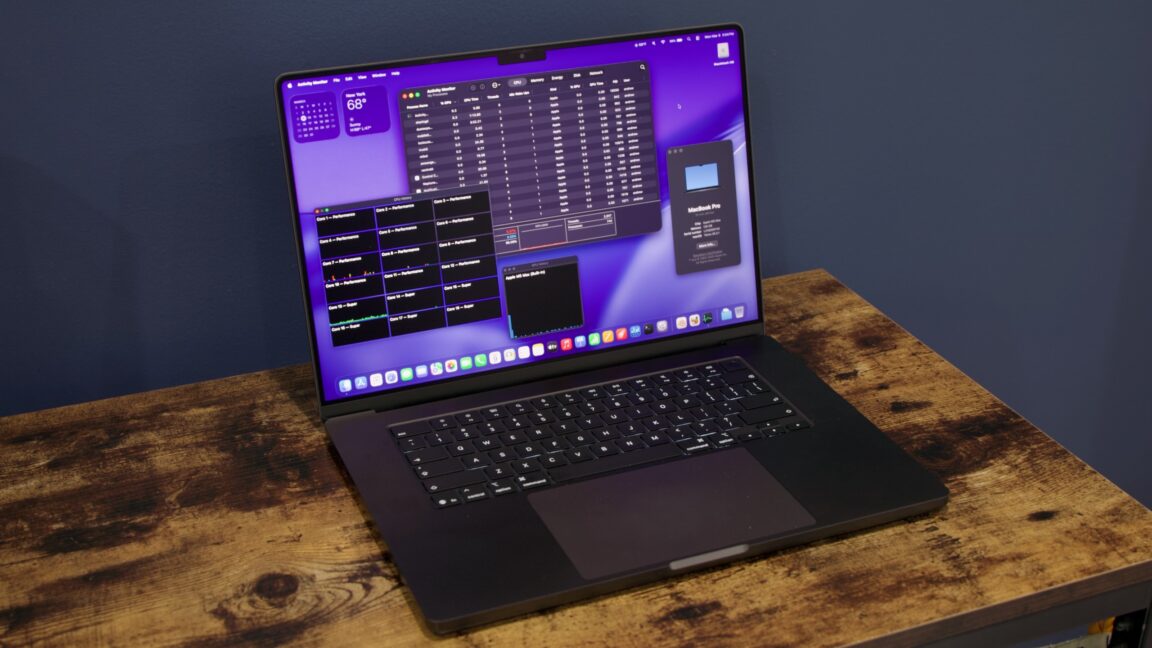
M5 Max "Fusion Architecture": A Technical Deep Dive
Executive summary
Apple’s M5 Max is the first high-end Apple Silicon chip to adopt a disaggregated “Fusion Architecture,” splitting the 18-core CPU complex (6 “super” + 12 “performance” cores) onto one die and the GPU + memory controller onto a second die, then packaging them together. The new design eliminates efficiency cores entirely in the Pro/Max lineup, introduces a third core type called “performance” cores, and delivers roughly 10–12 % higher single- and multi-core CPU performance and 20–35 % better GPU performance than the M4 Max while maintaining similar power efficiency. The architecture trades some peak single-threaded frequency headroom for improved multi-die scaling and manufacturing flexibility, positioning the M5 family for continued leadership in laptop-class performance-per-watt through at least 2027.
Technical architecture
The most significant change in the M5 Pro and M5 Max is the move away from a monolithic system-on-chip (SoC) to a chiplet-style package Apple calls “all-new Fusion Architecture.” This is the same interposer-and-die-bonding technology previously used only for the Ultra variants that glue two Max dies together.
- CPU die: Contains the entire 18-core CPU cluster (6 “super” cores + 12 new “performance” cores), the 16-core Neural Engine, Thunderbolt controllers, display engines, and SSD controller.
- GPU die: Contains either 20 GPU cores (M5 Pro) or 40 GPU cores (M5 Max), the memory controller, and the high-speed fabric that connects to the CPU die.
Because the memory controller lives on the GPU die, the M5 Max supports up to 614 GB/s of unified memory bandwidth (double the M5 Pro’s 307 GB/s), while the M5 Pro and Max share the identical CPU silicon. This explains why CPU-bound workloads are expected to be nearly identical between the two SKUs.
Apple has also revised its CPU core taxonomy for the M5 generation:
| Chip | Fastest cores (“super”) | Medium cores (“performance”) | Efficiency cores | GPU cores | Memory bandwidth |
|---|---|---|---|---|---|
| M5 Max | Up to 6 | Up to 12 | 0 | Up to 40 | Up to 614 GB/s |
| M5 Pro | Up to 6 | Up to 12 | 0 | Up to 20 | 307 GB/s |
| M5 | 4 | 0 | 6 | Up to 10 | 153 GB/s |
| M4 Max | 12 (“performance”) | 0 | 4 | Up to 40 | Up to 546 GB/s |
The “super” cores appear to be an evolution of the previous high-performance core design, now rebranded and running at slightly higher clocks. The new “performance” cores in the M5 Pro/Max are a third microarchitecture—distinct from both the efficiency cores in the base M5 and the older performance cores in the M4 family. They are not simply rebadged efficiency cores; they deliver substantially higher IPC and clock speeds than the E-cores while still being more power-efficient than the top “super” cores. This hybrid three-tier CPU design (super + performance + efficiency) gives Apple finer-grained control over power and thermal envelopes in sustained workloads.
Each GPU core now includes an integrated neural accelerator, and the overall Neural Engine has been widened to 16 cores with higher-bandwidth connectivity to memory. Apple claims this combination yields up to 4× faster LLM prompt processing and 8× faster AI image generation compared to M1 Pro/Max.
Performance analysis
Testing of a pre-production 16-inch MacBook Pro with the fully enabled M5 Max (18-core CPU, 40-core GPU, 128 GB unified memory) produced the following results versus the M4 Max:
- Single-core CPU: ~10 % higher (Geekbench 6, Cinebench R23 single)
- Multi-core CPU: 10–12 % typical; up to 30 % in Cinebench R23 (outlier)
- GPU compute/graphics: 20–35 % uplift depending on workload, with larger gains in neural-network-heavy tasks
- M5 Max vs base M5: ~66–120 % higher multi-core, 3–4× graphics performance
Power measurements via powermetrics during sustained Handbrake encoding showed the M5 Max consuming approximately 23 % more average power than the M4 Max, resulting in slightly higher total energy per task. However, overall performance-per-watt remains in line with Apple’s historical efficiency curve.
The reduction from 12 top-tier cores (M4 Max) to 6 “super” cores plus 12 new “performance” cores has not produced the regression some feared. In multi-threaded workloads the 18-core M5 Max is still roughly 1.7–2× faster than the 10-core base M5, confirming that the new medium “performance” cores close most of the gap.
Technical implications
The Fusion Architecture gives Apple several strategic advantages:
- Manufacturing flexibility — CPU and GPU dies can be fabricated on different process nodes or even at different foundries if needed.
- Yield and binning — Defects on one die no longer scrap the entire SoC.
- Scalability — The same CPU die is reused across Pro and Max; only the GPU die changes. This reduces design cost for future Ultra variants that will presumably glue two M5 Max packages together.
- Memory hierarchy — Keeping the memory controller on the GPU die preserves the high-bandwidth connection critical for graphics and ML workloads.
For the broader ecosystem, the move to chiplets signals that Apple is preparing for even larger core counts and more heterogeneous compute in the M6 and M7 generations. Developers targeting Apple Silicon should continue optimizing for the unified memory model and the new Neural Engine bandwidth improvements, particularly for on-device LLM inference and image generation.
Limitations and trade-offs
- The M5 Max does not deliver the same generational leap seen in the M3-to-M4 transition; the 10–12 % CPU uplift is modest by Apple’s recent standards.
- Elimination of efficiency cores in Pro/Max SKUs means slightly higher idle power in light workloads compared to previous designs, although real-world battery life impact appears minimal.
- The rebranding of core types has created temporary confusion in tooling and documentation;
powermetrics,sysctl, and third-party monitoring apps required updates to correctly label “super” vs new “performance” cores. - Peak single-threaded frequency does not scale as aggressively as on competing x86 designs; Apple continues to prioritize sustained multi-core and graphics throughput over burst frequency.
Expert perspective
The M5 Pro/Max represents a quiet but important inflection point. By adopting a disaggregated design for its flagship laptop chips, Apple has demonstrated that it can maintain its performance-per-watt leadership while solving the yield and cost challenges that come with ever-larger monolithic dies. The introduction of a third core type shows Apple is willing to invest in custom microarchitectures tailored to specific points on the power-performance curve rather than simply scaling existing designs. For ML engineers and pro application developers, the tighter integration of neural accelerators directly into each GPU core plus the widened Neural Engine is the more immediately impactful change. Expect the next 12–18 months to see a wave of optimized Core ML and Metal Performance Shaders updates that specifically target these new hardware blocks.
Technical FAQ
How does the M5 Max compare to the M4 Max on sustained multi-threaded workloads?
In most cross-platform benchmarks the M5 Max shows a 10–12 % advantage. In highly optimized media-encoding workloads the gap can reach ~30 %. The new “performance” cores largely compensate for the reduction in top-tier “super” cores.
Is the Fusion Architecture visible to developers or does it remain transparent?
Completely transparent at the software level. The unified memory model, cache-coherency protocol, and Metal API surface remain unchanged. Only low-level power and telemetry tools expose the two-die nature of the package.
Will existing M4-optimized code require changes to take advantage of the new Neural Engine?
Code using the higher-level Core ML or Neural Engine APIs will automatically benefit from the 16-core engine and per-GPU neural accelerators. Hand-tuned Metal compute kernels that directly target the old neural engine layout may see additional gains after re-tuning for the new bandwidth characteristics.
How does the M5 Pro’s 20-core GPU configuration compare to the previous M4 Pro?
The M5 Pro offers roughly 20–30 % higher graphics and compute throughput at similar power, thanks to architectural improvements inside each GPU core and the integrated neural accelerator. Memory bandwidth remains the primary differentiator versus the M5 Max.
Sources
- Ars Technica — Testing Apple’s 2026 16-inch MacBook Pro, M5 Max, and its new “performance” cores
- Apple Newsroom — Apple introduces MacBook Pro with all-new M5 Pro and M5 Max
- Apple Newsroom — Apple debuts M5 Pro and M5 Max to supercharge the most demanding pro workflows
- MacRumors — Apple Unveils MacBook Pro Featuring M5 Pro and M5 Max Chips With New Fusion Architecture
- Macworld — MacBook Pro M5 Pro & Max 2026 complete guide