
Testing Apple's 2026 16-inch MacBook Pro with M5 Max and Its New "Performance" Cores
Key Facts
- Apple has launched the 2026 16-inch MacBook Pro powered by M5 Pro and M5 Max chips featuring an all-new "Fusion Architecture" that splits CPU and GPU cores across two separate silicon dies packaged together.
- M5 Max uses an 18-core CPU (up to 6 "super" cores + up to 12 new "performance" cores) and up to 40-core GPU with up to 614 GB/s memory bandwidth; M5 Pro offers the same CPU configuration with 20 GPU cores and 307 GB/s bandwidth.
- The chips eliminate traditional efficiency cores in Pro/Max models, introducing a third core type called "performance" cores that differ from both the rebranded "super" cores and the efficiency cores found in the base M5.
- Benchmarks show approximately 10-12% CPU gains and 20-35% GPU gains over the M4 Max, with larger leaps from M1/M2-era systems.
- A faster 16-core Neural Engine delivers significant AI performance improvements, including claims of 4x faster LLM prompt processing and 8x faster AI image generation compared to M1 Pro.
Apple has begun shipping its 2026 16-inch MacBook Pro models equipped with the new M5 Pro and M5 Max processors, marking the first major architectural shift in Apple's high-end laptop silicon since the introduction of the M-series chips.
The new chips adopt an all-new Fusion Architecture that splits the CPU cores and other components onto one die while placing GPU cores and the memory controller on a second die, which are then packaged together into a single chip. This approach mirrors the technique Apple has used to create Ultra chips by combining two Max dies. Both the M5 Pro and M5 Max share the same 18-core CPU die but differ in GPU configuration: the Pro uses a 20-core GPU die while the Max doubles that to 40 cores, delivering correspondingly higher memory bandwidth and capacity support.
The redesign also brings a significant change to Apple's CPU core strategy. The high-end M5 Pro and M5 Max chips no longer use the company's traditional "efficiency" cores. Instead, they employ a combination of the fastest "super" cores—previously known as performance cores in earlier M5 variants—and an entirely new type of core that Apple is also calling "performance" cores, distinct from both the super cores and the efficiency cores found in the base M5 chip.
Architectural Changes and Core Rebranding
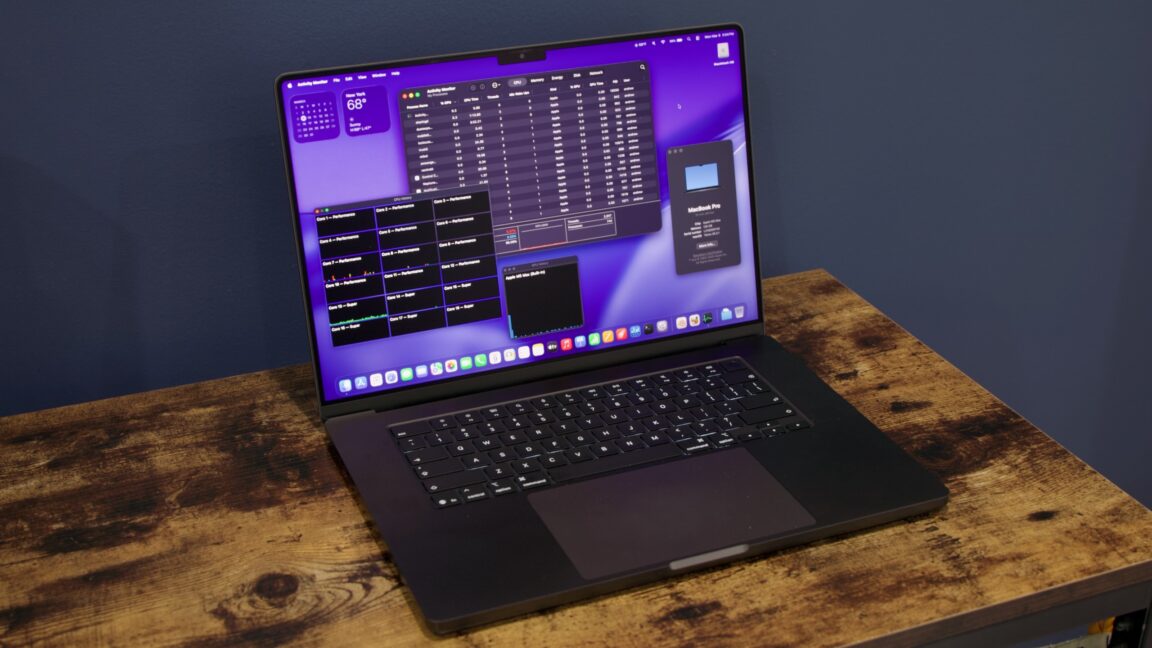
According to Ars Technica's testing, the M5 Max configuration tested included up to 6 "super" cores and up to 12 of the new "performance" cores paired with a 40-core GPU. This represents a reduction in the number of top-tier cores compared to the M4 Max, which featured up to 12 performance cores. However, early benchmarks suggest these concerns about fewer peak cores may be overstated.
The publication's testing showed the fully enabled M5 Max delivering single-core performance roughly 10 percent higher than the M4 Max in last year's 16-inch MacBook Pro. Multi-core results were more variable, with most tests showing modest 10-12 percent gains, though Cinebench R23 registered a larger 30 percent improvement. Graphics performance saw stronger gains of 20-35 percent depending on the workload, with Apple indicating even higher uplifts possible in GPU compute tasks that leverage the new neural accelerator integrated into each M5-family GPU core.
The external design of the 2026 MacBook Pro remains unchanged from the 2021 redesign that introduced the notch, mini-LED Liquid Retina XDR display, and improved port selection. Apple has focused its innovation almost entirely on the silicon for this generation.
Performance Compared to Previous Generations
When compared to the base M5 chip in the 14-inch MacBook Pro, the M5 Max shows roughly equivalent single-core performance, consistent with Apple's longstanding approach of delivering higher multi-core and graphics performance through additional cores rather than higher clock speeds on individual cores. Multi-core performance jumps between 66 percent (Geekbench) and 120 percent (Cinebench R23), suggesting that for sustained workloads an 18-core M5 Max should deliver approximately double the CPU performance of the base M5.
Graphics performance sees even more dramatic improvement, with the jump from the base M5's 10 GPU cores to the M5 Max's 40 cores typically delivering three to four times the graphics performance. These gains build on Apple's claims of up to 30 percent faster multithreaded performance over the M4 generation and up to 2.5 times faster performance than M1 Pro and M1 Max systems.
The M5 Pro and M5 Max also incorporate a faster 16-core Neural Engine with higher bandwidth connections to memory. Apple claims this enables 4x faster large language model prompt processing and 8x faster AI image generation compared to M1 Pro systems, according to multiple reports covering the announcement.
Memory, Storage and Power Considerations
Memory bandwidth has been significantly increased to support the new architecture. The M5 Pro offers 307 GB/s while the M5 Max reaches up to 614 GB/s depending on GPU core count. SSD storage performance has also been enhanced, with Apple doubling read and write speeds compared to previous generations in some configurations.
The source testing notes that power consumption measurements for the M5 Max were being conducted, though complete details were truncated in the available report. The shift to a disaggregated die design for CPU and GPU components represents a fundamental change in how Apple builds its highest-end chips, potentially offering advantages in manufacturing yields and future scalability while maintaining the unified memory architecture that has been central to Apple Silicon's performance advantages.
Impact on Professional Workflows
For professional users, the M5 Pro and M5 Max chips promise meaningful improvements in demanding workloads ranging from video editing and 3D rendering to software development and AI-enhanced creative tasks. The combination of stronger CPU performance, substantially improved GPU capabilities, and enhanced neural engine performance positions these laptops as powerful tools for on-device AI processing without requiring cloud resources.
The architectural changes may also signal Apple's preparation for even more advanced multi-die designs in future Ultra configurations, potentially allowing for greater performance and efficiency at the top of the product stack. Developers and power users will benefit from the increased memory bandwidth and improved neural processing capabilities, particularly as Apple Intelligence features and third-party AI applications become more prevalent.
What's Next
The 2026 MacBook Pro models maintain the same chassis design that has served Apple well for five years, suggesting the company is satisfied with the industrial design and is focusing innovation on the silicon and internal components. Future updates may bring refreshed displays, ports, or battery technology, but for this generation the story remains centered on the M5 Pro and M5 Max processors.
As more comprehensive reviews and real-world testing emerge, the full implications of the new Fusion Architecture and the restructured CPU core lineup will become clearer. Early indications suggest these chips deliver the expected generational improvements while introducing architectural changes that could influence Apple's silicon roadmap for years to come.
The base 14-inch MacBook Pro with the standard M5 has also seen a price adjustment, now starting $100 higher but including 1TB of storage instead of 512GB as standard.
Sources
- Testing Apple's 2026 16-inch MacBook Pro, M5 Max, and its new "performance" cores
- Apple introduces MacBook Pro with all-new M5 Pro and M5 Max
- Apple debuts M5 Pro and M5 Max to supercharge the most demanding pro workflows
- MacBook Pro M5 Pro & Max 2026 complete guide: Price, specs, release date
- Apple Unveils MacBook Pro Featuring M5 Pro and M5 Max Chips With New Fusion Architecture
- M5 Pro and M5 Max arrive in MacBook Pro, but little else has changed