
- What: Replit and Databricks launched a native integration and connector for "vibe coding" enterprise applications.
- Key Feature: Replit Agent can now query governed Databricks tables, models, and warehouses without moving sensitive data.
- Goal: Enable non-engineers to ship production-grade data tools in minutes rather than weeks.
- Business Context: Replit recently closed a $400 million funding round at a $9 billion valuation to scale its AI-driven development platform.
Replit and Databricks have announced a strategic integration that brings "vibe coding"—the practice of building software through high-level natural language prompts and AI agents—to the world of secure enterprise data. By connecting Replit’s AI Agent directly to Databricks’ governed data platform, the partnership allows product managers, analysts, and operations teams to build and deploy data-aware applications that previously required months of traditional engineering and business intelligence (BI) resources.
The collaboration addresses a critical bottleneck in enterprise AI: the "wall" between rapid prototyping and sensitive production data. While developers have used Replit to "vibe code" side projects for years, enterprise-grade apps require access to sales pipelines, revenue figures, and customer history—data that is typically locked behind strict governance controls within Databricks. This new connector allows Replit apps to tap into those governed tables and models while ensuring the data stays safely within the Databricks environment.
Bridging the Gap Between Prototyping and Production
For many organizations, the most valuable data is often the hardest to build with. According to Manny, a representative from Replit and former data scientist, "vibe coding is allowing teams to ship more and to ship faster," but those teams often hit a wall when they need real company context.
Traditional development cycles for data products often involve requesting data exports, waiting for security approvals, and managing complex infrastructure. The Replit-Databricks connector simplifies this into a three-step process:
- Adding the Databricks connector within the Replit IDE.
- Authenticating against a Databricks workspace.
- Allowing the Replit Agent to discover available catalogs, schemas, and tables.
Once connected, the Replit Agent handles the scaffolding, UI boilerplate, and data plumbing, while Databricks manages the scale and governance. This ensures that the generated code respects existing access controls and reuses the machine learning models or vector indexes that the organization's data team already maintains.
Scaling "Vibe Coding" to the Fortune 500
The partnership positions Databricks as the "source of truth" for the AI era. Cong, a representative from Databricks, noted that the company currently serves over 20,000 enterprise customers, including a significant portion of the Fortune 500. By opening these datasets to Replit’s agentic workflow, Databricks aims to democratize app creation.
"It should be as easy to build a custom app for your use case than it is now to create a slide," Cong stated during a live demonstration of the technology.
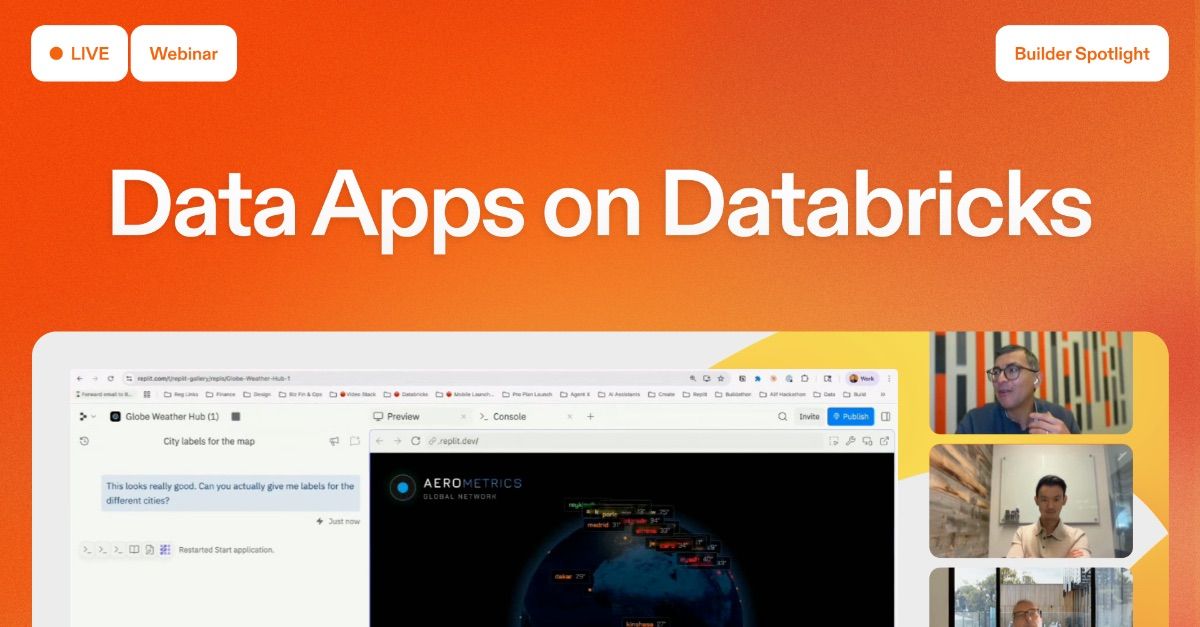
In a practical showcase of the integration, Replit demonstrated "vibe coding" a 3D weather globe application. Using natural language prompts, the Replit Agent built a frontend visualization powered by real-time sample data pulled directly from Databricks. Rather than spending days stitching together API layers and frontend frameworks, the builder focused on refining the prompt and editing the AI-generated code, shipping a functional tool in minutes.
Technical Synergy: Genie and AppKit
A key component of the integration is the use of Databricks Genie, which acts as an in-app data copilot. Genie allows builders to ask natural-language questions about their data and receive answers with cited tables, providing transparency so users can verify the source of every insight.
Furthermore, the integration utilizes the Databricks AppKit, which bridges the gap between the rapid iteration of Replit and the rigorous backend requirements of modern corporations. Applications built in Replit can be deployed directly into the Databricks ecosystem, inheriting the platform's security, user access controls, and infrastructure scaling.
This shift moves the industry toward "agentic" software development, where the AI doesn't just suggest code snippets but manages the entire lifecycle of an application—from querying a production warehouse to deploying a secure UI.
Impact on the Enterprise Landscape
For developers and business teams, this integration represents a significant shift in power. Revenue operations (RevOps) teams can now spin up custom automations and designers can ship full data-driven websites without waiting in an engineering queue.
"This integration bridges the gap between rapid vibe coding and the rigorous backend requirements of the modern enterprise," according to a recent Databricks blog post.
The business implications are equally significant. Replit’s recent $400 million funding round, which valued the company at $9 billion, underscores the massive investor interest in "vibe coding" as the future of software development. By partnering with Databricks, Replit is signaling its intent to move beyond the hobbyist market and become a staple in the enterprise software stack.
What’s Next
As the integration rolls out, the focus will likely shift to how organizations manage the explosion of "vibe-coded" internal tools. With the barrier to entry lower than ever, the industry may see a surge in specialized, single-purpose apps designed for niche business tasks.
Future updates are expected to further streamline the deployment process, making it possible to move from a natural language prompt in Replit to a live, governed application in Databricks with a single click. For now, the message to enterprises is clear: the era of waiting weeks for a data dashboard is ending, and the era of shipping at the speed of a "vibe" has begun.
Sources
- Replit Blog: Vibe Coding Enterprise Data Apps
- Databricks Blog: Ship Enterprise Apps Faster with Databricks AppKit and Replit
- Replit Blog: Ship Enterprise Data Apps Faster with Replit and Databricks
- SiliconANGLE: Vibe coding startup Replit closes $400M round at $9B valuation
- IT Digest: Databricks and Replit Team Up to Accelerate Enterprise App Delivery