
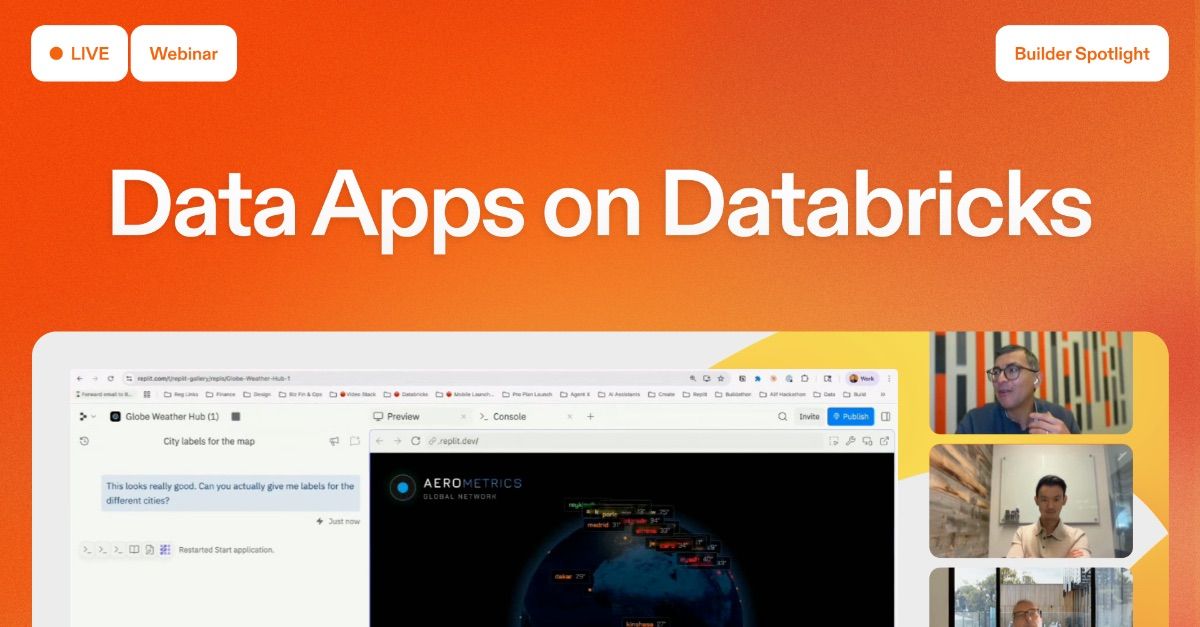
Vibe Coding Hits the Enterprise: Replit and Databricks Reveal New Connector to Unlock Governed Data Apps
Key Facts
- What: Replit and Databricks launched a new integration connector for "vibe coding" enterprise applications.
- Capabilities: Users can build data-aware apps using natural language via Replit Agent while maintaining Databricks’ security and governance.
- Security: Sensitive data remains within Databricks' governed environment rather than being copied into external projects.
- Scale: The integration targets Databricks’ base of over 20,000 customers, including a significant portion of the Fortune 500.
Replit and Databricks have announced a strategic integration that brings "vibe coding"—AI-assisted, natural language software development—directly to enterprise-grade data. Revealed during a live demonstration on March 13, 2026, the new Replit–Databricks connector allows product managers, analysts, and developers to ship governed data applications in minutes by plugging Replit’s AI agent into Databricks’ secure data warehouses.
Bridging the Gap Between Speed and Governance
The partnership aims to solve a persistent bottleneck in corporate environments: the "engineering queue." While AI agents have made prototyping faster for simple projects, enterprise applications have traditionally required weeks of manual work to ensure data security and compliance. By connecting Replit’s IDE directly to Databricks’ governed tables and models, the companies claim teams can now bypass these delays.
"Vibe coding is allowing teams to ship more and to ship faster," said Manny, a representative from Replit, during the announcement. He noted that while RevOps and product teams often want to build custom tools, they are frequently blocked because the necessary data—such as sales pipelines or marketing performance—is locked behind strict access controls.
The new connector allows Replit projects to query Databricks tables directly and generate code that respects existing governance. According to Databricks’ Cong, the long-term vision is to make building a custom, data-driven application "as easy to build... as it is now to create a slide."
Technical Integration: Replit Agent Meets Databricks Genie
The integration leverages two primary AI components to automate the development lifecycle:
- Replit Agent: Handles the heavy lifting of project scaffolding, UI creation, and front-end development.
- Databricks Genie: Functions as an in-app data copilot that answers natural-language questions about the data, providing cited tables to ensure accuracy and transparency.
During a live demonstration, the teams showcased a "3D weather globe" application. Using only plain-language prompts, the Replit Agent scaffolded a project, wired up connections to Databricks sample datasets, and handled the data plumbing to create a functional visualization. This process, which typically takes days of traditional BI (Business Intelligence) work, was completed in minutes.
The integration also supports the reuse of machine learning models and vector indexes already maintained by a company's data team. This ensures that the "vibe-coded" apps are not just toys, but are built on the same "source of truth" used by the rest of the organization.
Impact on Professional Workflows
For the AI industry, this move signals a shift from "vibe coding" as a hobbyist trend to a legitimate enterprise methodology. By removing the need to manually manage credentials or spin up external infrastructure, the barrier to entry for internal tool creation has been significantly lowered.
"This integration bridges the gap between rapid vibe coding and the rigorous backend requirements of the modern enterprise," according to a Databricks blog post. For developers and business users, this means apps can be deployed into Databricks with a single click, inheriting all existing user access controls automatically.
This is particularly significant given Replit's growing market position; the company recently closed a $400 million funding round at a $9 billion valuation, underscoring the massive demand for AI-native development platforms.
What’s Next
The Replit–Databricks connector is now available for builders looking to connect their IDE to Databricks workspaces. As more companies adopt "vibe coding" workflows, the industry expects to see a surge in "micro-apps"—hyper-specific internal tools built by non-engineers to solve niche departmental problems.
Future iterations are expected to deepen the integration with Databricks AppKit, further streamlining the path from a natural language prompt to a production-grade application deployed within a secure enterprise perimeter.
Sources
- Replit Blog: Vibe Coding Enterprise Data Apps with Replit and Databricks
- Databricks Blog: Ship Enterprise Apps Faster with Databricks AppKit and Replit
- SiliconANGLE: Vibe coding startup Replit closes $400M round at $9B valuation
- Luma: Vibe Code Enterprise Data Apps with Replit + Databricks
All technical specifications, pricing, and benchmark data in this article are sourced directly from official announcements. Competitor comparisons use publicly available data at time of publication. We update our coverage as new information becomes available.