
NVIDIA Launches TensorRT Edge-LLM with MoE, Hybrid Reasoning for Edge AI in Vehicles and Robots
Key Facts
- What: NVIDIA TensorRT Edge-LLM adds full support for Mixture of Experts (MoE), NVIDIA Cosmos Reason 2, Qwen3-TTS/ASR, and Nemotron 2 Nano on embedded platforms.
- Platforms: Optimized for NVIDIA DRIVE AGX Thor and NVIDIA Jetson Thor, enabling low-latency inference within strict power constraints.
- Capabilities: Hybrid Mamba-2-Transformer architecture for System 2 reasoning, multimodal voice dialogue, spatio-temporal reasoning, and end-to-end trajectory planning via NVIDIA Alpamayo.
- Models: Supports Qwen3 MoE for efficient expert activation, FP8-accelerated Vision Transformers, and flow matching for autonomous vehicle planning.
- Availability: Released March 12, 2026, as a high-performance C++ inference runtime for LLMs and VLMs.
NVIDIA has released an updated TensorRT Edge-LLM inference engine that brings advanced Mixture of Experts models, hybrid reasoning architectures, and multimodal capabilities directly to power-constrained edge devices for autonomous vehicles and robotics.
The update, announced March 12, 2026, equips developers building next-generation physical AI with production-ready tools to run high-fidelity reasoning and real-time interaction without relying on cloud connectivity. By optimizing for NVIDIA DRIVE AGX Thor and Jetson Thor platforms, the company aims to shift autonomous systems from modular software stacks to integrated, reasoning-based vision-language-action (VLA) models.
Efficient Reasoning Through Mixture of Experts
The latest TensorRT Edge-LLM release fully enables MoE architectures at the edge, with specific optimizations for models like Qwen3 MoE. These models activate only a subset of expert parameters per token, delivering the reasoning power of much larger networks while maintaining the latency and power profile of smaller models.
This capability is critical for embedded platforms operating under tight power and real-time constraints. Developers can now scale intelligence in autonomous systems without breaching the strict operational envelopes required for safety-critical applications, according to NVIDIA's technical blog post.
Hybrid Architectures Enable On-Device System 2 Reasoning
A major addition is optimized support for NVIDIA Nemotron 2 Nano, which uses a novel Hybrid Mamba-2-Transformer architecture. This design dramatically reduces memory overhead from key-value cache storage while preserving the precision of traditional attention mechanisms.
TensorRT Edge-LLM provides specialized kernels that accelerate these hybrid layers, allowing massive context windows for retrieval-augmented generation and agentic workflows on embedded hardware. The result is dynamic "thinking" at the edge, where models can seamlessly switch between deep reasoning and immediate action.
"This enables developers to use the model’s massive context window for complex edge retrieval-augmented generation (RAG) pipelines or agentic workflows while maintaining a strict, production-viable device memory footprint," the NVIDIA blog states.
Multimodal Interaction and Advanced Planning Models
The update introduces native support for Qwen3-TTS and Qwen3-ASR models, enabling low-latency end-to-end voice dialogue through a Thinker-Talker framework. This brings natural multimodal interaction to in-cabin assistants and robotic dialogue agents.
NVIDIA also integrated Cosmos Reason 2, an open planning model for physical AI that delivers advanced spatio-temporal reasoning, 3D localization, and long-context processing. These features target humanoid robotics and embodied agents operating entirely at the edge.
For autonomous vehicles, the release includes NVIDIA Alpamayo integration for end-to-end trajectory planning. It employs flow matching trajectory decoding, explainable decision-making with multicamera context, and FP8-accelerated Vision Transformers, marking a transition toward production-ready reasoning-based VLA models.
Impact on Developers and the Physical AI Landscape
This release addresses the core challenge in physical AI: moving beyond simply running large language models to enabling high-fidelity reasoning, real-time multimodal interaction, and trajectory planning within strict power and latency limits.
"The challenge is no longer how to run a large language model (LLM), but how to enable high-fidelity reasoning, real-time multimodal interaction, and trajectory planning within strict power and latency envelopes," NVIDIA's blog post emphasizes.
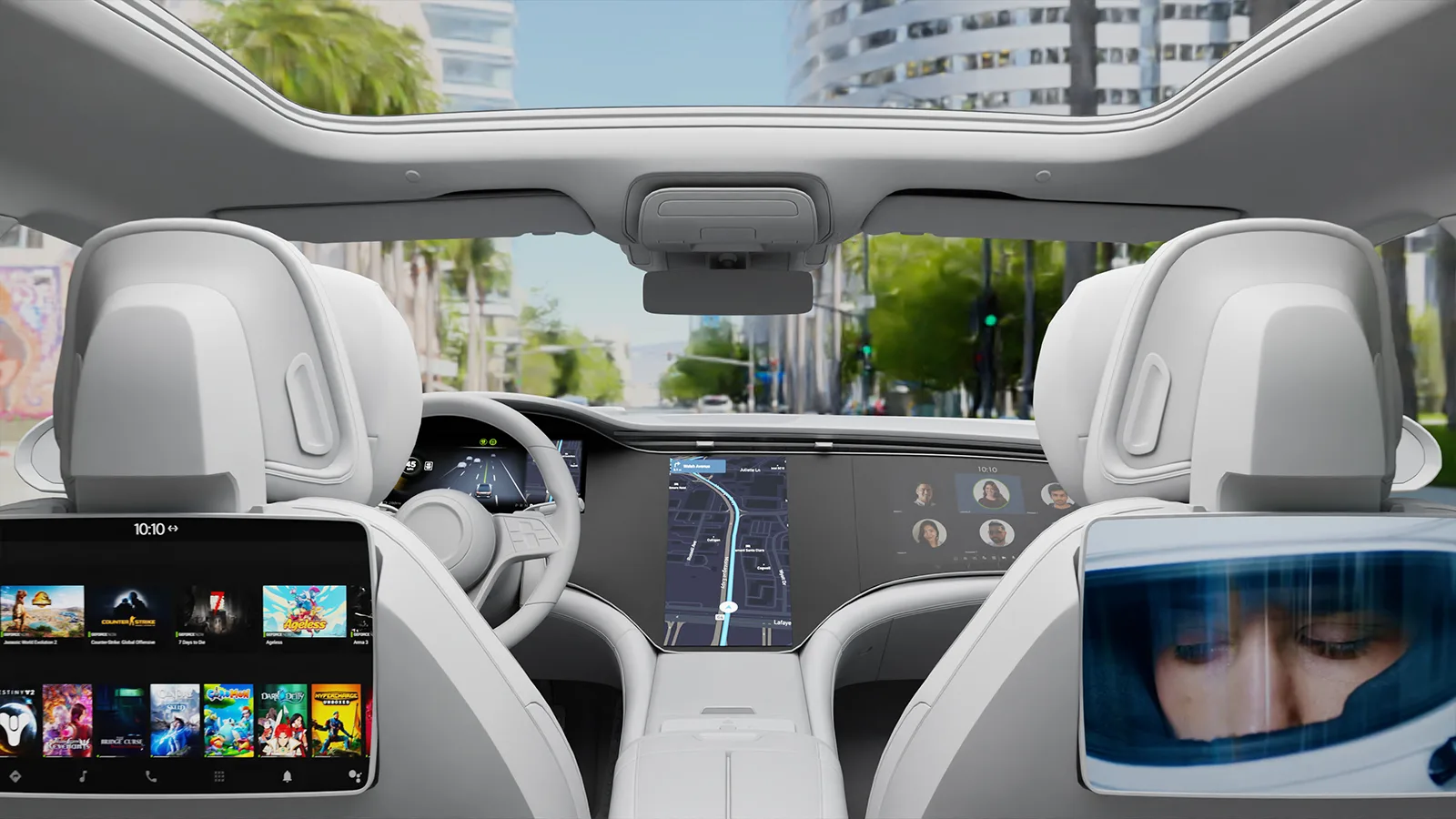
For developers, the toolkit provides a unified C++ runtime that bridges the gap between cutting-edge model research and deployable edge systems. Industry partners including Bosch, ThunderSoft, and MediaTek have already adopted TensorRT Edge-LLM for in-car AI assistants, on-device conversational AI, and advanced cabin monitoring.
The advancements arrive as competition intensifies in edge AI. Qualcomm recently unveiled its Dragonwing IQ10 robotics processor for similar use cases in industrial robots, autonomous mobile robots, and humanoids, highlighting the growing race to deliver energy-efficient physical AI at the edge.
What's Next
NVIDIA positions this release as foundational for software-defined autonomous vehicles and humanoid robots. Future iterations are expected to further expand model support within the Nemotron family and refine optimizations for even more complex embodied AI scenarios.
Developers can begin building with the updated TensorRT Edge-LLM immediately on DRIVE AGX Thor and Jetson Thor platforms, with additional resources available through the NVIDIA Developer Program.
The timing aligns with NVIDIA GTC 2026, taking place March 16-19 in San Jose, where edge AI and physical intelligence are expected to feature prominently in sessions on scalable, safety-critical systems.
Sources
- NVIDIA Technical Blog: Build Next-Gen Physical AI with Edge-First LLMs
- NVIDIA Technical Blog: Getting Started with Edge AI on NVIDIA Jetson
- Arm Newsroom: The next platform shift - Physical and edge AI
- NVIDIA GTC 2026
All technical specifications, pricing, and benchmark data in this article are sourced directly from official announcements. Competitor comparisons use publicly available data at time of publication. We update our coverage as new information becomes available.