
TensorRT Edge-LLM vs Competitors: Which Edge LLM Should You Choose for Physical AI?
NVIDIA TensorRT Edge-LLM is best for production-grade autonomous vehicles and robotics requiring low-latency MoE, hybrid reasoning, and multimodal voice on embedded hardware, while competitors like Qualcomm Dragonwing and general-purpose edge runtimes excel at broader Arm-based flexibility or lower initial hardware cost.
This article compares NVIDIA’s latest TensorRT Edge-LLM release (March 2026) against competing edge AI solutions for physical AI workloads in autonomous vehicles (AVs) and robotics. The new runtime brings production-ready Mixture-of-Experts (MoE), hybrid Mamba-Transformer reasoning, Cosmos Reason 2 spatio-temporal planning, Qwen3-TTS/ASR voice, and Nemotron 2 Nano support to NVIDIA DRIVE AGX Thor and Jetson Thor platforms. We evaluate whether the upgrade is meaningful, how it stacks up against the top alternatives, the price/performance trade-offs, and the migration effort required.
Feature Comparison Table
| Model / Runtime | Context Window | Price (input/output per M tokens) | Standout Capability | Best For |
|---|---|---|---|---|
| NVIDIA TensorRT Edge-LLM | Massive (via Nemotron 2 Nano hybrid) | Hardware-dependent (DRIVE/Jetson) | MoE + Hybrid Mamba-2-Transformer + Cosmos Reason 2 + Qwen3 TTS/ASR | Low-latency AV trajectory planning & humanoid robotics |
| Qualcomm Dragonwing IQ10 | Check latest official specs | Check latest official pricing | Energy-efficient Arm-based physical AI for AMRs & humanoids | Cost-sensitive industrial robotics & AMRs |
| General Edge LLM (e.g. ONNX + Arm NN) | Varies by model | Check latest official pricing | Broad hardware compatibility | Prototyping across non-NVIDIA hardware |
| Previous TensorRT Edge-LLM | Smaller / no native MoE | Same hardware | Basic LLM/VLM inference | Legacy edge deployments |
Detailed Analysis
MoE Support at the Edge
The latest TensorRT Edge-LLM introduces full MoE optimization, specifically for models like Qwen3 MoE. By activating only a subset of expert parameters per token, it delivers the reasoning power of a much larger model while keeping the active compute and power envelope suitable for strict automotive and robotic constraints. This is a major leap from prior versions that lacked native MoE kernels on embedded platforms. Competitors such as Qualcomm’s Dragonwing portfolio focus on overall energy efficiency but do not currently advertise equivalent MoE-specific acceleration on their latest robotics processors.
Hybrid Reasoning with Nemotron 2 Nano
TensorRT Edge-LLM now fully supports NVIDIA Nemotron 2 Nano’s Hybrid Mamba-2-Transformer architecture. This dramatically reduces KV cache memory footprint while preserving the precision of attention layers, enabling “System 2” deep reasoning directly on DRIVE AGX Thor and Jetson Thor. The runtime provides optimized kernels for the hybrid layers, making long-context RAG and agentic workflows viable within tight device memory limits. This capability is unique to the NVIDIA stack in the current announcement and gives it a clear advantage for in-cabin AI assistants and robotic dialogue agents that must alternate between fast responses and complex reasoning.
Multimodal Voice and Spatio-Temporal Reasoning
Native support for optimized Qwen3-TTS and Qwen3-ASR enables end-to-end, low-latency voice dialogue using a Thinker-Talker framework. Additionally, Cosmos Reason 2 brings advanced 3D localization, spatio-temporal reasoning, and long-context processing for humanoid robotics and embodied agents. These features are production-tuned for the edge, something rarely matched in competing runtimes without significant custom engineering.
Autonomous Vehicle Trajectory Planning
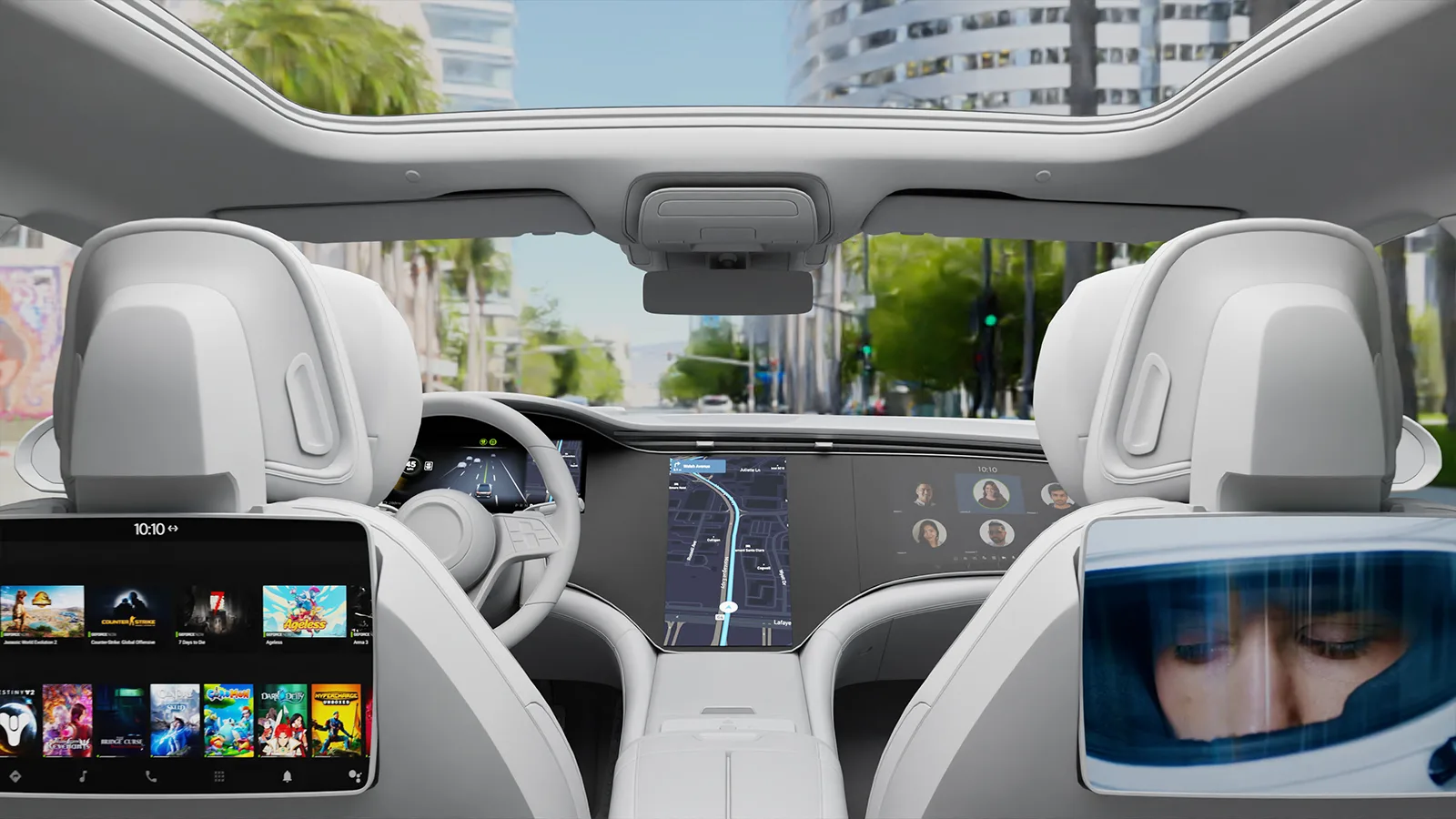
NVIDIA Alpamayo integration delivers end-to-end reasoning-based VLA (Vision-Language-Action) models. It uses flow matching trajectory decoding, explainable decision-making with multicamera context, and FP8-accelerated Vision Transformers. This marks a shift from traditional modular AV stacks to unified, production-ready models — a capability that sets TensorRT Edge-LLM apart from both previous NVIDIA runtimes and current Qualcomm offerings focused on general robotics processors.
Worth Upgrading?
For teams already on NVIDIA Jetson or DRIVE platforms, this is a meaningful upgrade, not incremental. The addition of MoE, hybrid Mamba-Transformer, Cosmos Reason 2, and native Qwen3 speech models directly addresses previous limitations in reasoning depth, memory efficiency, and multimodal interaction at the edge. If your application requires high-fidelity reasoning or real-time voice within strict power/latency budgets, the improvements justify the move. Teams on older TensorRT Edge-LLM versions without these features will see significant gains in model scale and capability without increasing hardware power draw.
For teams not yet on NVIDIA hardware, the upgrade case is weaker — the runtime is tightly coupled to DRIVE AGX Thor and Jetson Thor, so switching requires new hardware.
vs the Competition
Qualcomm is the most direct competitor in physical and edge AI for robotics and automotive. Their Dragonwing IQ10 processor targets industrial robots, AMRs, and humanoids with an emphasis on energy-efficient Arm-based compute. While Qualcomm offers strong overall efficiency for sensing-decision-action loops, the NVIDIA announcement shows clearer leadership in LLM-specific optimizations (MoE, hybrid architectures, and specialized planning models like Cosmos Reason 2). Arm-based general runtimes provide broader hardware choice but lack the highly tuned kernels and model-specific accelerations that TensorRT Edge-LLM delivers for Nemotron, Qwen3, and Cosmos families.
NVIDIA’s solution currently leads in reasoning fidelity per watt for complex AV and humanoid use cases, while Qualcomm maintains advantages in broader ecosystem compatibility and potentially lower entry cost for non-NVIDIA hardware.
Price/Performance Verdict
TensorRT Edge-LLM itself is not priced per token — cost is tied to NVIDIA DRIVE and Jetson hardware platforms. Performance is exceptional for its class: MoE and hybrid architectures allow “large-model intelligence” at the power and latency cost of much smaller models. This makes it highly cost-effective for safety-critical, real-time applications where cloud offloading is impossible.
It is cost-effective for workloads involving:
- Autonomous vehicle trajectory planning
- Humanoid robot embodiment and spatio-temporal reasoning
- Low-latency in-cabin voice assistants with deep reasoning
It is less cost-effective for early-stage prototyping or teams needing to deploy across many different hardware vendors, where Qualcomm or generic Arm solutions may offer better upfront economics.
Migration Effort
From previous TensorRT Edge-LLM: Moderate. Existing pipelines can largely reuse the C++ runtime. Developers must update model loading for MoE and hybrid layers, integrate new Cosmos Reason 2 and Qwen3 models, and re-optimize FP8 Vision Transformers. NVIDIA provides optimized kernels, reducing the need for custom CUDA work.
From Qualcomm or other Arm-based solutions: High. Migration requires moving to NVIDIA DRIVE or Jetson hardware, re-validating safety certifications for automotive use, and rewriting inference code to use the TensorRT Edge-LLM C++ API. Model conversion from Hugging Face is supported, but full re-tuning for the new hybrid and MoE kernels is necessary.
From cloud LLMs: Very high. Moving to edge requires significant quantization, latency engineering, and power budgeting work, but TensorRT Edge-LLM reduces much of the inference runtime burden.
Use Case Recommendations
Best for Autonomous Vehicles
TensorRT Edge-LLM with Alpamayo and Cosmos Reason 2 is the strongest choice. The combination of multicamera FP8 Vision Transformers, flow matching trajectory decoding, and explainable reasoning makes it ideal for software-defined vehicles moving from modular to end-to-end VLA architectures.
Best for Humanoid Robotics and Embodied Agents
The spatio-temporal reasoning of Cosmos Reason 2 combined with hybrid Nemotron 2 Nano and low-latency Qwen3 voice gives NVIDIA a clear edge. Teams building advanced robotic dialogue agents or physical AI that require long-context understanding should choose this stack.
Best for Startups and Prototyping
Qualcomm Dragonwing or smaller Jetson Orin Nano configurations may be more suitable due to lower initial hardware investment and broader Arm ecosystem support. Use TensorRT Edge-LLM only if you have already committed to the NVIDIA platform.
Best for Enterprise Automotive Deployments
NVIDIA TensorRT Edge-LLM is recommended for production safety-critical systems. The combination of Bosch, ThunderSoft, and MediaTek adoption signals strong industry validation for in-car AI assistants and cabin monitoring.
Verdict
Must upgrade if you are already on NVIDIA DRIVE or Jetson Thor and need deeper reasoning, multimodal voice, or modern VLA planning capabilities — the improvements in MoE, hybrid architectures, and Cosmos Reason 2 are substantial and production-focused.
Wait and see if you are early in development or hardware-agnostic — evaluate both NVIDIA and Qualcomm solutions as the physical AI space evolves rapidly.
Skip only if your workload is simple inference without complex reasoning or you cannot adopt NVIDIA hardware.
For teams building next-generation physical AI under strict power and latency constraints, TensorRT Edge-LLM currently offers the most complete edge-first LLM solution for autonomous vehicles and robotics.
Sources
- Build Next-Gen Physical AI with Edge‑First LLMs for Autonomous Vehicles and Robotics
- The next platform shift: Physical and edge AI, powered by Arm
- Getting Started with Edge AI on NVIDIA Jetson: LLMs, VLMs, and Foundation Models for Robotics
All technical specifications, pricing, and benchmark data in this article are sourced directly from official announcements. Competitor comparisons use publicly available data at time of publication. We update our coverage as new information becomes available.