
Our Honest Take on NVIDIA TensorRT Edge-LLM: Solid engineering for real edge constraints, but still more toolkit than full “next-gen Physical AI” solution
Verdict at a glance
- Genuinely impressive: First-class MoE and hybrid Mamba-2-Transformer optimizations running on Jetson Thor and DRIVE AGX Thor; hybrid /think vs /no_think modes that actually deliver measurable quality-latency tradeoffs (97.8% MATH500 in reasoning mode).
- Disappointing: Heavy reliance on NVIDIA-specific hardware and models; no disclosed absolute latency, power, or FPS numbers on real silicon; Cosmos Reason 2 and Alpamayo remain relatively unknown outside NVIDIA’s ecosystem.
- Who it’s for: Teams already committed to NVIDIA’s DRIVE or Jetson Thor platforms building AV copilots, in-cabin assistants, or humanoid robot brains.
- Price/performance verdict: Excellent if you’re already in the NVIDIA walled garden and can use the provided models. Otherwise, you’re paying the NVIDIA tax for highly specialized kernels with limited portability.
What’s actually new
The March 2026 update to TensorRT Edge-LLM adds three concrete technical capabilities that matter for embedded physical AI:
-
MoE support specifically tuned for Qwen3 MoE on Jetson and DRIVE Thor. By routing tokens to only a subset of experts, the runtime lets devices access parameter counts that would otherwise exceed power and memory budgets while keeping active compute closer to a dense ~7B-class model.
-
Hybrid Mamba-2-Transformer acceleration for Nemotron 2 Nano. This is the most interesting piece: the architecture combines Mamba state-space layers (excellent for long-context KV-cache efficiency) with traditional attention layers for precision. TensorRT Edge-LLM supplies custom kernels that accelerate the hybrid transitions, enabling “System 2” reasoning within tight device memory footprints.
-
Native multimodal voice and planning models: Optimized Qwen3-TTS and Qwen3-ASR for low-latency end-to-end voice dialogue using a Thinker-Talker framework, plus Cosmos Reason 2 (spatio-temporal reasoning, 3D localization, long-context) and Alpamayo (flow-matching trajectory decoding with multicamera FP8 Vision Transformers).
These are genuine engineering advances in the deployment layer rather than new model architectures. The blog correctly identifies that the hard problem has shifted from “can we run an LLM at the edge?” to “can we run high-fidelity reasoning and multimodal interaction inside strict power/latency envelopes?” TensorRT Edge-LLM is NVIDIA’s answer to that deployment question on its own silicon.
The hype check
The post repeatedly uses marketing language such as “next-gen Physical AI,” “production-ready, reasoning-based VLA models,” and “shift from modular stacks.” These claims are only partially substantiated.
- The hybrid reasoning modes (/think and /no_think) are real and useful. Switching between chain-of-thought and direct response is a practical innovation for in-cabin assistants or robot dialogue agents.
- However, “production-ready” is overstated without published benchmarks on actual power draw, end-to-end latency, or safety-critical metrics (e.g., ISO 26262, ASIL-D, or real-world robot collision rates). The 97.8% MATH500 score is impressive but was likely measured on a single academic benchmark, not in noisy physical environments.
- “End-to-end trajectory planning” via Alpamayo sounds transformative, yet the blog provides no head-to-head comparison against classical planning stacks or against competitors like Tesla’s FSD end-to-end or Mobileye’s latest. FP8 Vision Transformers are efficient, but the claim that this marks a full shift from modular to VLA (Vision-Language-Action) models needs far more evidence than is given.
In short, the technical work is credible; the rhetoric inflates it into a broader platform narrative that the provided data doesn’t fully support.
Real-world implications
This release is most valuable for two groups:
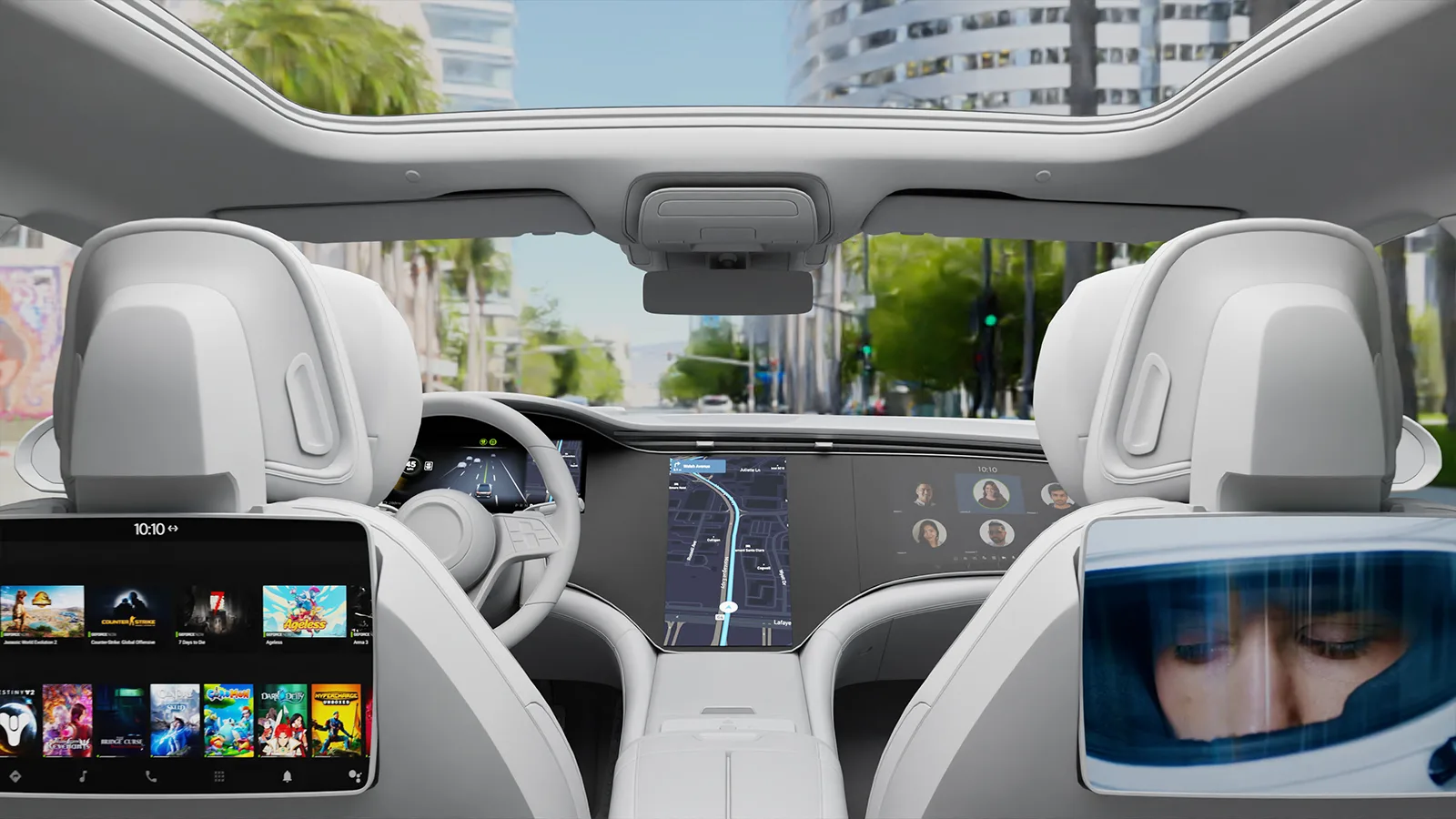
- Automotive OEMs and Tier-1s already designing next-generation software-defined vehicles on DRIVE Thor. They can now realistically run sophisticated in-cabin voice assistants that reason about user intent while staying under tight power budgets, or experiment with more explainable trajectory planning that incorporates multicamera context.
- Humanoid and mobile robotics teams using Jetson Thor who want on-device spatio-temporal reasoning and voice interaction without constant cloud dependency. The combination of Cosmos Reason 2 + Qwen3 speech models + Nemotron hybrid reasoning could unlock more natural human-robot interaction in industrial or home settings.
The unlocked use cases are genuine: low-latency conversational agents that can think when necessary, and early embodied VLA prototypes running entirely at the edge. However, these are still largely developer previews rather than drop-in production solutions.
Limitations they’re not talking about
Several critical gaps remain unaddressed in the announcement:
- Benchmark transparency: No numbers on tokens/second, power consumption (watts), memory footprint, or latency for any of the new models on Thor silicon. In edge AI, these are the only numbers that matter.
- Model openness and portability: While Qwen3 and Nemotron are described as “open,” the highly tuned kernels are NVIDIA-specific. Teams wanting to run these on Qualcomm Dragonwing, AMD, or custom silicon will likely see major performance cliffs.
- Safety and certification: For autonomous vehicles, claims around “explainable decision-making” and “production-ready” must be backed by extensive validation data. None is provided.
- Ecosystem maturity: Cosmos Reason 2 and Alpamayo are NVIDIA-native models. Their performance compared to more established open models (Llama-4, Claude 3.7, or specialized robotics models from Physical Intelligence or Covariant) is unknown.
- Long-term maintenance: Edge runtimes tend to require continuous kernel updates as models evolve. NVIDIA’s track record is strong, but the blog gives no roadmap for supporting future hybrid architectures or newer MoE designs.
How it stacks up
Compared to Qualcomm’s Dragonwing IQ10 and broader Arm-based robotics push, NVIDIA offers superior software integration and proven automotive silicon but at higher cost and with less architectural flexibility. Qualcomm emphasizes energy efficiency across a wider range of robots and vehicles; NVIDIA emphasizes raw performance and model-specific kernel optimization on its own platforms.
Versus pure open-source edge efforts (llama.cpp, ExecuTorch, or MediaTek’s recent LLM work), TensorRT Edge-LLM wins on performance for supported models but loses badly on hardware choice and developer freedom. If your hardware is locked to NVIDIA, this is currently the best option. If not, the gap is still large.
Constructive suggestions
NVIDIA should prioritize three things in the next 6–9 months:
- Publish rigorous, apples-to-apples benchmarks: power, latency, tokens/sec, and memory for all announced models on both Jetson Thor and DRIVE AGX Thor under realistic workloads (noisy audio, multicamera input, varying context lengths).
- Release a public “Edge-LLM Model Hub” with quantized, pre-optimized versions of the most useful open models beyond just the NVIDIA family, including conversion tools for community models.
- Provide safety and validation toolkits — especially for the Alpamayo planning stack — that help customers generate the certification evidence required for automotive and industrial deployment.
Doing so would turn an impressive engineering release into a genuine platform advantage.
Our verdict
Teams deeply embedded in the NVIDIA automotive or robotics ecosystem should adopt TensorRT Edge-LLM now for experimentation and early pilots, particularly if they need hybrid reasoning or on-device voice. The MoE and Mamba-Transformer optimizations are real technical wins that solve painful deployment problems.
Everyone else should wait. The absence of hard performance numbers, limited model choice, and heavy platform lock-in make this too risky for new designs in 2026. Watch for independent benchmarks from early adopters (Bosch, ThunderSoft, etc.) before committing at scale.
This is high-quality infrastructure work that advances the state of edge Physical AI — but it is not yet the platform shift the title promises.
FAQ
### Should we switch from cloud LLMs or modular AV stacks to this?
Only if your latency, privacy, or connectivity requirements strictly demand on-device execution and you are already using NVIDIA Thor silicon. The hybrid reasoning is compelling, but replacing a mature modular stack requires far more validation data than provided here.
### Is the performance good enough for production AVs and humanoids today?
Unknown. The blog gives zero concrete metrics on power or latency under load. Until those numbers are published and independently verified, treat this as an excellent developer runtime, not yet a production solution.
### How does this compare to Qualcomm’s robotics push?
NVIDIA wins on model-specific optimization and automotive pedigree. Qualcomm currently offers broader hardware options and emphasizes energy efficiency across more robot categories. Choose based on your silicon roadmap more than the software announcement.
Sources
- Build Next-Gen Physical AI with Edge‑First LLMs for Autonomous Vehicles and Robotics
- Additional context from related NVIDIA and industry announcements (Qualcomm Dragonwing, Jetson ecosystem posts)
All technical specifications, pricing, and benchmark data in this article are sourced directly from official announcements. Competitor comparisons use publicly available data at time of publication. We update our coverage as new information becomes available.