
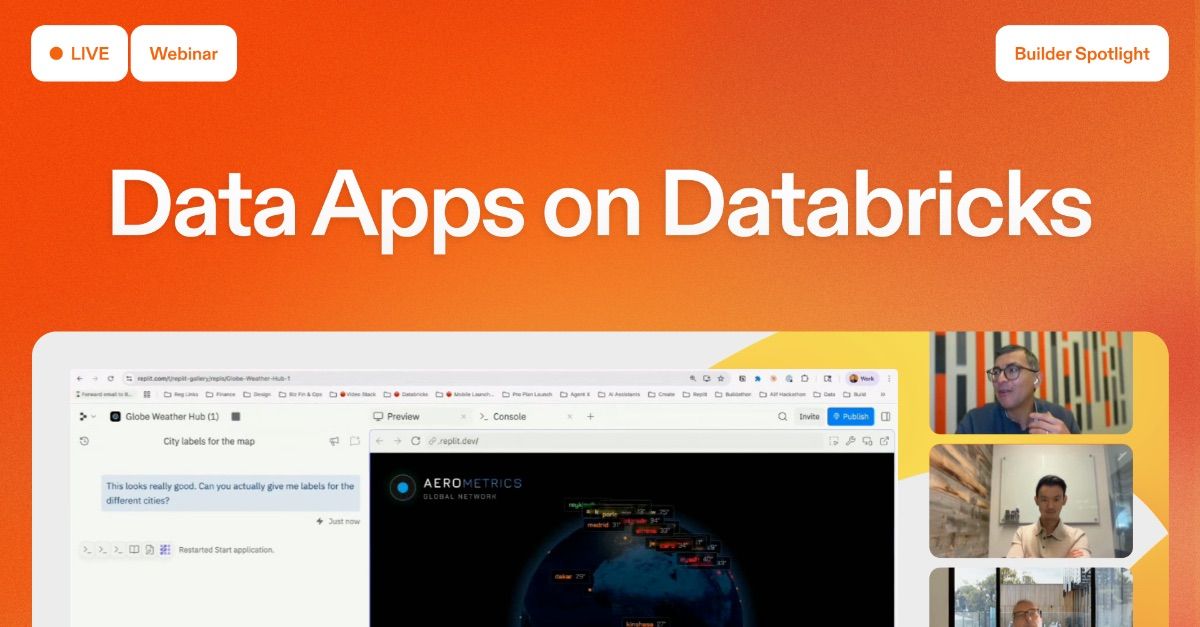
Replit–Databricks Integration: A Technical Deep Dive
Executive summary
- Replit and Databricks have introduced a native integration that pairs Replit’s AI-agentic "vibe coding" workflow with Databricks’ governed data platform, enabling developers and non-technical stakeholders to build and deploy enterprise-grade data applications without data exfiltration.
- The integration utilizes a new Replit–Databricks Connector to authenticate against Databricks workspaces, allowing Replit Agent to discover schemas and tables directly through a governed interface.
- Applications are deployed as Databricks Apps, ensuring they inherit the host platform's security, access controls, and compute scale.
- Databricks Genie is integrated as an in-app data copilot to provide natural-language querying with verifiable citations, bridging the gap between raw data and AI-generated UI.
Technical architecture
The integration between Replit and Databricks represents a shift from "siloed development" to "governed agentic development." The architecture can be broken down into four primary layers:
1. The Agentic Layer (Replit Agent)
Replit Agent serves as the primary orchestration engine. Unlike a standard autocomplete LLM, the Agent handles the high-level scaffolding of the project. It generates the frontend (React/HTML), handles state management, and wires up the backend logic. In this specific integration, the Agent is "Databricks-aware," meaning it can interpret the metadata provided by the Databricks connector to write queries that match the user's specific enterprise schema.
2. The Connectivity Layer (Databricks Connector)
The new connector acts as a secure bridge. It eliminates the manual management of environment variables and API keys for Databricks.
- Discovery: The connector allows the Replit Agent to "see" the available Unity Catalog (implied) schemas and tables.
- Authentication: Users authenticate via OAuth or similar enterprise-grade protocols against their existing Databricks workspace.
- Zero Data Movement: Crucially, the connector allows the app to query data in place. Data is not copied into the Replit environment for training or storage; it is accessed via a governed warehouse connection.
3. The Data Intelligence Layer (Databricks Genie)
Databricks Genie acts as a specialized data copilot within the loop. While the Replit Agent builds the application's shell and logic, Genie focuses on the data semantics:
- NL-to-SQL: It translates natural language questions into precise SQL queries.
- Citations: It provides transparency by citing the specific tables and fields used to generate an insight, satisfying enterprise auditing requirements.
4. The Deployment Layer (Databricks Apps)
Rather than hosting the final application on a public Replit URL, the integration supports deploying the code into the Databricks Apps environment. This ensures:
- Security: The app inherits the IAM and workspace permissions of the Databricks environment.
- Compute: The app can leverage Databricks SQL warehouses and serverless compute for heavy lifting.
Performance analysis
The primary performance metric discussed in the announcement is Development Velocity. The transition from traditional BI/Data engineering to "vibe coding" suggests a significant reduction in the time-to-production for internal tools.
Benchmark: Traditional vs. Vibe Coding Development
| Metric | Traditional Data App Dev | Replit + Databricks Vibe Coding |
|---|---|---|
| Infrastructure Setup | Hours to Days (Compute/Auth/CI/CD) | Minutes (Native Connector/AppKit) |
| Data Governance | Manual review/Security tickets | Inherited (Unity Catalog/Databricks Apps) |
| UI Scaffolding | Manual (React/Vue/Streamlit) | Agentic (Natural Language Prompting) |
| Data Discovery | Manual documentation/Data catalogs | Automated (Genie/Connector Discovery) |
| Deployment Time | Days to Weeks (Staging/Security/Prod) | Minutes (One-click to Databricks Apps) |
Note: Specific latency and throughput benchmarks for the Databricks SQL Warehouse connection within the Replit environment were not yet disclosed.
Technical implications
The End of "Shadow BI"
Historically, when business teams needed a custom tool, they would export sensitive data to CSVs and build unmanaged apps. This integration allows those teams (PMs, RevOps, Analysts) to build tools in a "sandbox" (Replit) that is natively wired into the "fortress" (Databricks), preventing data leakage.
"Vibe Coding" Goes Professional
"Vibe coding"—the process of describing an application’s behavior in natural language and iterating with an AI—has been viewed as a hobbyist or prototyping tool. By providing access to production-grade data warehouses and enterprise governance, Replit is positioning "vibe coding" as a viable enterprise software development lifecycle (SDLC) methodology.
AppKit and Portability
The mention of the Databricks AppKit suggests a standardized way to package these applications. This likely provides a set of SDKs that allow the Replit-generated code to interact with Databricks services (like Vector Search or MLflow) without manual boilerplate.
Limitations and trade-offs
- Prompt Sensitivity: The quality of the "vibe-coded" app is heavily dependent on the user's ability to prompt the Replit Agent effectively. Complex business logic may still require manual code intervention.
- Closed Ecosystem Dependencies: While powerful, the integration creates a tight coupling between Replit and Databricks. Migrating an app built this way to another data platform (e.g., Snowflake or BigQuery) would likely require a significant rewrite of the data-access layer.
- Abstraction Overhead: Using Databricks Genie and Replit Agent adds layers between the developer and the SQL. While faster, it may make debugging edge-case performance issues in complex queries more difficult for senior engineers.
- Resource Cost: Running serverless Databricks Apps and utilizing high-end AI agents in Replit involves costs that may exceed those of static BI dashboards.
Expert perspective
This partnership is a strategic masterstroke for both companies. For Replit, it provides the missing piece for enterprise adoption: Trust. By allowing the Replit Agent to work inside the Databricks perimeter, they bypass the "security "no" that usually stops AI tools at the enterprise gates.
For Databricks, it solves the "last mile" problem of data utility. Thousands of companies have petabytes of data sitting in Unity Catalog that is currently only accessible via complex SQL or static dashboards. By letting Replit "vibe code" on top of that data, Databricks transforms from a storage and processing layer into a dynamic application platform. We are moving toward a future where "building a tool" is functionally no different from "asking a question."
Technical FAQ
Does the enterprise data ever leave the Databricks environment?
No. The integration is designed so that Replit acts as the development IDE, but the data remains governed by Databricks. When the app is deployed via Databricks Apps, the compute and data access happen entirely within the Databricks perimeter.
How does the Replit Agent handle schema changes?
The Databricks Connector allows for live discovery. If a table schema changes in Databricks, the user can re-sync the connector, and the Replit Agent will be made aware of the updated metadata for subsequent "vibe coding" iterations.
Is this compatible with existing Unity Catalog permissions?
Yes. The connection uses standard Databricks authentication. Any row-level or column-level security policies defined in Unity Catalog are enforced at the warehouse level when the Replit app executes queries.
Can the Agent use Databricks-hosted ML models?
Yes. The announcement notes that Replit projects can "reuse models and AI endpoints" that the data team already maintains in Databricks, likely through Databricks Model Serving endpoints.
References
- Ship Enterprise Apps Faster with Databricks AppKit and Replit
- Replit Blog: Vibe Coding Enterprise Data Apps
Sources
All technical specifications, pricing, and benchmark data in this article are sourced directly from official announcements. Competitor comparisons use publicly available data at time of publication. We update our coverage as new information becomes available.